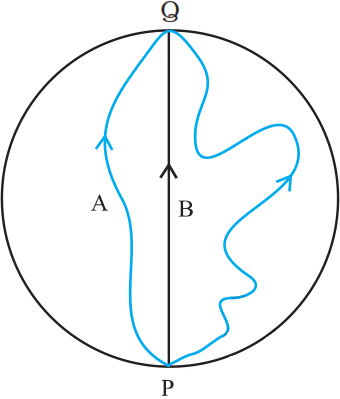
a, b, c, and d must each be a null vector.
Explanation:
In order to make vectors a + b + c + d = 0, it is not necessary to have all the four given vectors to be null vectors. There are many other combinations which can give the sum zero.50 questions · timed · auto-graded
Explanation:
In order to make vectors a + b + c + d = 0, it is not necessary to have all the four given vectors to be null vectors. There are many other combinations which can give the sum zero.
Explanation:
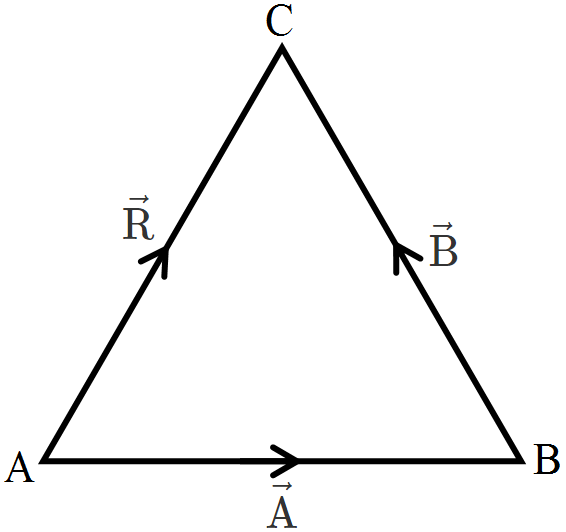
a + b + c + d = 0 a + c = – (b + d) Taking modulus on both the sides, we get, |a + c| = |–(b + d)| = |b + d| Hence, the magnitude of (a + c) is the same as the magnitude of (b + d).Explanation:
a + b + c + d = 0 a = -(b + c + d) Taking modulus both sides, we get, |a| = |b + c + d| |a| ≤ |a| + |b| + |c| .....(i) Equation (i) shows that the magnitude of a is equal to or less than the sum of the magnitudes of b, c, and d. Hence, the magnitude of vector a can never be greater than the sum of the magnitudes of b, c, and d.
Work done is given by the dot product of force and displacement.
W = (F.S)
Since the dot product of two quantities is always a scalar, therefore work is a scalar physical quantity.
Current is described only by its magnitude. Its direction is not taken into account. Hence, it is a scalar quantity.

$4\Big(\frac{2\text{bg}}{\text{u}^2}\Big)\Big[1-\frac{2\text{bg}}{\text{u}^2}\Big]=\frac{\text{a}^2\text{g}^2}{\text{u}^4}$
$\frac{8\text{bg}}{\text{u}^2}-\frac{16\text{b}^2\text{g}^2}{\text{u}^4}=\frac{\text{a}^2\text{g}^2}{\text{u}^4}$
$\text{a}^2\text{g}^2+16\text{b}^2\text{g}^2=\text{u}^28\text{bg}$
$\text{u}^2=\frac{\text{a}^2\text{g}^2+16\text{b}^2\text{g}^2}{8\text{bg}}$
$\text{u}=\Big[2\text{g}\Big(\text{b}+\frac{\text{a}^2}{16\text{b}}\Big)\Big]^\frac{1}{2}.$

OR
For what value of m, the vector $\vec{\text{A}}=2\hat{\text{i}}+3\hat{\text{j}}-6\hat{\text{k}}$ is perpendicular to $\vec{\text{B}}=3\hat{\text{i}}-\text{m}\hat{\text{j}}+6\hat{\text{k}}.$
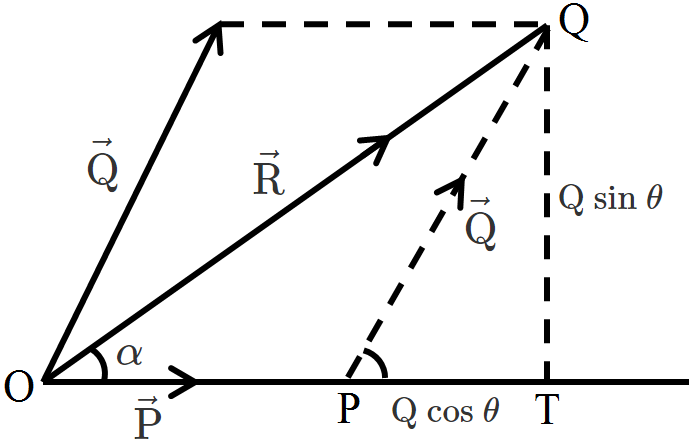
$\alpha=\tan^{-1}\Big(\frac{\text{Q}\sin\theta}{\text{P}+\text{Q}\cos\theta}\Big)$
Given: $\vec{\text{A}}=2\hat{\text{i}}+3\hat{\text{j}}-6\hat{\text{k}};$ $\vec{\text{B}}=3\hat{\text{i}}-\text{m}\hat{\text{j}}+6\hat{\text{k}};$ $\therefore\ \vec{\text{A}}.\vec{\text{B}}=\text{AB}\cos90^\circ=0$ Hence, $(2\hat{\text{i}}+3\hat{\text{j}}-6\hat{\text{k}}).(3\hat{\text{i}}-\text{m}\hat{\text{j}}+6\hat{\text{k}})=0$ $\Rightarrow\ 2\times3+3\times(-\text{m})+(-6)\times6=0$ $\Rightarrow\ 6-3\text{m}-36=0$ $\Rightarrow\ \text{m}=-10$
Time taken to travel this distance,
$\text{t}=\frac{\text{x}}{\text{v}}=\frac{100}{500}=\frac{1}{5}\text{s}$ Vertical distance travelled by the bullet in time $\frac{1}{5}\text{s}$ is $\text{y}=\text{u}_\text{oy}\text{t}+\frac{1}{2}\text{gt}^2$ $=0+\frac{1}{2}\times10\times\frac{1}{25}=\frac{1}{5}\text{m}=20\text{cm}.$ If he directly aims at the bird, the bullet will hit 20cm below the bird. Therefore, the gun must be aimed at 20cm above the position of the bird.
or, the vectors
$\vec{\text{A}}$ and $\vec{\text{B}}$ are mutually perpendicular.To find tR we need to know, in addition to the initial angle
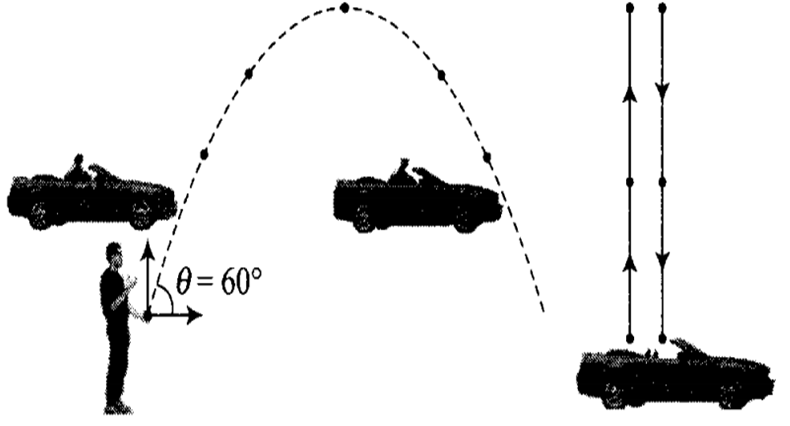
$\theta_0$ (as given), the initial speed v0, which is not given. We can find v0 by applying the range equation $\text{R}=\frac{\text{v}_0^2\sin2\theta_0}{\text{g}}$ Solving for v0, we obtain $\text{v}_0=\sqrt{\frac{\text{Rg}}{\sin2\theta_0}}$ We obtain the same value for v0 whether we use,$\theta_0=30.0^\circ$
or $\theta_0=60.0^\circ$Since,
$\sin2(30.0^\circ)=\sin2(60.0^\circ)$$\text{v}_0=\sqrt{\frac{(20.0\text{m})(9.80\text{m/s}^2)}{\sin60.0^\circ}}=15.0\text{m/ s}$
Now, we can find tp for each snowball $\text{t}_\text{g}=\frac{2\text{v}_{\text{y0}}}{\text{g}}\Rightarrow\ \text{t}_\text{g}=\frac{2\text{v}_0\sin\theta_0}{\text{g}}$ For the first snowball, $\text{t}_\text{R}=\frac{2(15.0\text{m/s})(\sin60.0^\circ)}{9.80\text{m/s}^2}=2.65\text{s}$ For the second snowball, $\text{t}_\text{R}'=\frac{2(15.0\text{m/s})(\sin30.0^\circ)}{9.80\text{m/s}^2}=1.53\text{s}$ Thus, you should wait a time $\Delta\text{t}$ before making your second throw, where $\Delta\text{t}$ is the difference in the times of flight, $\Delta\text{t}=\text{t}_\text{R}-\text{t}_\text{R}'=2.65\text{s}-1.53\text{s}=1.12\text{s}$


And
$\text{A}^2+\text{B}^2+2\text{AB}\cos\theta=12^2=144\dots(\text{ii})$ If A is the smaller force, then as per question $\tan90^\circ=\frac{\text{B}\sin\theta}{\text{A}+\text{B}\cos\theta}$ $\infty=\frac{\text{B}\sin\theta}{\text{A}+\text{B}\cos\theta}$ $\text{A}+\text{B}\cos\theta=0$ $\cos\theta=-\frac{\text{A}}{\text{B}}$ From (ii), $\text{A}^2+\text{B}^2+2\text{AB}\Big(-\frac{\text{A}}{\text{B}}\Big)=144$ $\text{B}^2-\text{A}^2=144$ $(\text{B}-\text{A})(\text{B}+\text{A})=144$ $(\text{B}-\text{A})=\frac{144}{(\text{B}+\text{A})}=\frac{144}{18}=8\dots(\text{iii})$ Solving (i) and (ii) A = 5N and B = 13N$\tan\theta=\frac{2\text{k}-2}{2\text{k}+2}=\frac{\text{k}-1}{\text{k}+1}$
Using,
$\text{v}=\text{u}+\text{at}$We have,
$0=\text{u}\sin\theta-\text{gt}\Rightarrow\ \text{t}=\frac{\text{u}\sin\theta}{\text{g}}$ The time to reach topmost point, $\text{t}=\frac{\text{u}\sin\theta}{\text{g}}$Using,
$\text{v}^2=\text{u}^2+2\text{as}$We have,
$0=\text{u}^2\sin^2\theta-2\text{gh}_\text{max}$$\Rightarrow\ \text{h}_\text{max}=\frac{\text{u}^2\sin^2\theta}{2\text{g}}.$
Explanation:
In order to make vectors a + b + c + d = 0, it is not necessary to have all the four given vectors to be null vectors. There are many other combinations which can give the sum zero.$\because\ \text{v}^2-\text{v}_0^2=-2\text{gh},$ here at highest point, v = 0
$\therefore\ \text{h}=\frac{\text{v}_0^2}{2\text{g}}$
$\because\ \text{t}=2\frac{\text{v}_0}{\text{g}}$
Thus, x = ut
$\text{x}=\text{u}\sqrt{\frac{2\text{h}}{\text{g}}}$i.e.,
$\text{h}=\text{x}^2.\frac{\text{g}}{2\text{u}^2}$As
$\text{h}\propto\text{x}^2,$ the path is a parabola.

OR
Prove the following relations by calculus method:OR
$\therefore$ instantaneous velocity, $\text{v}=\frac{\text{dx}}{\text{dt}}$ or dx = vdt.
dx = (u + at)dt $(\because$ v = u + at)
let x0 and x be the displacements of the obhect at time 'zero' and 't'.
$\int\limits^{\text{x}}_{\text{x}_0}\text{dx}=\int\limits^{\text{t}}_0(\text{u}+\text{at})\text{dt}$
$=\text{u}\int\limits^{\text{t}}_0\text{dt}+\text{a}\int\limits^{\text{t}}_0\text{t dt}$
$(\text{x})^{\text{x}}_{\text{x}_0}=\text{u}(\text{t})^\text{t}_0+\text{a}\Big(\frac{\text{t}^2}{2}\Big)^\text{t}_0$
$\text{x}-\text{x}_0=\text{ut}+\frac{1}{2}\text{at}^2$
If x = x0 = s (distance) covered by the object.
$\text{s}=\text{ut}+\frac{1}{2}\text{at}^2$
Then, $\text{a}=\frac{\text{dv}}{\text{dt}}=\frac{\text{dv}}{\text{dx}}\times\frac{\text{dx}}{\text{dt}}=\frac{\text{dv}}{\text{dx}}\times\text{v}$
$\text{a dx}=\text{v dv}$
Integrating,
$\int\limits^{\text{x}}_{\text{x}_0}\text{a dx}=\int\limits^{\text{V}}_\text{u}\text{v dv}$
$\Rightarrow\ \text{a}|\text{x}|^{\text{x}}_{\text{x}_0}=\Big[\frac{\text{v}^2}{2}\Big]^\text{V}_\text{u}$
$\text{a}(\text{x}-\text{x}_0)=\frac{\text{v}^2}{2}-\frac{\text{u}^2}{2}$
$\text{v}^2-\text{u}^2=2\text{a}(\text{x}-\text{x}_0)$
$\text{v}^2-\text{u}^2=2\text{a}\text{s.}$