Question
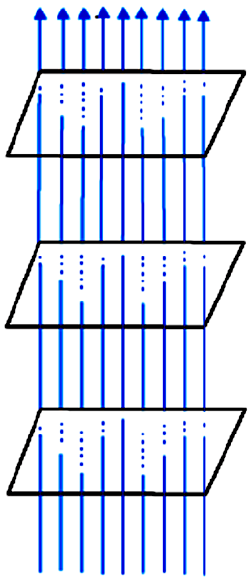
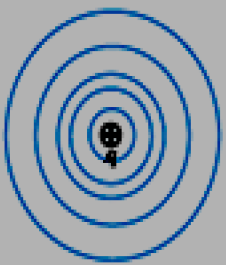
Define an equipotential surface. Draw equipotential surface:
  1. In the case of a single point charge and,
  2. In a constant electric field in Z-direction.
Why the equipotential surfaces about a single charge are not equidistant?
  1. Can electric field exist tangential to an equipotential surface? Give reason.
Answer

Surface with a constant value of potential at all points on the surface.
  1.  

  1. $\text{V} \propto\frac{1}{\text{r}}/$
  1. No If the field lines are tangential, work will be done in moving a charge on the surface which goes against the definition of equipotential surface.

Need a full question paper?

Generate a complete, print-ready paper with questions like this in minutes — across 16+ boards, with answer keys.

Start Generating Free

Similar questions

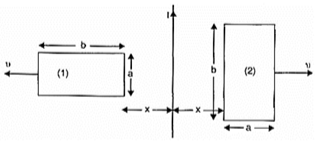
The figure shows two identical rectangular loops (1) and (2) placed on a table along with a straight long current carrying conductor between them.
i. What will be the directions of the induced current in the loops when they are pulled away from the conductor with same velocity v?
ii. Will the emf induced in the two loops be equal?
Image
A cell of emf $E$ and internal resistance r is connected across a variable load resistor $R$. Draw the plots of the terminal voltage $V$ versus $(i)$ resistance R and $(ii)$ current $I.$
It is found that when $R=4 \Omega$, the current is $1 A$ and when $R$ is increased to $9 \Omega$, the current reduces to $0.5 A $.Find the values of the emf $E$ and internal resistance r.
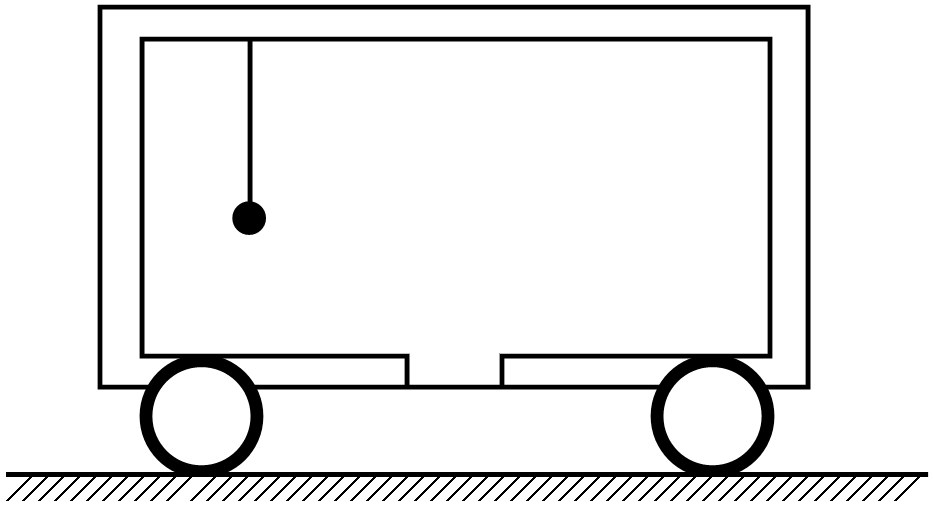
A cart of mass M is at rest on a frictionless horizontal surface and a pendulum bob of mass m hangs from the roof of the cart. The string breaks, the bob falls on the floor, makes several collisions on the floor and finally lands up in a small slot made in the floor. The horizontal distance between the string and the slot is L. Find the displacement of the cart during this process.
Two heating elements of resistances $R_1$ and $R_2$ when operated at a constant supply of voltage, V, Consume power $P_1$ and $P_2 $ respectively. Deduce the expressions for the power of their combination when they are, in turn, connected in (i) series and (ii) parallel across the same voltage supply.
Using Biot-Savart law, deduce the expression for the magnetic field at a point (x) on the axis of a circular current carrying loop of radius R. How is the direction of the magnetic field determined at this point?
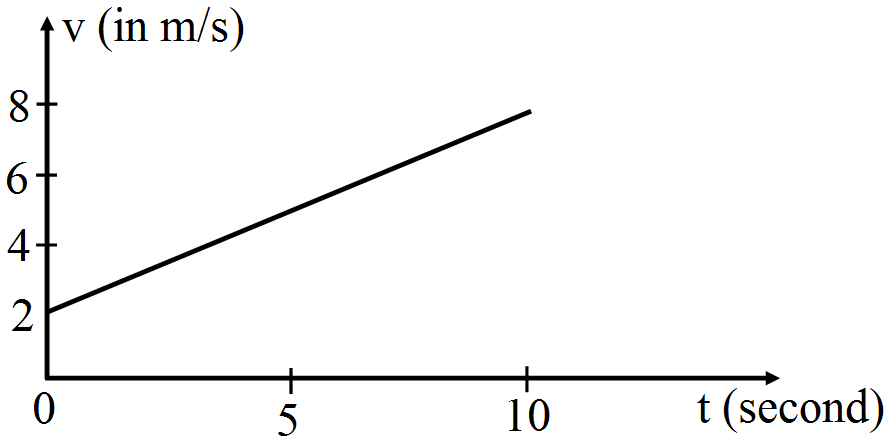
Figure shows the graph of velocity versus time for a particle going along the X-axis. Find:
  1. The acceleration.
  2. The distance travelled in 0 to 10s.
  3. The displacement in 0 to 10s.
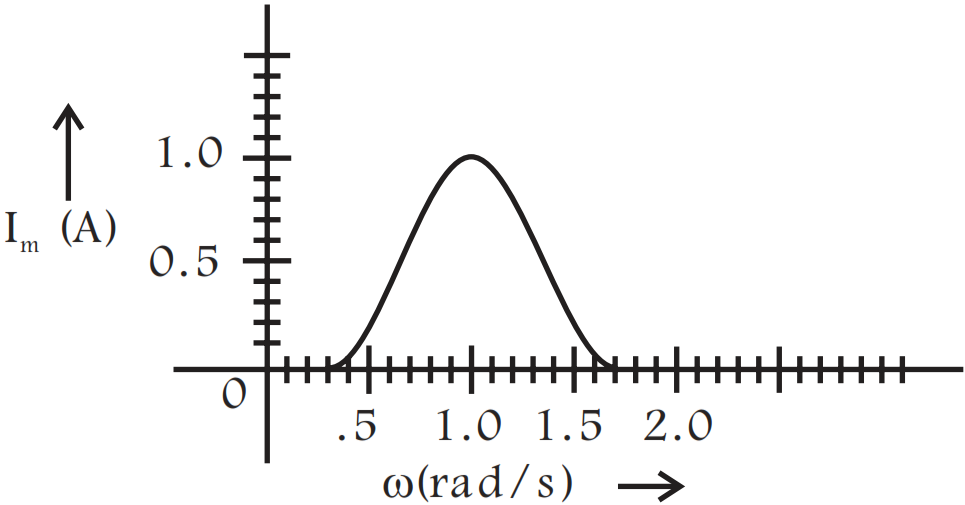
In series LCR circuit, the plot of $I_{max}$ vs $\omega$ is shown in Fig. Find the bandwidth and mark in the figure.
For a CE-transistor amplifier, the audio signal voltage across the collected resistance of 2k Ω is 2 V. Suppose the current amplification factor of the transistor is 100, find the input signal voltage and base current, if the base resistance is 1k Ω.
A particle goes in a circle of radius 2.0cm. A concave mirror of focal length 20cm is placed with its principal axis passing through the centre of the circle and perpendicular to its plane. The distance between the pole of the mirror and the centre of the circle is 30cm. Calculate the radius of the circle formed by the image.
  1. Define ‘activity’ of a radioactive material and write its S.I. unit.
  2. Plot a graph showing variation of activity of a given radioactive sample with time.
  3. The sequence of stepwise decay of a radioactive nucleus is


If the atomic number and mass number of $D_2$ are 71 and 176 respectively, what are their corresponding values for D?