Question
  1. Define current sensitivity of a galvanometer. Write its expression.
  2. A galvanometer has resistance $G$ and shows full scale deflection for current $Ig.$
  1. How can it be converted into an ammeter to measure current up to $I_0(I_0 > Ig)?$
  2. What is the effective resistance of this ammeter?
Answer

  1. Current sensitivity: It is defined as the amount of deflection produced per unit magnitude of current passes.
$\text{C}_\text{s}=\frac{\phi}{\text{I}}\text{ or }\text{C}_\text{s}=\frac{\text{NAB}}{\mu,}$
  1.  
  1.  

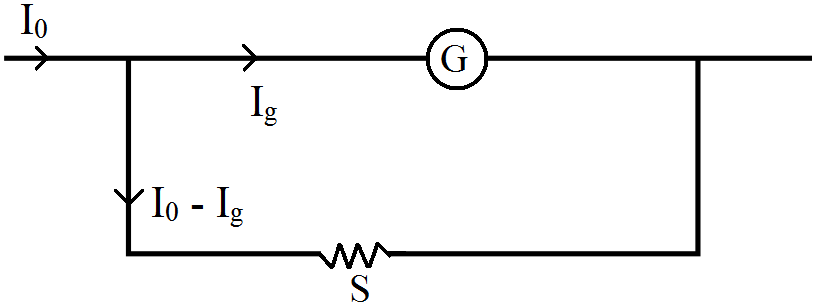
$(G)$ can be converted into an ammeter by connected a small stunt resistance parallel to $(G)$ coil so that,
$\text{IgG}=\big(\text{I}_0-\text{I}_\text{g}\big)\text{S}$
$\therefore\text{S}=\frac{\text{IgG}}{\text{I}_0-\text{I}_\text{g}}$
  1. Effective resistance of $(\text{A})\Rightarrow\frac{\text{GS}}{\text{G}+\text{S}}$

Need a full question paper?

Generate a complete, print-ready paper with questions like this in minutes — across 16+ boards, with answer keys.

Start Generating Free

Similar questions

State Kirchhoff's laws and explain them by giving examples.###Explain that first law of Kirchhoff is equivalent to law of conservation of charge and the second law is a descriptive form of Ohm's law.###For a current carrying conductor, write Kirchhoff's laws of charge and energy conservation.
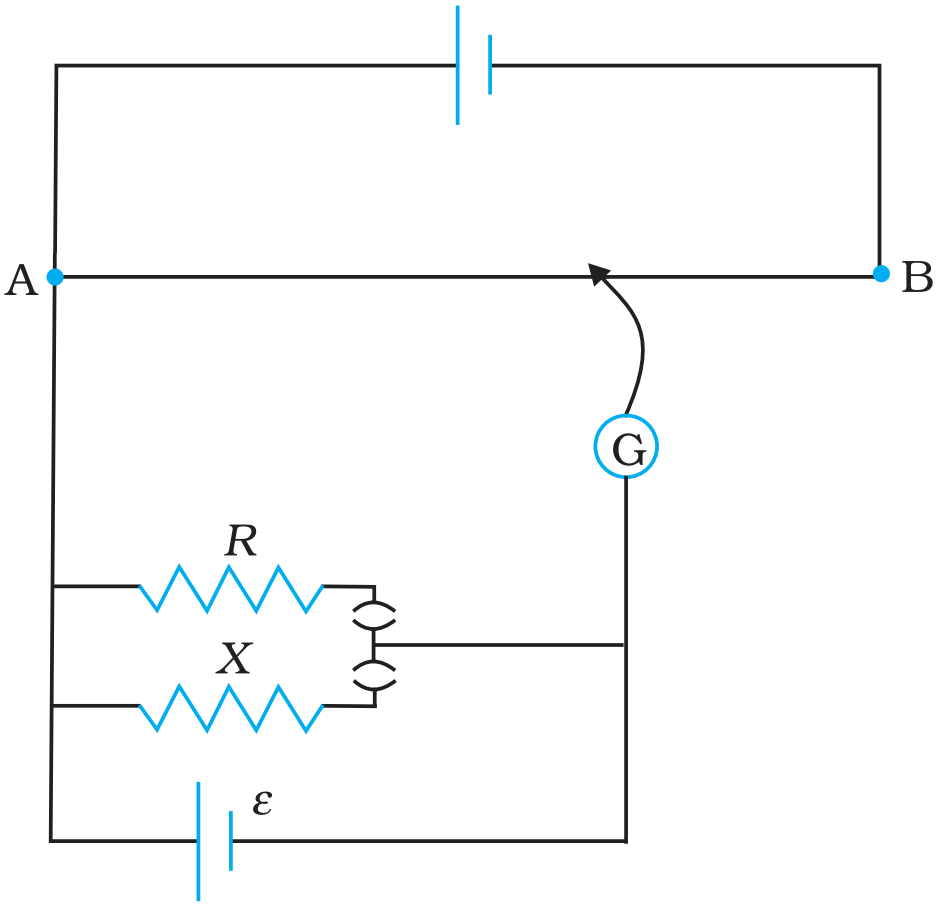
Figure shows a potentiometer circuit for comparison of two resistances. The balance point with a standard resistor $\text{R}=10.0\ \Omega$ is found to be $58.3 \ cm,$ while that with the unknown resistance $X$ is $68.5 \ cm$. Determine the value of $X$. What might you do if you failed to find a balance point with the given cell of emf $\varepsilon?$
Theory of relativity reveals that mass can be converted into energy. The energy E so obtained is proportional to certain powers of mass m and the speed c of light. Guess a relation among the quantities using the method of dimensions.
Draw the circuit diagram of a full wave rectifier and explain its working. Also, give the input and output waveforms.
The energy flux of sunlight reaching the surface of the earth is $1.388 \times 10^3 W/m^2.$ How many photons $($nearly$)$ per square metre are incident on the Earth per second? Assume that the photons in the sunlight have an average wavelength of $550\ nm.$
The magnetic field $B$ inside a long solenoid, carrying a current of $5.00A,$ is $3.14 \times 10^{-2}T.$ Find the number of turns per unit length of the solenoid.
Two electric bulbs have the following specifications.
  1. 100W at 220V.
  2. 1000W at 220V.
Which bulb has higher resistance? What is the ratio of their resistances?
Using $\text{B}=\mu_0\text{H},$ find the ratio $\frac{\text{E}_0}{\text{H}_0}$ for a plane electromagnetic wave propagating through vacuum. Show that it has the dimensions of electric resistance. This ratio is a universal constant called the impedance of free space.
Let AE denote the energy gap between the valence band and the conduction band. The population of conduction electrons (and of the holes) is roughly proportional to $\text{e}^{\frac{-\Delta\text{E}}{2\text{kT}}}.$ Find the ratio of the concentration of condu.ction electrons in diamond to that in silicon at room temperature 300K. $\Delta\text{E}$ for silicon is 1.1eV and for diamond is 6.0eV. How many conduction electrons are likely to be in one cubic metre of diamond?
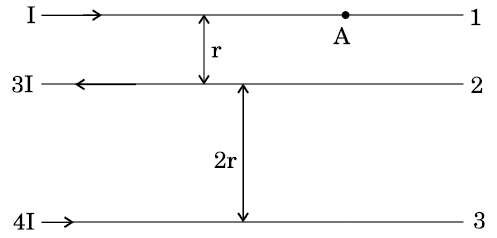
The figure shows three infinitely long straight parallel current carrying conductors. Find the:
  1. Magnitude and direction of the net magnetic field at point A lying on conductor 1.
  2. Magnetic force on conductor 2.