Question
Define elastic and inelastic collisions. Write their basic characteristics. A bullet is fired into a block of wood. If it gets totally embedded in it and the system moves together as one entity, then state what happens to the initial kinetic energy and linear momentum of the bullet?
Answer

Elastic collision: A collision in which there is absolutely no loss of kinetic energy is called elastic collision.

Characteristics :

  1. The linear momentum is conserved.
  2. Total energy of system is conserved.
  3. Kinetic energy is conserved.
  4. Forces involved during elastic collisions must be conservative forces.
Inelastic collision: A collision in which there occurs some loss of kinetic energy is called inelastic collision.

Characteristics :

  1. Linear momentum is conserved.
  2. Total energy is conserved.
  3. K.E. is not conserved.
  4. Some or all forces involved may be non-conservative.
Consider two particles A and B of masses m1 and m2 moving with initial velocities u1 and u2 along x-axis. They collide and move as one entity. Let V be the common velocity when they move as single mass.

m1 = Mass of bullet

u1 = Initial velocity of bullet

m2 = Mass of wood.

u2 = Initial velocity of wood = 0

According to conservation of momentum.

mu1 + m2 u2 = ( m1 + m2 )V

u2 = 0 

$\text{V}=\frac{\text{m}_1\text{u}_2}{\text{m}_1+\text{m}_2}\cdots{\text{i}}$

Initial K.E, $\text{k}_\text{i}\frac{1}{2}\text{m}_1\text{u}_1^2$

Final K.E., $\text{k}_\text{f}=\frac{1}{2}(\text{m}_1+\text{m}_2)\text{V}^2$

$\frac{\text{K}_\text{f}}{\text{K}_\text{i}}=\frac{\frac{1}{2}(\text{m}_1+\text{m}_2)\text{V}^2}{\frac{1}{2}\text{m}_1\text{u}_1^2}$

$=\Big(\frac{\text{m}_1+\text{m}_2}{\text{m}_1}\Big)\frac{\text{V}^2}{\text{u}_1^2}\ \cdots\text{(ii)}$

From (i) and (ii)

$\frac{\text{K}_\text{f}}{\text{K}_\text{i}}=\Big(\frac{\text{m}_1\text{m}_2}{\text{m}_1}\Big)\Big(\frac{\text{m}_1}{\text{m}_1+\text{m}_2}\Big)^2$

$=\frac{\text{m}_1}{\text{m}_1+\text{m}_2}$

When, $\text{K}_\text{f}<\text{K}_\text{i}$ there is loss in K.E.

Need a full question paper?

Generate a complete, print-ready paper with questions like this in minutes — across 16+ boards, with answer keys.

Start Generating Free

Similar questions

A fighter plane is flying horizontally at an altitude of 1.5 km with a speed of $720 km / h$. At what angle of sight (w.r.t horizontal) when the target is seen, should the pilot drop the bomb in order to attack the target?
Main concept used: $u =720 km / h =720 \times \frac{5}{18} m / s =200 m / s$
A converging lens of focal length 15cm and a converging mirror of focal length 10cm are placed 50cm apart with common principal axis. A point source is placed in between the lens and the mirror at a distance of 40cm from the lens. Find the locations of the two images formed.
A thin circular loop of radius R rotates about its vertical diameter with an angular frequency $\omega.$ Show that a small bead on the wire loop remains at its lowermost point for $\omega\le\sqrt{\frac{\text{g}}{\text{R}}}.$ What is the angle made by the radius vector joining the centre to the bead with the vertical downward direction for $\omega=\sqrt{\frac{2\text{g}}{\text{R}}}?$ Neglect friction.
The heavier block in an Atwood machine has a mass twice that of the lighter one. The tension in the string is 16.0N when the system is set into motion. Find the decrease in the gravitational potential energy during the first second after the system is released from rest.
Estimate the mean free path and collision frequency of a nitrogen molecule in a cylinder containing nitrogen at 2.0 atm and temperature 17°C. Take the radius of a nitrogen molecule to be roughly $1.0\mathring{\text{A}}$ Compare the collision time with the time the molecule moves freely between two successive collisions (Molecular mass of N2 = 28.0u).
A tube of certain diameter and of length 48cm is open at both ends. Its fundamental frequency of resonance is found to be 320Hz. The velocity of sound in air is 320m/s. Estimate the diameter of the tube. One end of the tube is now closed, calculate the lowest frequency of resonance for the tube.
The linear momentum of a body is increased by 10%. What is the percentage change in kinetic energy?
A circular coil of 200 turns has a radius of 10cm and carries a current of 2.0A.
  1. Find the magnitude of the magnetic field. B at the centre of the coil.
  2. At what distance from the centre along the axis of the coil will the field B drop to half its value at the centre? $\big(\sqrt[3]{4}=1.5874\ ...\big)$
In an experiment on the specific heat of a metal, a 0.20kg block of the metal at 150°C is dropped in a copper calorimeter (of water equivalent 0.025kg) containing 150cm3 of water at 27°C. The final temperature is 40°C. Compute the specific heat of the metal. If heat losses to the surroundings are not negligible, is your answer greater or smaller than the actual value for specific heat of the metal?
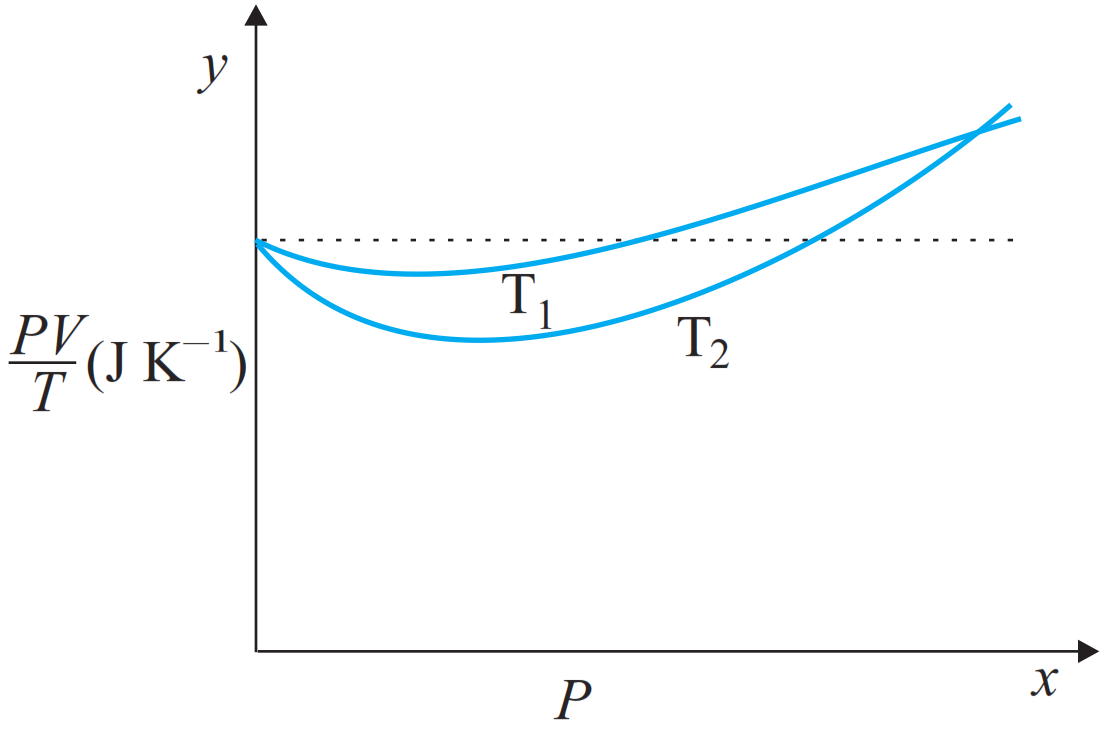
Shows plot of $\frac{\text{PV}}{\text{T}}$ versus P for 1.00 × 10⁻³kg of oxygen gas at two different temperatures:

If we obtained similar plots for 1.00 × 10⁻³kg of hydrogen, would we get the same value of $\frac{\text{PV}}{\text{T}}$ at the point where the curves meet on the y-axis? If not, what mass of hydrogen yields the same value of $\frac{\text{PV}}{\text{T}}$ (for low pressure high temperature region of the plot)? (Molecular mass of H2 = 2.02u, of O2 = 32.0u, R = 8.31J mo1-1K-1).