Question
Define electric potential difference and prove that the electric potential at any point inside the electric field is equal to the ratio of the work W done in bringing a test charge from infinity to that point and the value of the test charge $q_0$.
Answer

SELF

Need a full question paper?

Generate a complete, print-ready paper with questions like this in minutes — across 16+ boards, with answer keys.

Start Generating Free

Similar questions

Consider a metal exposed to light of wavelength 600nm. The maximum energy of the electron doubles when light of wavelength 400snm is used. Find the work function in eV.
A charge is distributed uniformly over a ring of radius ‘a’. Obtain an expression for the electric intensity E at a point on the axis of the ring. Hence show that for point’s at large distances from the ring, it behaves like a point charge.
(a) Prove that the mean power supplied to the inductor in a complete cycle is zero. (b) If in an LCR alternatin current circuit $R =$ $24 \Omega, X _{ L }=110 \Omega$, and $X _{ C }=110 \Omega$, then find the impednce of the current.
Radiations of frequency 1015Hz are incident on two photosensitive surfaces A and B. Following observations are recorded:
Surface A: No photoemission takes place.
Surface B: Photoemission takes place but photoelectrons have zero energy.
Explain the above observations on the basis of Einstein’s photoelectric equation. How will the observation with surface B change when wavelength of incident light is decreased?
Suppose the entire system of the previous question is kept inside an elevator which is coming down with an acceleration a < g. Repeat parts (a) and (b).
It is found that yellow light does not eject photoelectrons from a metal. Is it advisable to try with orange light? With green light?
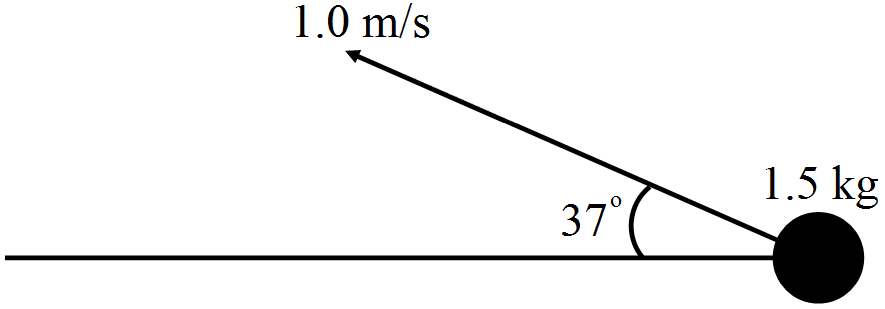
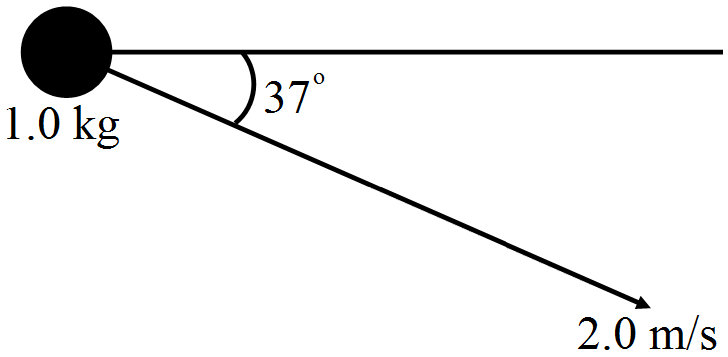
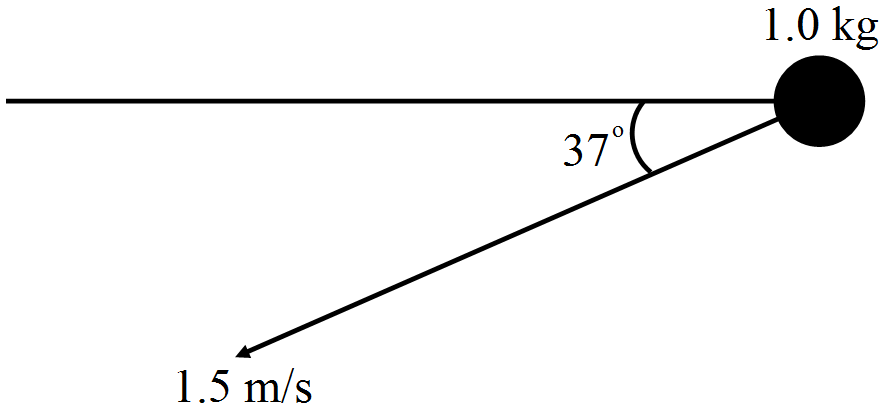
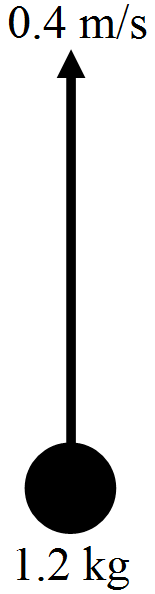
Calculate the velocity of the centre of mass of the system of particles shown in figure.


A body of weight w1 is suspended from the ceiling of a room through a chain of weight w2. The ceiling pulls the chain by a force:
  1. w1
  2. w2
  3. w1 + w2
  4. $\frac{\text{w}_1+\text{w}_2}{2}$
A particle of mass 100g moving at an initial speed u collides with another particle of same mass kept initially at rest. If the total kinetic energy becomes 0.2J after the collision, what could be the minimum and the maximum value of u.
Answer the following questions:
  1. Explain qualitatively on the basis of domain picture the irreversibility in the magnetisation curve of a ferromagnet.
  2. The hysteresis loop of a soft iron piece has a much smaller area than that of a carbon steel piece. If the material is to go through repeated cycles of magnetisation, which piece will dissipate greater heat energy?
  3. ‘A system displaying a hysteresis loop such as a ferromagnet, is a device for storing memory?’ Explain the meaning of this statement.
  4. What kind of ferromagnetic material is used for coating magnetic tapes in a cassette player, or for building ‘memory stores’ in a modern computer?
  5. A certain region of space is to be shielded from magnetic fields. Suggest a method.