Question
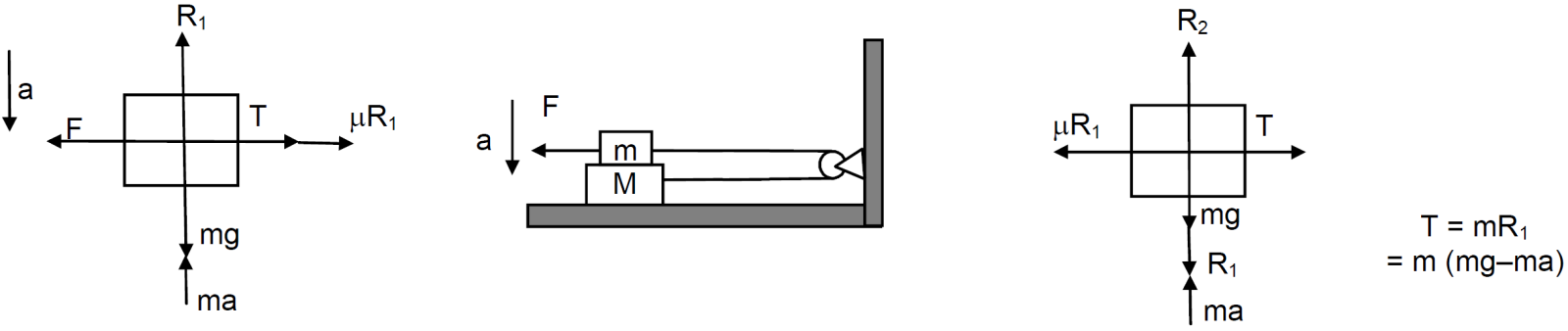
Suppose the entire system of the previous question is kept inside an elevator which is coming down with an acceleration a < g. Repeat parts (a) and (b).
Answer

  1.  

$\text{R}_1+\text{ma}-\text{mg}=0$

$\Rightarrow\text{R}_1=\text{m(g}-\text{a) = mg}-\text{ma} \ ...(\text{i})$

$\text{T}-\mu\text{R}_1=0\Rightarrow\text{T = m(mg}-\text{ma}) \ ...(\text{ii})$

Again, $\text{F}-\text{T}-\mu\text{R}_1=0$

$\Rightarrow\text{F}-\{\mu(\text{mg}-\text{ma})\}-\text{u}(\text{mg}-\text{ma})=0$

$\Rightarrow\text{F}-\mu\text{mg}+\mu\text{ma}-\mu\text{mg}+\mu\text{ma}=0$

$\Rightarrow\text{F}=2\mu\text{mg}-2\mu\text{ma}\Rightarrow\text{F}=2\mu\text{m(g}-\text{a})$
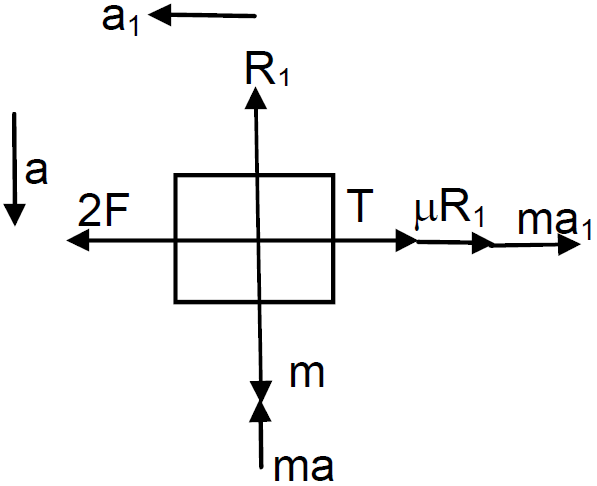
  1. Acceleration of the block be a1

$\text{R}_1=\text{mg}-\text{ma} \ ...(\text{i})$

$2\text{F}-\text{T}-\mu\text{R}_1-\text{ma}_1=0$

$\Rightarrow2\text{F}-\text{t}-\mu\text{mg}+\mu\text{a}-\text{ma}_1=0 \ ...(\text{ii})$
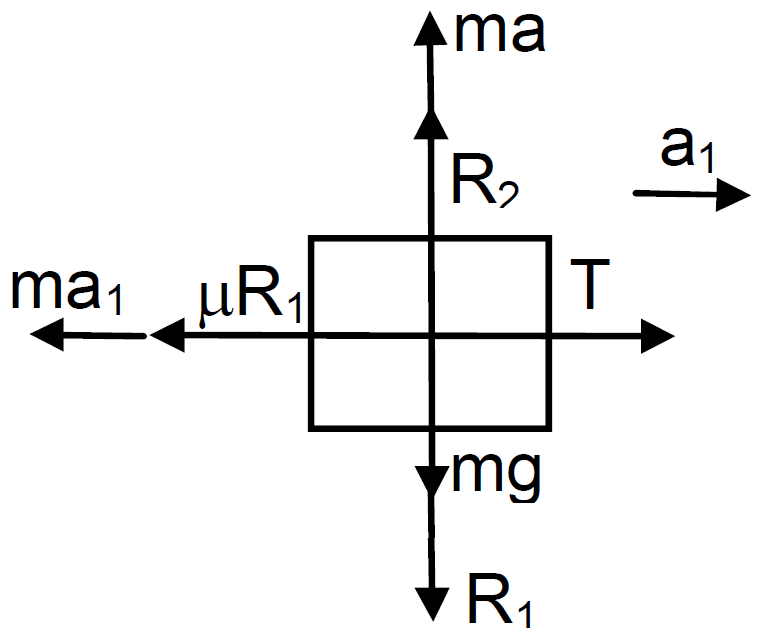
$\text{T}-\mu\text{R}_1-\text{Ma}_1=0$

$\Rightarrow\text{T}=\mu\text{R}_1+\text{Ma}_1$

$\Rightarrow\text{T}=\mu(\text{mg}-\text{ma})+\text{Ma}_1$

$\Rightarrow\text{T}=\mu\text{mg}-\mu\text{ma + Ma}_1$

Subtracting values of F & T, we get

$2(2\mu\text{m(g}-\text{a}))-2(\mu\text{mg}-\mu\text{ma}+\text{Ma}_1)\\-\mu\text{mg}+\mu\text{ma}-\mu\text{a}_1=0$

$\Rightarrow4\mu\text{mg}-4\mu\text{ma}-2\mu\text{mg}+2\mu\text{ma = ma}_1+\text{Ma}_1$

$\Rightarrow\text{a}_1=\frac{2\mu\text{m(g}-\text{a})}{\text{M + m}}$

Both blocks move with this acceleration but in opposite directions.

Need a full question paper?

Generate a complete, print-ready paper with questions like this in minutes — across 16+ boards, with answer keys.
Start Generating Free

Similar questions

A train starts from rest and moves with a constant acceleration of 2.0m/s2 for half a minute. The brakes are then applied and the train comes to rest in one minute. Find:
  1. The total distance moved by the train.
  2. The maximum speed attained by the train.
  3. The position(s) of the train at half the maximum speed.
By explaining diamagnetic, paramagnetic and ferromagnetic substances, analyse their characteristic properties.###Define diamagnetic, paramagnetic and ferromagnetic substances and analyse their characteristics on the basis of (a) reason for magnetic property (b) relative magnetic permeability (c) magnetic susceptibility (d) intensity of magnetisation (e) magnetic induction.
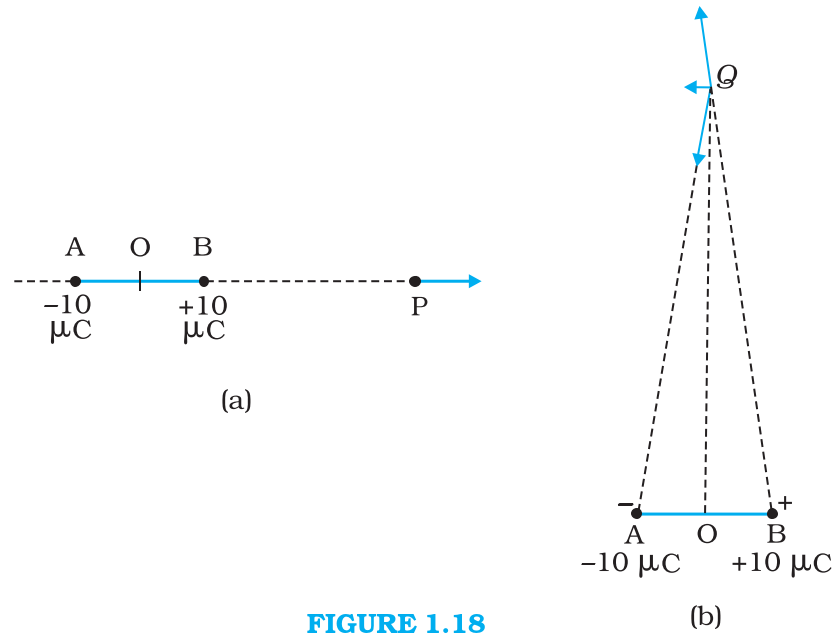
Two charges $\pm 10 \mu C$ are placed $5.0 mm$ apart. Determine the electric field at (a) a point $P$ on the axis of the dipole $15 cm$ away from its centre $O$ on the side of the positive charge, as shown in Fig. $1.18( a )$, and (b) a point $Q , 15 cm$ away from $O$ on a line passing through $O$ and normal to the axis of the dipole, as shown in Fig. 1.18(b).
Image
Define the term magnetic moment of a current loop. Write the expression for the magnetic moment when an electron revolves at a speed v around an orbit of radius ‘r’ in hydrogen atom.
In a Young's double slit experiment using monochromatic light, the fringe pattern shifts by a certain distance on the screen when a mica sheet of refractive index 1.6 and thickness 1.964 micron (1 micron = 10-6m) is introduced in the path of one of the interfering waves. The mica sheet is then removed and the distance between the screen and the slits is doubled. It is found that the distance between the successive maxima now is the same as the observed fringe-shift upon the introduction of the mica sheet. Calculate the wavelength of the monochromatic light used in the experiment.
A nuclide 1 is said to be the mirror isobar of nuclide 2 if Z1 =N2 and Z2 =N1.
  1. What nuclide is a mirror isobar of 1123Na?
  2. Which nuclide out of the two mirror isobars have greater binding energy and why?
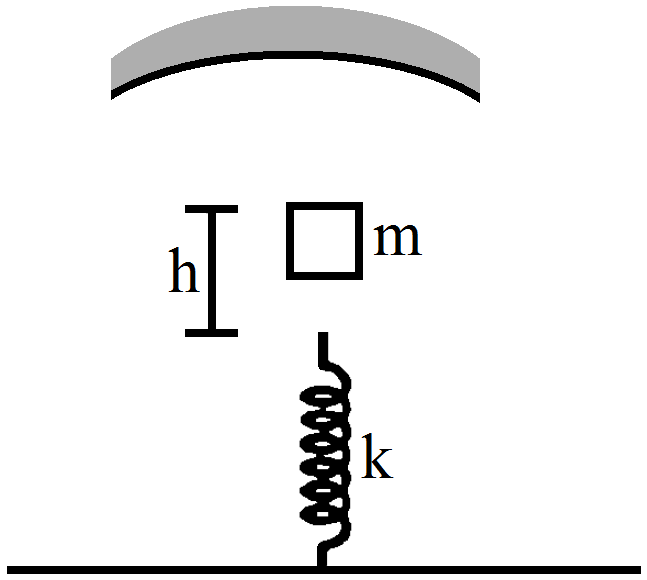
A mass m = 50g is dropped on a vertical spring of spring constant 500N/m from a height h = 10cm as shown in figure. The mass sticks to the spring and executes simple harmonic oscillations after that. A concave mirror of focal length 12cm facing the mass is fixed with its principal axis coinciding with the line of motion of the mass, its pole being at a distance of 30cm from the free end of the spring. Find the length in which the image of the mass oscillates.

The particle P shown in figure has a mass of 10mg and a charge of $-0.01\mu\text{C}.$ Each plate has a surface area 100cm2 on one side. What potential difference V should be applied to the combination to hold the particle P in equilibrium?

Define magnifying power of a telescope. Write its expression.
A small telescope has an objective lens of focal length 150 cm and an eye piece of focal length 5 cm. If this telescope is used to view a 100m high tower 3 km away, find the height of the final image when it is formed 25 cm away from the eye piece.
A proton projected in a magnetic field of 0.020T travels along a helical path of radius 5.0cm and pitch 20cm. Find the components of the velocity of the proton along and perpendicular to the magnetic field. Take the mass of the proton = 1.6 × 10⁻²⁷kg