Question
Define electron gain enthalpy. What are its units?

Answer

The energy which is released by an isoated gaseous atom in gaining an electron from outside atom or ion to form negative ion (or anion) is called electron gain enthalpy $(\Delta e g H)$. Unit of electron gain enthalpy is $kJ / mol$.
In some cases like in noble gas atoms do not have any attraction to gain an electron in that case energy has to be supplied.
For example
$\begin{aligned} & N e(g)+e^{-} \rightarrow N e^{-}(g) \\ & \Delta e g H=+116 k J mol^{-1}\end{aligned}$

Need a full question paper?

Generate a complete, print-ready paper with questions like this in minutes — across 16+ boards, with answer keys.
Start Generating Free

Similar questions

Indicate the type of bonds present in NH4NO3 and state the mode of hybridisation of two N-atoms in it.
Calculate the uncertainty in the position of a dust particle with mass equal to 1mg if the uncertainty in velocity is 5.5 × 10⁻²⁰ms-1. (h = 6.626 × 10⁻³⁴Js)
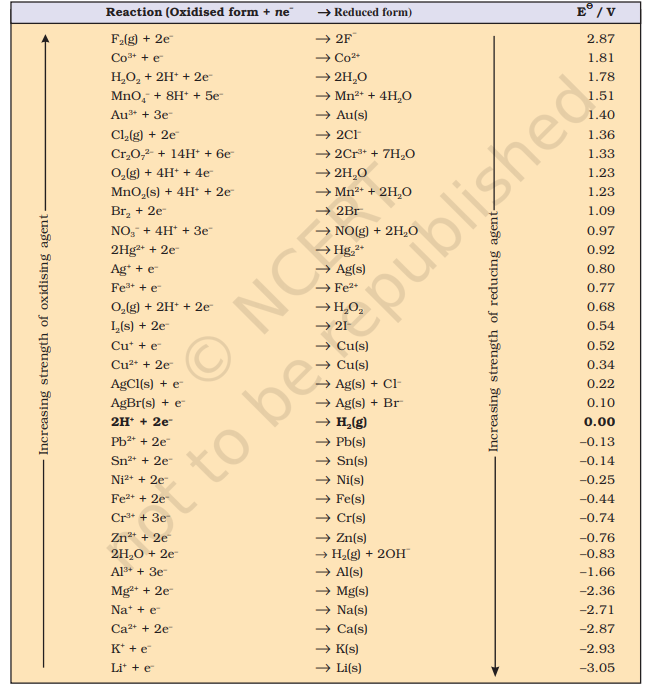
Using the standard electrode potentials given in the Table, predict if the reaction between the following is feasible:

Fe3+(aq) and Cu(s).
Calculate the wavelength of tennis ball of mass 60 gram moving with a velocity of 10ms-1. (h = 6.626 × 10⁻³⁴Js)
What are the oxidation number of the underlined elements in the following and how do you rationalise your results?
CH3COOH
The amount of energy released when 1 × 10¹⁰ atoms of chlorine in vapour state are converted to Cl- ions according to the equation,
Cl(g) + e- → Cl-(g) is 57.86 × 10-10J
Calculate the electron gain enthalpy of chlorine atom in terms of kJ mol-1 and eV per atom.
Calculate the total number of electrons present in 1.6g of methane.
Correct the following electronic configuration of the elements in the ground state.
  1. $1\text{s}^2\ 2\text{s}^1,2\text{p}^2_\text{x},2\text{p}^2_\text{y},2\text{p}^2_\text{z},3\text{s}62,2\text{p}^1_\text{x}$
  2. $1\text{s}^2\ 2\text{s}^1,2\text{p}^1_\text{x},2\text{p}^1_\text{y},2\text{p}^1_\text{z}$
  3. $1\text{s}^2\ 2\text{s}^1,2\text{p}^6,3\text{s}^2,3\text{p}^6,3\text{d}^5$
  4. $1\text{s}^2\ 2\text{s}^2,2\text{p}^6,3\text{p}^6,3\text{d}^4,4\text{s}^2$
Apart from tetrahedral geometry, another possible geometry for $C H _{ 4 }$ is square planar with the four H atoms at the corners of the square and the $C$ atom at its centre. Explain why $C H _{ 4 }$ is not square planar?
Calculate the standard Gibbs energy change for the formation of propane at 298K.

$3\text{C(graphite)}+4\text{H}_2\text{O}\overrightarrow{\ \ \ \ \ \ \ }\ \text{C}_3\text{H}_8(\text{g})$

$\Delta_\text{f}\text{H}^\circ$ for propane, C3H8(g) is -103.8kJ mol-1

Given: $\text{S}^\circ_\text{m}\text{C}_3\text{H}_8(\text{g})=270.2\text{JK}^{-1}\text{mol}^{-1},$ $\text{S}^\circ_\text{m}\text{C}_{(\text{graphite})}=5.70\text{JK}^{-1}\text{mol}^{-1}$ and $\text{S}^\circ_\text{m}\text{H}_2(\text{g})=130.7\text{JK}^{-1}\text{mol}^{-1}$