Question
Using the standard electrode potentials given in the Table, predict if the reaction between the following is feasible:
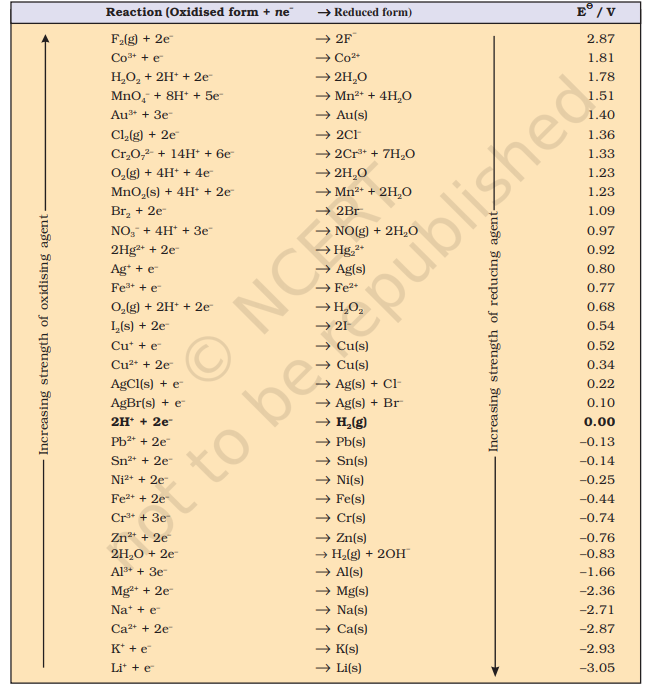
Fe3+(aq) and Cu(s).

Answer

The possible reaction between Fe3+(aq) and Cu(s) is given by,

$2\text{Fe}^{3+}_{(\text{aq})}+\text{Cu}_{(\text{s})}\rightarrow2\text{Fe}^{2+}_{(\text{s})}+\text{Cu}^{2+}_{(\text{aq})}$

$\text{Oxidation half equation:}\ \ \ \ \ \ \ \text{Cu}_{(\text{s})}\xrightarrow{\ \ \ \ \ \ }\text{Cu}^{2+}_{(\text{aq})}+2\text{e}^-;\ \ \text{E}^\circ=-0.34\text{V}\\\text{Reduction half equation:}\ \ [\text{Fe}^{3+}_{(\text{aq})}+\text{e}^-\xrightarrow{\ \ \ \ \ }\text{Fe}^{2+}_{(\text{s})}]\times2;\ \ \ \text{E}^\circ=+0.77\text{V}\\\overline{\ \ \ \ \ \ \ \ \ \ \ \ \ \ \ \ \ \ \ \ \ \ \ \ \ \ \ \ \ \ \ \ \ \ \ \ \ \ \ \ \ \ \ \ \ \ \ \ \ \ \ \ \ \ \ \ \ \ \ \ \ \ \ \ \ \ \ \ \ \ \ \ \ \ \ \ \ \ \ \ \ \ \ \ \ \ \ \ \ \ \ \ \ \ \ \ \ \ \ \ \ \ \ \ \ \ \ \ \ \ \ \ \ \ \ \ \ \ }\\\ \ \ \ \ \ \ \ \ \ \ \ \ \ \ \ \ \ \ \ \ \ \ \ \ \ \ \ \ \ \ \ 2\text{Fe}^{3+}_{(\text{aq})}+\text{Cu}_{(\text{s})}\xrightarrow{\ \ \ \ \ }2\text{Fe}^{2+}_{(\text{s})}+\text{Cu}^{2+}_{(\text{aq})};\ \ \ \text{E}^\circ=+0.43\text{V}$

E° positive for the overall reaction is positive. Hence, the reaction between Fe3+(aq) and Cu(s) is feasible.

Need a full question paper?

Generate a complete, print-ready paper with questions like this in minutes — across 16+ boards, with answer keys.
Start Generating Free

Similar questions

Using the standard electrode potentials given in the Table, predict if the reaction between the following is feasible:

Ag(s) and Fe3+(aq).
The dipole moment of a molecule AB is 0.54D and the bond distance is $1.41\mathring{\text{A}}.$ Calculate the fractional change $\delta$ on A and B atom in AB molecule (electronic charge, e = 4.8 × 10⁻¹⁰ esu.)
Calculate the wavelength of an electron moving with a velocity of 2.05 × 10⁷ms–1.
  1. Using the data given below, calculate the value of equilibrium constant for the reaction at 298K.

$3\text{CH}\equiv\text{CH}(\text{g})\rightleftharpoons\text{C}_6\text{H}_6(\text{g})$ assuming ideal gas behaviour, $\Delta_\text{f}\text{G}^\circ[\text{HC}\equiv\text{CH(g)}]=2.09\times10^5\text{J mol}^{-1},$ $\Delta_\text{f}\text{G}^\circ[\text{C}_6\text{H}_6(\text{g})]=1.24\times10^5\text{J mol}^{-1},$ R = 8.314JK-1 mol-1.
  1. Based on your calculated value, comment whether this process can be recommended as a practical method for making benzene.
Write IUPAC names of the following:

  1.  

  1.  

  1.  

Why is the entropy of a substance taken as zero at 0K?

Calculate the standard Gibbs free energy change for the reaction:

$\text{N}_2(\text{g})+3\text{H}_2(\text{g})\rightleftharpoons2\text{NH}_3(\text{g})$ at 298K

The value of equilibrium constant for the above reaction is 6.6 × 10⁵. [R = 8.314J K-1mol-1]

In astronomical observations, signals observed from the distant starts are generally weak. If the photon detector receives a total of $=3.15 \times 10^{-18} J$ from the radiations of 600 nm . Calculate the number of photons received by the detector.
221.4J is needed to heat 30 g of ethanol from $15^{\circ} C$ to $18^{\circ} C$. Calculate (a) specific heat capacity, and (b) molar heat capacity of ethanol.
What happens when :
(i) ethylene dibromide is heated with zinc.
(ii) solution of sodium succinate is electrolysed.
(iii) ethylene dichloride is heated with zinc.
Give the appropriate reason.
  1. It is preferable to determine the change in enthalpy rather than the change in internal energy.
  2. It is necessary to define the 'standard state'.
  3. It is necessary to specify the phases of the reactants and products in a thermochemical equation.