Question
Define magnetic susceptibility of a material. Name two elements, one having positive susceptibility and the other having negative susceptibility. What does negative susceptibility signify

Answer

Magnetic susceptibility of a material is defined as the ratio of the intensity of magnetisation (i) induced in the material to the magnetisation force (H) applied on it. Magnetic susceptibility is represented as: Substances such as copper, lead, etc. have negative susceptibility. These substances are called diamagnetic substances. Substances such as aluminium, calcium, etc. have positive susceptibility. These substances are called paramagnetic substances. Substances with negative susceptibility signify that they are repelled by magnets.

Need a full question paper?

Generate a complete, print-ready paper with questions like this in minutes — across 16+ boards, with answer keys.
Start Generating Free

Similar questions

Define electric field intensity. Write its SI unit. Write the magnitude and direction of electric field intensity due to an electric dipole of length 2a at the midpoint of the line joining the two charges.
Three point charges +Q, -2Q and -3Q are placed at the vertices of an equilateral triangle ABC of side l.
If these charges are displaced to the mid points $A_1, B_1$ and $C_1$ respectively, calculate the amount of work done in shifting the charges to the new locations.
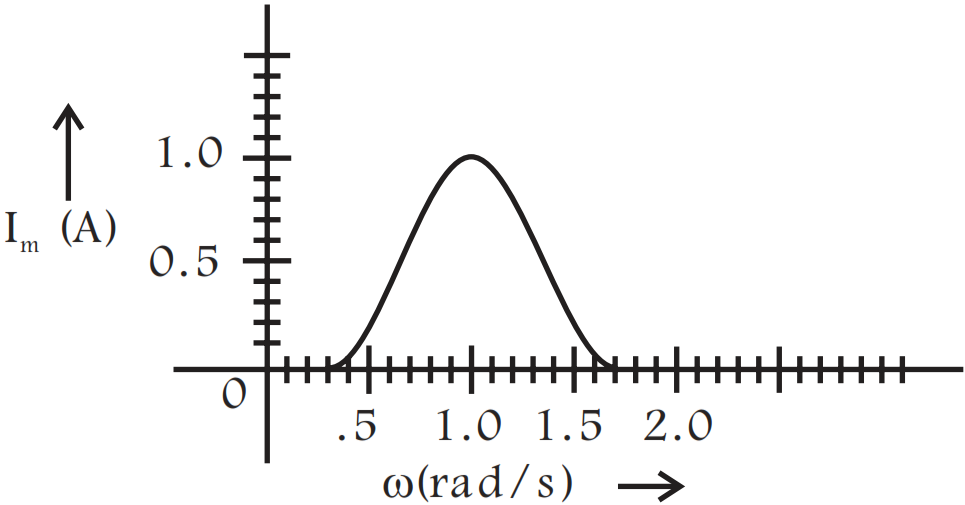
In series LCR circuit, the plot of $I_{max}$ vs $\omega$ is shown in Fig. Find the bandwidth and mark in the figure.
An ideal diode should pass a current freely in one direction and should stop it completely in the opposite direction. Which is closer to ideal-vacuum diode or a p-n junction diode?
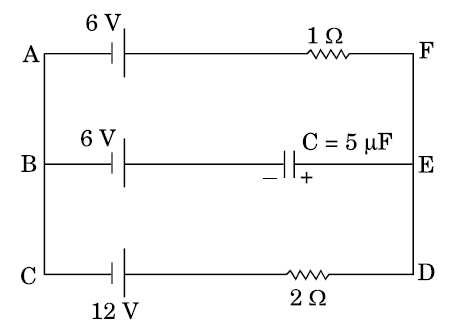
In the given circuit, with steady current, calculate the potential difference across the capacitor and the charge stored in it.
A series LCR circuit with R = 20Ω, L = 1.5H and C = 35μF is connected to a variable-frequency 200V ac supply. When the frequency of the supply equals the natural frequency of the circuit, what is the average power transferred to the circuit in one complete cycle?
Find the ratio of the lengths of an iron rod and an aluminium rod for which the difference in the lengths is independent of temperature. Coefficients of linear expansion of iron and aluminium are ${12 \times 10^{-6}}  ^\circ C^{-1}$ and ${23 \times 10^{-6}}^\circ C^{-1}$ respectively.
A disc of radius 10cm is rotating about its axis at an angular speed of 20rad/s. Find the linear speed of:
  1. A point on the rim.
  2. The middle point of a radius.
Consider a uniform electric field $E = 3 \times 10^3$ î N/C.
  1. What is the flux of this field through a square of 10 cm on a side whose plane is parallel to the yz plane?
  2. What is the flux through the same square if the normal to its plane makes a 60° angle with the x-axis?