Question
Define magnifying power of a telescope. Write its expression.
A small telescope has an objective lens of focal length 150 cm and an eye piece of focal length 5 cm. If this telescope is used to view a 100m high tower 3 km away, find the height of the final image when it is formed 25 cm away from the eye piece.

Answer

  1. Magnifying power is the ratio of the angle subtended at the eye by the image to the angle subtended at the unaided eye by the object.

Expression

$\text{m} = \beta\big/\alpha = \text{f}_{o}\big/\text{f}_{e}$

or $\text{m} = \text{f}_{o} /_{ \text{f}_{e}}\bigg(1 + \frac{\text{f}_{e}}{\text{D}}\bigg)$

  1. Using, the lens equation for objective lens,:

$\frac{1}{\text{f}_{o}} =\frac{1}{\text{v}_{o}}-\frac{1}{\text{u}_{o}}$

$ => \frac{1}{150} = \frac{1}{\text{v}_{o}} - \frac{1}{-3\times10^{5}}$

$ => \frac{1}{\text{v}_{o}} =\frac{1}{150} -\frac{1}{-3\times10^{5}} = \frac{2000-1}{3\times10^{5}}$

$ =>\text{v}_{o} = \frac{3\times10^{5}}{1999}\text{cm}$

$\approx 150 \text{cm}$

Hence, magnification due to the objective lens

$\text{m}_{o} =\frac{\text{v}_{o}}{\text{u}_{o}} = \frac{150\times10^{-2}\text{m}}{3000\text{m}}$

$\approx\frac{10^{-2}}{20} = .05\times10^{-2}$

Using lens formula for eyepiece

$\frac{1}{\text{f}_{e}} =\frac{1}{\text{v}_{e}} - \frac{1}{\text{u}_{e}}$

$ = > \frac{1}{5} = \frac{1}{-25} -\frac{1}{\text{u}_{e}}$

$ = > \frac{1}{\text{u}_{e}} =\frac{1}{-25} - \frac{1}{5} = \frac{-1-5}{25}$


$ = >\text{u}_{e} =\frac{-25}{6}\text{cm}$

$\therefore\text{ Magnification due to eyepiece} \text{ m}_{e} =\frac{-25}{-\frac{25}{6}}= 6 $

Hence, total magnification $ = > \text{m} = \text{m}_{e}\times\text{m}_{o}$

$\text{m} = 6 \times5\times10^{-4} = 30 \times10^{-4}$

Hence, size of final image

$ = 30 \times10^{-4}\times100 \text{m}$

$ = 30 \text{ cm}.$
Need a full question paper?

Generate a complete, print-ready paper with questions like this in minutes — across 16+ boards, with answer keys.

Start Generating Free

Similar questions

The radius of a gold nucleus (Z = 79) is about 7.0 × 10⁻¹⁵m. Assume that the positive charge is distributed uniformly throughout the nuclear volume. Find the strength of the electric field at:
  1. The surface of the nucleus.
  2. At the middle point of a radius. Remembering that gold is a conductor, is it justified to assume that the positive charge is uniformly distributed over the entire volume of the nucleus and does not come to the outer surface?
One mole of an ideal gas undergoes a process $\text{p}=\frac{\text{p}_0}{1+\Big(\frac{\text{V}}{\text{V}_0}\Big)^2}$ where P0 and V0 are constants. Find the temperature of the gas when V = V0.
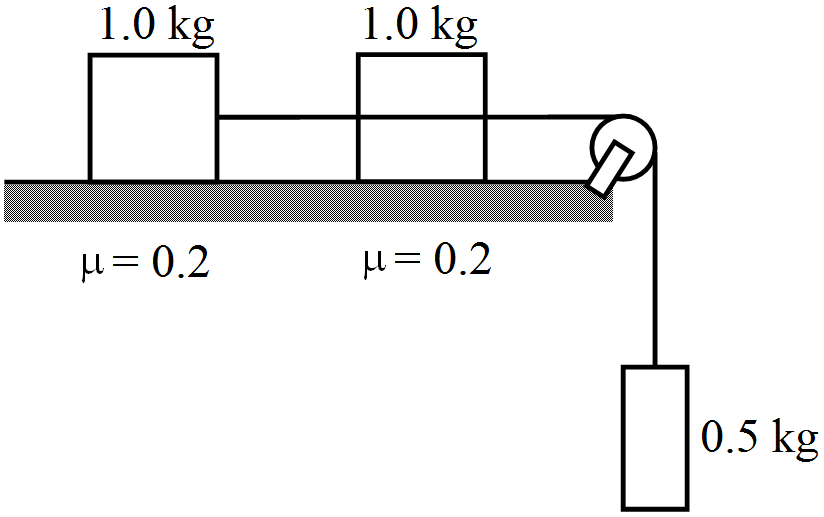
Consider the situation shown in figure. Calculate:
  1. The acceleration of the 1.0kg blocks.
  2. The tension in the string connecting the 1.0kg blocks.
  3. The tension in the string attached to 0.50kg.

A boy riding on a bicycle going at 12km/h towards a vertical wall whistles at his dog on the ground. If the frequency of the whistle is 1600Hz and the speed of sound in air is 330m/s, find
  1. The frequency of the whistle as received by the wall.
  2. The frequency of the reflected whistle as received by the boy.
Is it possible that in a Coolidge tube characteristic $\text{L}_\alpha$ X-rays are emitted but not $\text{K}_\alpha$ X-rays?
A long wire carries a current of 4.00A. Find the energy stored in the magnetic field inside a volume ot 1.00mm at a distance of 10.0cm from the wire.
A long wire carrying a current i is bent to form a plane angle $\alpha.$ Find the magnetic field B at a point on the bisector of this angle situated at a distance x from the vertex.
Obtain the amount of $^{60}_{27}\text{Co}$ necessary to provide a radioactive source of 8.0 mCi strength. The half-life of $^{60}_{27}\text{Co}$ is 5.3 years.
A parallel-plate capacitor having plate area 400cm2 and separation between the plates 1.0mm is connected to a power supply of 100V. A dielectric slab of thickness 1.0mm and dielectric constant 5.0 is inserted into the gap:
  1. Find the increase in electrostatic energy.
  2. If the power supply is now disconnected and the dielectric slab is taken out, find the further increase in energy.
  3. Why does the energy increase in inserting the slab as well as in taking it out?
Can the work by kinetic friction on an object be positive? Zero?