Question
A parallel-plate capacitor having plate area 400cm2 and separation between the plates 1.0mm is connected to a power supply of 100V. A dielectric slab of thickness 1.0mm and dielectric constant 5.0 is inserted into the gap:
  1. Find the increase in electrostatic energy.
  2. If the power supply is now disconnected and the dielectric slab is taken out, find the further increase in energy.
  3. Why does the energy increase in inserting the slab as well as in taking it out?
Answer

A = 400cm2 = 4 × 10⁻²m2
d = 1cm = 1 × 10⁻³m
V = 160V
t = 0.5 = 5 × 10⁻⁴m
k = 5
$\text{C}=\frac{\in_0\text{A}}{\text{d}-\text{t}+\frac{\text{t}}{\text{k}}}$
$=\frac{8.85\times10^{-12}\times4\times10^{-2}}{10^{-3}-5\times10^{-4}+\frac{5\times10^{-4}}{5}}$
$=\frac{35.4\times10^{-4}}{10^{-3}-0.5}$

Need a full question paper?

Generate a complete, print-ready paper with questions like this in minutes — across 16+ boards, with answer keys.

Start Generating Free

Similar questions

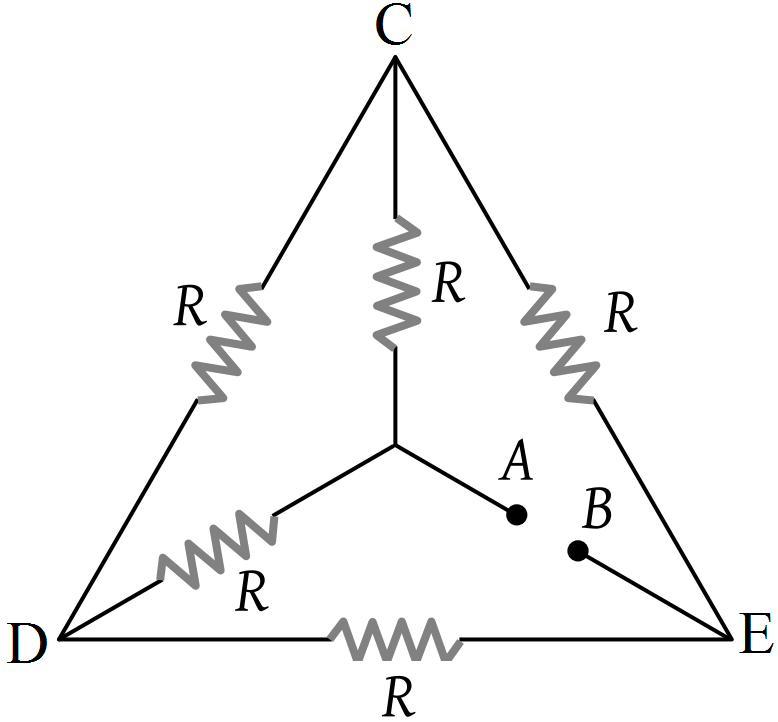
  1. Calculate the equivalent resistance of the given electrical network between points A and B.

  1. Also calculate the current through CD and ACB if a 10V dc source is connected between points A and B and the value of $\text{R}=2\Omega.$
A plane electromagnetic wave is passing through a region. Consider (a) electric field (b) magnetic field (c) electrical energy in a small volume and (d) magnetic energy in a small volume. Construct the pairs of the quantities that oscillate with equal frequencies.
The mixture a pure liquid and a solution in a long vertical column (i.e, horizontal dimensions < < vertical dimensions) produces diffusion of solute particles and hence a refractive index gradient along the vertical dimension. A ray of light entering the column at right angles to the vertical is deviated from its original path. Find the deviation in travelling a horizontal distance d < < h, the height of the column.
Two parallel wires seprated by a distance of 10cm carry currents of 10A and 40A along-the same direction. Where should a third current be placed so that it experiences no magnetic force?
An apple falls from a tree. An insect in the apple finds that the earth is falling towards it with an acceleration g. Who exerts the force needed to accelerate the earth with this acceleration g?
A pin of length 2.00cm is placed perpendicular to the principal axis of a converging lens. An inverted image of size 1.00cm is formed at a distance of 40.0cm from the pin. Find the focal length of the lens and its distance from the pin.
A regular polygon of n sides is formed by bending a wire of total length $27\pi\text{r}$ which carries a current i.
  1. Find the magnetic field B at the centre of the polygon.
  2. By letting $\text{n}\rightarrow\infty,$ deduce the expression for the magnetic field at the centre of a circular current.
The electric field associated with a light wave is given by $\text{E}=\text{E}_0\sin[(1.57\times10^7\text{m}^{-1})(\text{x}-{\text{ct}})].$ Find the stopping potential when this light is used in an experiment on photoelectric effect with the emitter having work function 1.9eV.
A body of mass m makes an elastic collision with another identical body at rest. Show that if the collision is not head-on, the bodies go at right angle to each other after the collision.
Natural water contains a small amount of tritium $\big(\text{ }^3_1\text{H}\big).$ This isotope beta-decays with a half-life of 12.5 years. A mountaineer while climbing towards a difficult peak finds debris of some earlier unsuccessful attempt. Among other things he finds a sealed bottled of whisky. On returning, he analyses the whisky and finds that it contains only 1.5 per cent of the $\text{}^3_1\text{H}$ radioactivity as compared to a recently purchased bottle marked '8 years old'. Estimate the time of that unsuccessful attempt.