Question
Define mean value and root mean square value of alternating current.

Answer

Mean Value : Alternating voltage and alternating current both vary in magnitude with time and change the direction periodically. During one of the half cycles these have positive value whereas in the next half negative value. Thus the mean value of alternating voltage and alternating current each for a complete cycle is zero. Because of this an ordinary voltmeter or ammeter gives no deflection in alternating current circuit.
But for any half cycle the mean value of alternating voltage or alternating current is not zero, which can be shown as follows:
The mean value of alternating current for first positive half cycle is expressed as follows:
$I_{m}=\frac{\int_{0}^{T/2}Idt}{T/2}=\frac{\int_{0}^{T/2}(I_{0}sin \omega t)dt}{T/2}$
or $I_{m}=\frac{\int_{0}^{T/2}I_{0}sin(\frac{2\pi}{T}).tdt}
{T/2} = \frac{2I_{0}}{T}\frac{[-cos\frac{2\pi}{T}.t]_{0}^{T/2}}{\frac{2\pi}{T}}$
or $I_{m}=-\frac{2I_{0}}{T}\times\frac{T}{2\pi}[cos \pi-cos0]=-\frac{I_{0}}{\pi}[-1-1]$
or $I_{m}=+(\frac{2I_{0}}{\pi})$
or $I_{m}=+\frac{2I_{0}}{3.14}\Rightarrow I_{m}=+0.637~I_{0}$
Similarly, for next negative half cycle the average value of alternating current will be :
$I_{m}=-(\frac{2I_{0}}{\pi})$ or $I_{m}=-0.637~I_{0}$
Thus the mean value of alternating current for one complete cycle is:
$I_{m}=(+\frac{2I_{0}}{\pi})+(-\frac{2I_{0}}{\pi})=0$
Root Mean Square Value : Although the mean value of alternating voltage and alternating current both for one complete cycle is zero, the mean value of their square for one complete cycle is not zero. Therefore, rest mean square value of these is very important for alternating current circuits.
Root mean square value of alternating current is defined as follows:
"The square root of the mean value of the square of alternating current for its one complete cycle is called its root mean square value." It is denoted by $I_{rms}$ and is calculated as follows:
Mean value of $I^{2}$ for one complete cycle is given by:
$\overline{ I ^2}=\frac{\int_0^{ T } I ^2 \cdot d t}{T} \Rightarrow \overline{ I ^2}=\frac{\int_0^{ T }\left( I _0 \sin \omega t\right)^2 \cdot d t}{T}$
$\Rightarrow \quad \overline{ I ^2}=\frac{\int_0^{ T } I _0^2 \sin ^2 \omega t \cdot d t}{T}=\frac{\int_0^{ T } I _0^2 \sin ^2\left(\frac{2 \pi}{T}\right) \cdot t \cdot d t}{T}$
$\Rightarrow \quad \overline{ I ^2}=\frac{\int_0^{ T } I _0^2 2 \sin ^2\left(\frac{2 \pi}{T}\right) \cdot t \cdot d t}{2 T}$
or $\overline{ I ^2}=\frac{ I _0^2}{2 T} \int_0^{ T }\left[1-\cos 2 \times\left(\frac{2 \pi}{T}\right) \cdot t\right] d t$
$\Rightarrow \quad \overline{ I ^2}=\frac{ I _0^2}{2 T}\left[\int_0^{ T } d t-\int_0^{ T } \cos \left(\frac{4 \pi}{T}\right) \cdot t \cdot d t\right]$
$\Rightarrow \quad \overline{ I ^2}=\frac{ I _0^2}{2 T}\left[\frac{\{t\}_0^{ T }-\left[\sin \left(\frac{4 \pi}{T}\right) \cdot t\right]_0^{ T }}{\frac{4 \pi}{T}}\right]$
$\Rightarrow \quad \overline{ I ^2}=\frac{ I _0^2}{2 T}\left[\{ T \}-\left\{\frac{ T }{4 \pi}\left(\sin 4 \pi-\sin 0^0\right)\right\}\right]$
$\Rightarrow \quad \overline{ I ^2}=\frac{ I _0^2}{2 T} \times T -\frac{ I _0^2}{2 T} \times 0 \Rightarrow \overline{ I ^2}=\frac{ I _0^2}{2}$
But according to the definition of root mean square value of alternating current it is given by :
$I _{r m s}=\sqrt{\overline{\overline{ I ^2}}} \Rightarrow I _{r m s}=\sqrt{\left(\frac{ I _0^2}{2}\right)}$
or $I _{r m s}=\frac{ I _0}{\sqrt{2}}$
or $I_{r m s}=\frac{I_0}{1.414} \Rightarrow I_{r m s}=0.707 I_0$

Need a full question paper?

Generate a complete, print-ready paper with questions like this in minutes — across 16+ boards, with answer keys.
Start Generating Free

Similar questions


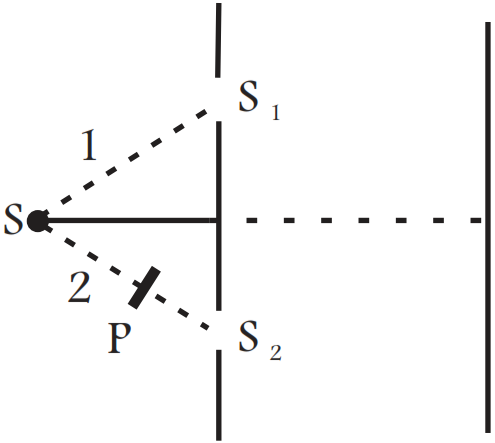
Figure shown a two slit arrangement with a source which emits unpolarised light. P is a polariser with axis whose direction is not given. If I0 is the intensity of the principal maxima when no polariser is present, calculate in the present case, the intensity of the principal maxima as well as of the first minima.
A block of weight 100N is slowly slid up on a smooth incline of inclination 37° by a person. Calculate the work done by the person in moving the block through a distance of 2.0m, if the driving force is:
  1. Parallel to the incline.
  2. In the horizontal direction.
A rod, when suspended in a magnetic field, stays in the east-west direction. Can we be sure that the field is in the east-west direction? Can it be in the north-south direction?
When a parallel beam of a monochromatic source of light of wavelength $\lambda$ is incident on a single slit of width a, show how the diffraction pattern is formed at the screen by the interference of the wavelets from the slit. Show that, besides the central maxima $\theta=0$, secondary maxima are observed at $\theta=\left(n+\frac{1}{2}\right) \frac{\lambda}{a}$ and the minima at $\theta=\frac{n \lambda}{a}$. Why do secondary maxima get weaker in intensity with increasing n?
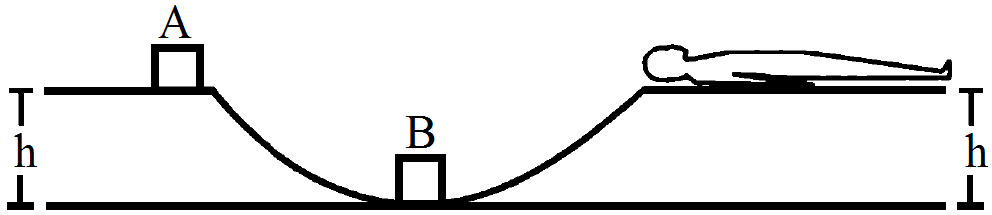
The track shown in figure is frictionless. The block B of mass 2m is lying at rest and the block A of mass m is pushed along the track with some speed. The collision between A and B is perfectly elastic. With what velocity should the block A be started to get the sleeping man awakened?

A bar magnet of length 1cm and cross-sectional area 1.0cm2 produces a magnetic field of 1.5 × 10. T at a point in end-on position at a distance 15cm away from the centre.
  1. Find the magnetic moment M of the magnet.
  2. Find the magnetization I of the magnet.
  3. Find the magnetic field B at the centre of the magnet.
Do permeability and relative permeability have the same dimensions?
Two wires carrying equal currents i each, are placed perpendicular to each other, just avoiding a contact. If one wire is held fixed and the other is free to move under magnetic forces, what kind of motion will result?
The uniform surface charge density of a thin spherical shell of radius $R$ is $\sigma$. Calculate the intensity of the electric field due it, in the following circumstances : $\square$(i) Elecric field outside the shell(ii) Electric field inside the shell.
A spherical capacitor has an inner sphere of radius 12cm and an outer sphere of radius 13cm. The outer sphere is earthed and the inner sphere is given a charge of 2.5µC. The space between the concentric spheres is filled with a liquid of dielectric constant 32.
  1. Determine the capacitance of the capacitor.
  2. What is the potential of the inner sphere?
  3. Compare the capacitance of this capacitor with that of an isolated sphere of radius 12cm. Explain why the latter is much smaller.