Question

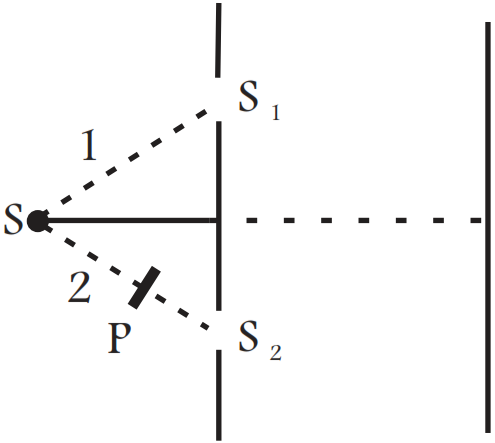
Figure shown a two slit arrangement with a source which emits unpolarised light. P is a polariser with axis whose direction is not given. If I0 is the intensity of the principal maxima when no polariser is present, calculate in the present case, the intensity of the principal maxima as well as of the first minima.
Answer

The resultant amplitude of wave reaching on screen will be the sum of amplitude of either wave in perpendicular and parallel polarisation.
Amplitude of the wave in perpendicular polarisation
$\text{A}_\bot=\text{A}_\bot^1+\text{A}_\bot^2=\text{A}_\bot^0\sin(\text{kx}-\omega\text{t})+\text{A}_\bot^2\sin(\text{kx}-\omega\text{t}+\phi)$
$\Rightarrow\ \text{A}_\bot=\text{A}_\bot^0(\sin(\text{kx}-\omega\text{t})+\sin(\text{kx}-\omega\text{t}+\phi))$
Amplitude of the wave in parallel polarisation
$\text{A}_{||}=\text{A}_{||}^{(1)}+\text{A}_{||}^{(2)}$
$\Rightarrow\ \text{A}_\bot=\text{A}_\bot^0[\sin(\text{kx}-\omega\text{t})+\sin(\text{kx}-\omega\text{t}+\phi)]$
$\therefore$ Average Intensity on the screen
$\text{I}=\begin{Bmatrix} \Big|\text{A}_\bot^0\Big|^2+\Big|\text{A}_\bot^0\Big|^2\end{Bmatrix}\big[\sin(\text{kx}-\omega\text{t})(1+\cos^2\phi+2\sin\phi)+\sin^2(\text{kx}-\omega\text{t})\sin^2\phi\big]_\text{average}$
$=\begin{Bmatrix} \Big|\text{A}_\bot^0\Big|^2+\Big|\text{A}_\bot^0\Big|^2\end{Bmatrix}\Big(\frac{1}{2}\Big)2(1+\cos\phi)$
$\Rightarrow\ \text{I}=2\Big|\text{A}_{||}^0\Big|^2(1+\cos\phi)\text{ since},\Big|\text{A}_\bot^0\Big|_\text{av}+\Big|\text{A}_\bot^0\Big|_\text{av}$
With polariser P,
Assume $\text{A}_\bot^2$ is blocked
Intensity $=(\text{A}_{||}^1+\text{A}_{||}^2)^2+({\text{A}_{||}^2})^2$
$=\Big|\text{A}_{\bot}^0\Big|(1+\cos\phi)+\Big|\text{A}_{\bot}^0\Big|.\frac{1}{2}$
Given, $\text{I}_0=4\Big|\text{A}_{\bot}^0\Big|=$ Intensity without polariser at principal maxima.
Intensity at first minima with polariser
$=\Big|\text{A}_{\bot}^0\Big|(1-1)+\frac{\Big|\text{A}_{\bot}^0\Big|}{2}=\frac{\text{I}_0}{8}.$

Need a full question paper?

Generate a complete, print-ready paper with questions like this in minutes — across 16+ boards, with answer keys.

Start Generating Free

Similar questions

The resistance of an iron wire and a copper wire at 20°C are $3.9\Omega$ and $4.1\Omega,$ respectively. At what temperature will the resistance be equal? Temperature coefficient of resistivity for iron is $5.0\times10^{-3}\text{K}^{-1}$ and for copper, it is $4.0\times10^{-3}\text{K}^{-1}.$ Neglect any thermal expansion.
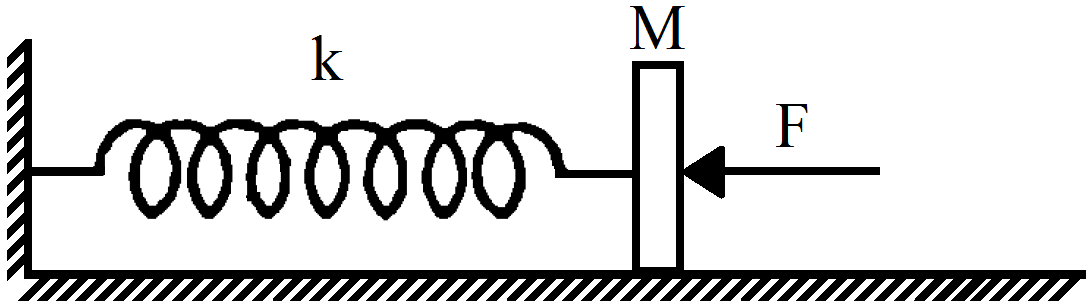
In figure k = 100N/m, M = 1kg and F = 10N,
  1. Find the compression of the spring in the equilibrium position.
  2. A sharp blow by some external agent imparts a speed of 2m/s to the block towards left. Find the sum of the potential energy of the spring and the kinetic energy of the block at this instant.
  3. Find the time period of the resulting simple harmonic motion.
  4. Find the amplitude.
  5. Write the potential energy of the spring when the block is at the left extreme.
  6. Write the potential energy of the spring when the block is at the right extreme.
The answers of (b), (e) and (f) are different. Explain why this does not violate the principle of conservation of energy.

Water leaks out from an open tank through a hole of area 2mm2 in the bottom. Suppose water is filled up to a height of 80cm and the area of cross-section of the tank is 0.4m2. The pressure at the open surface and at the hole are equal to the atmospheric pressure. Neglect the small velocity of the water near the open surface in the tank.
  1. Find the initial speed of water coming out of the hole.
  2. Find the speed of water coming out when half of water has leaked out.
  3. Find the volume of water leaked out during a time interval dt after the height remained is h. Thus find the decrease in height dh in terms of h and dt.
  4. From the result of part c find the time required for half of the water to leak out.
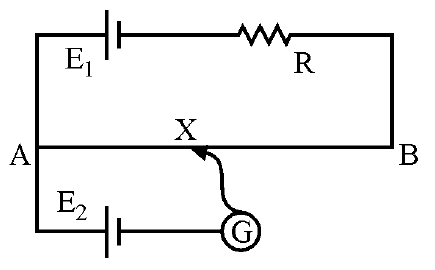
  1. In the circuit diagram given below, AB is a uniform wire of resistance 15Ω and length 1 m. It is connected to a cell E1 of emf 2V and negligible internal resistance and a resistance R. The balance point with another cell E2 of emf 75 mV is found at 30 cm from end A. Calculate the value of R.

  1. Why is potentiometer preferred over a voltmeter for comparison of emf. of cells?
  2. Draw a circuit diagram to determine internal resistance of a cell in the laboratory.
A regular polygon of n sides is formed by bending a wire of total length $27\pi\text{r}$ which carries a current i.
  1. Find the magnetic field B at the centre of the polygon.
  2. By letting $\text{n}\rightarrow\infty,$ deduce the expression for the magnetic field at the centre of a circular current.
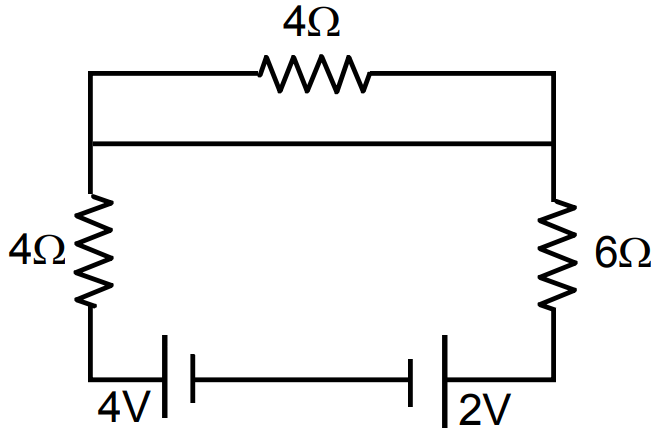
Find the currents through the three reaiators shown in figure.

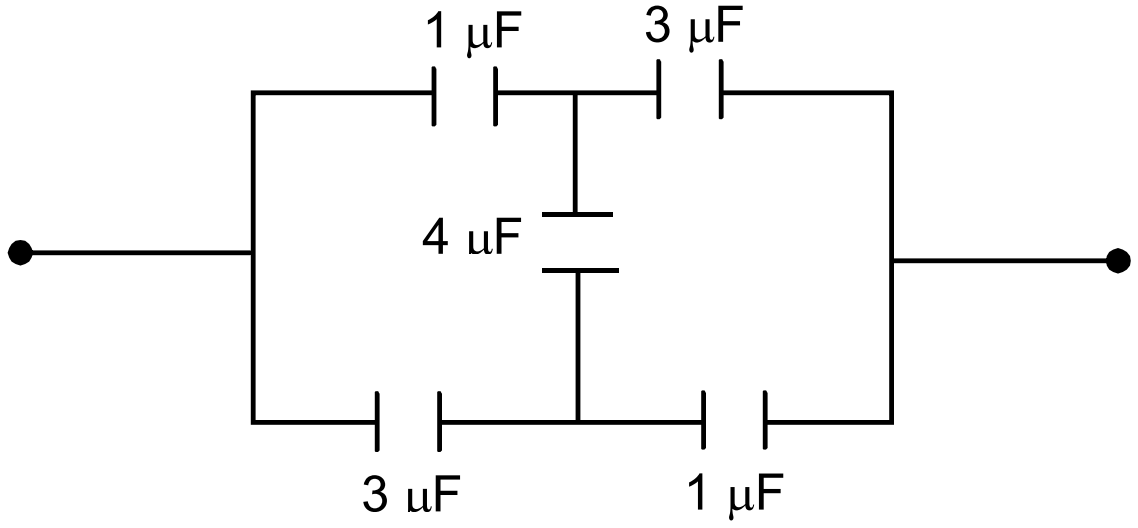
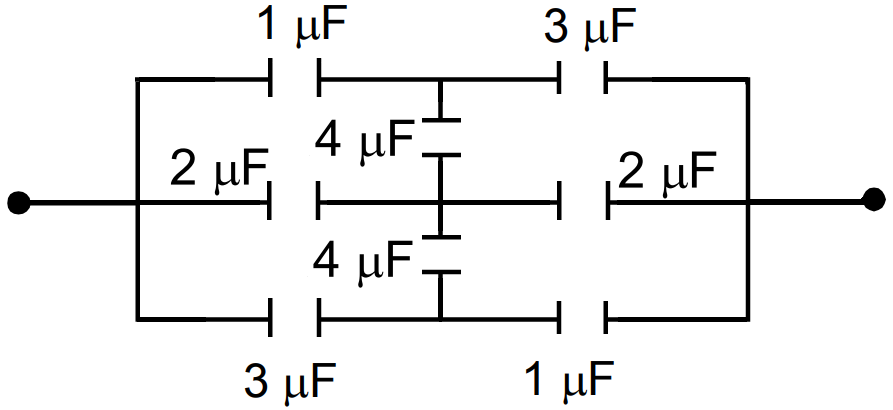
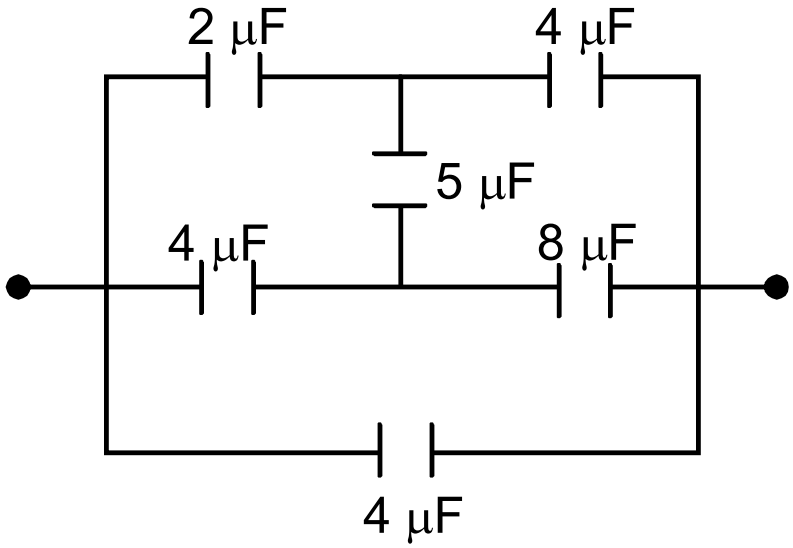
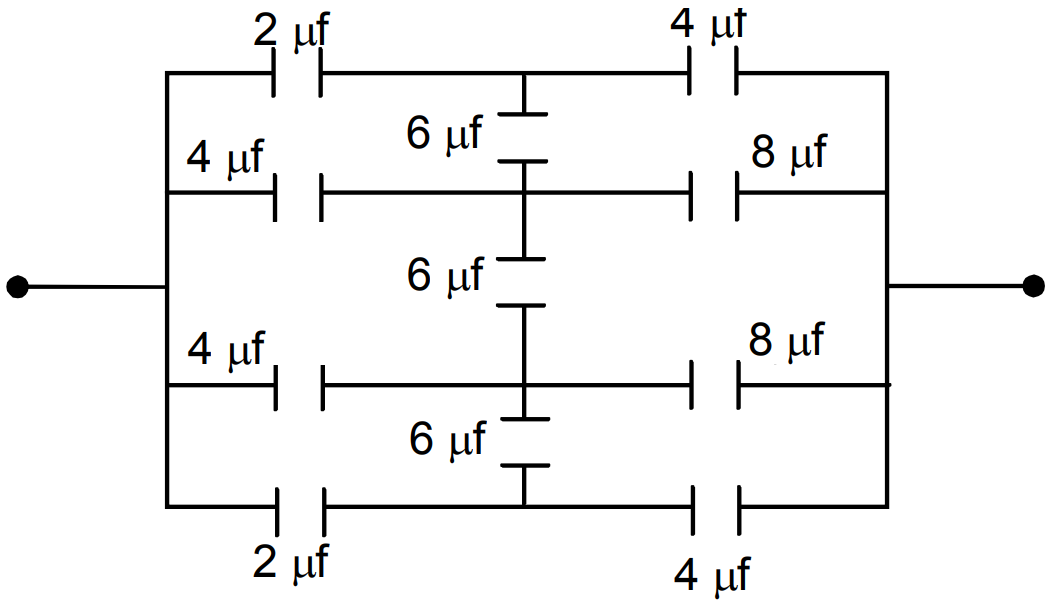
Find the equivalent capacitances of the combinations shown in figure between the indicated points.


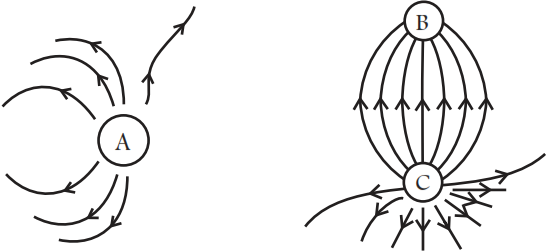
Fig. shows the electric field lines around three point charges A, B and C.

  1. Which charges are positive?
  2. Which charge has the largest magnitude? Why?
  3. In which region or regions of the picture could the electric field be zero? Justify your answer.
  1. Near A,
  2. Near B,
  3. Near C,
  4. Nowhere.
Calculate potential on the axis of a ring due to charge Q uniformly distributed along the ring of radius R.
An unsymmetrical double convex thin lens forms the image of a point object on its axis. Will the position of the image change if the lens is reversed?