Question
Define power of lens, obtain its equation and write its unit.

Answer

→Power of a lens is a measure of the convergence or divergence, which a lens introduces in the light falling on it.
→Clearly, a lense of shorter focal length bend the incident light more, while converging it in case of a convex lens and diverging it in case of a concave lens.
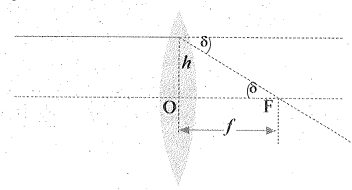
"The tangent of the angle by which it converges or diverges a beam of light parallel to the principal axis falling at unit distance from the optical centre is defined as the power P of a lens."
Image
→From figure, $\tan \delta=\frac{h}{f}$;
if $h=1$ then $\tan \delta=\frac{1}{f}$ or $\delta=\frac{1}{f}$
for small value of $\delta$. Thus
power $P =\frac{1}{f}$
→The SI unit for power of a lens is dioptre (D). $\therefore \quad 1 D =1 m^{-1}$.
→Power of a lens is positive for a convex lens and negative for a concave lens.
→When an optician prescribes a corrective lens of power +2.5 D , the required lens is a convex lens of focal length +40 cm . A lens of power of -4.0 D means a concave lens of focal length -25 cm .

Need a full question paper?

Generate a complete, print-ready paper with questions like this in minutes — across 16+ boards, with answer keys.
Start Generating Free

Similar questions

Distinguish between polarised and unpolarized light. Does the intensity of polarised light emitted by a Polaroid depend on its orientation? Explain briefly.
The vibrations in a beam of polarised light make an angle of 60° with the axis of the polaroid sheet. What percentage of light is transmitted through the sheet?
Depict the field-line pattern due to a current-carrying solenoid of finite length.
i. In what way do these lines differ from those due to an electric dipole?
ii. Why can't two magnetic field lines intersect each other?
What is reflection of light? Define angle of incidence and angle of reflection.
Two point charges $4\mu\text{C}$ and $-2 \mu\text{C}$  are separated by a distance of 1 m in air. Calculate at what point on the line joining the two charges is the electric potential zero.
A filter transmits only the radiation of wavelength greater than $440\ nm.$ Radiation from a hydrogen-discharge tube goes through such a filter and is incident on a metal of work function $2.0eV.$ Find the stopping potential which can stop the photoelectrons.
Figure shows an electrolyte of AgCl through which a current is passed. It is observed that 2.68g of silver is deposited in 10 minutes on the cathode. Find the heat developed in the $20\Omega$ resistor during this period. Atomic weight of silver is 107.9g/mole.
Light incident normally on a plane mirror attached to a galvanometer coil retraces backwards. A current in the coil produces a deflection of 3.5° of the mirror. What is the displacement of the reflected spot of light on a screen placed 1.5 m away?
Using the curve for the binding energy per nucleon as a function of mass number A, state clearly how the release in energy in the processes of nuclear fission and nuclea fusion can be explained.
Write down the equation of displacement current and derive the Ampere$-$Maxwell's law.
A free neutron beta$-$decays to a proton with a half$-$life of $14$ minutes.
  1. What is the decay constant?
  2. Find the energy liberated in the process.