Question
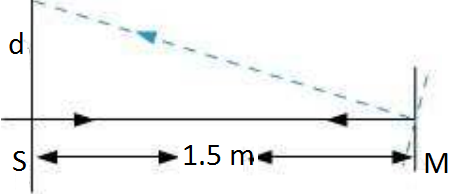
Light incident normally on a plane mirror attached to a galvanometer coil retraces backwards. A current in the coil produces a deflection of 3.5° of the mirror. What is the displacement of the reflected spot of light on a screen placed 1.5 m away?
Answer

Angle of deflection, θ = 3.5°
Distance of the screen from the mirror, D = 1.5 m
The reflected rays get deflected by an amount twice the angle of deflection i.e., 2θ = 7.0°
The displacement (d) of the reflected spot of light on the screen is given as:
$\tan2\theta=\frac{\text{d}}{1.5}$
$\therefore \ \text{d}=1.5\times\tan7^\circ=0.814 \ \text{m}=18.4 \ \text{cm}$
Hence, the displacement of the reflected spot of light is 18.4 cm.

Need a full question paper?

Generate a complete, print-ready paper with questions like this in minutes — across 16+ boards, with answer keys.

Start Generating Free

Similar questions

A point source is placed at a depth h below the surface of water (refractive index = μ).
  1. Show that light escapes through a circular area on the water surface with its centre directly above the point source.
  2. Find the angle subtended by a radius of the area on the source.
Two positive point charges $12 \mu C$ and 5 $\mu C$ are present in air at a distance of 10 cm from each other. Calculate the work required to bring them closer to 4 cm .
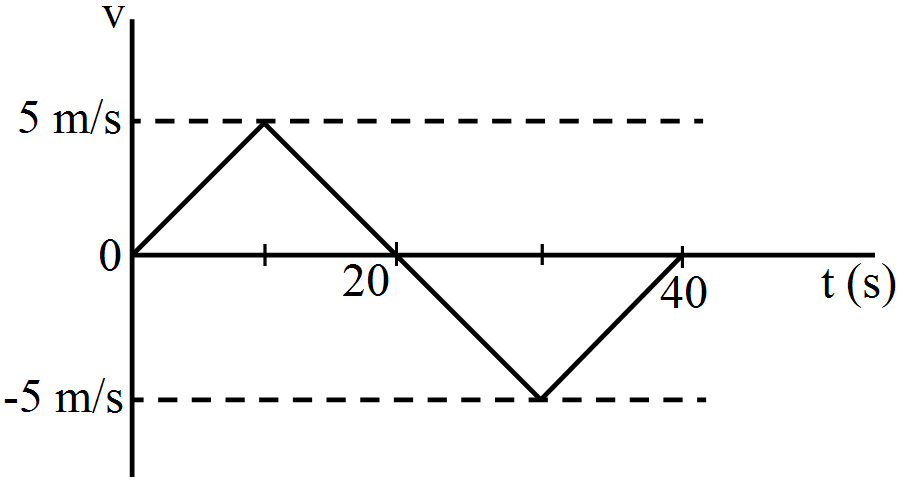
From the velocity-time plot shown in figure, find the distance travelled by the particle during the first 40 seconds. Also find the average velocity during this period.
Two capacitors of capacitance 6 μF an 12 μF are connected in series with a battery. The voltage across the 6 capacitor is 2 V. Compute the total battery voltage.
An electroplating unit plates $3.0g$ of silver on a brass plate in $3.0$ minutes. Find the current used by the unit. The electrochemical equivalent of silver is $1.12 \times 10^{-6}\ kg\ C^{-1.}$
A convex lens of focal length $25 \ cm$ is placed coaxially in contact with a concave lens of focal length $20 \ cm.$ Determine the power of the combination. Will the system be converging or diverging in nature?
If light of wavelength 412·5nm is incident on each of the metals given below, which ones will show photoelectric emission and why?
Metal
Work Function (eV)
Na
1.92
K
2.15
Ca
3.20
Mo
4.17
Answer the following question:
Magnifying power of a simple microscope is inversely proportional to the focal length of the lens. What then stops us from using a convex lens of smaller and smaller focal length and achieving greater and greater magnifying power?
A long narrow horizontal slit is placed $1\ mm$ above a horizontal plane mirror. The interference between the light coming directly from the slit and that after reflection is seen on a screen $1.0m$ away from the slit. Find the fringe$-$width if the light used has a wavelength of $700\ nm$.
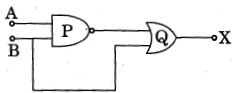
  1. Identify the logic gates marked P and Q in the given logic circuit.
  1. Write down the output at X for the inputs A = 0, B = 0 and A = 1, B = 1.