Question
Define resolving power of a compound microscope. How does the resolving power of a compound microscope change when:
  1. Refractive index of medium between the object and objective lens increases.
  2. Wavelength of radiation used is increased?

Answer

Resolving Power of a Microscope:

The resolving power of a microscope is defined as its ability to form separate images of two close objects placed near the microscope.

The minimum distance between close objects for which microscope can just form separate images of the objects is called the limit of resolution of microscope. Smaller the limit, larger the resolving power.

The angular resolving limit of microscope is $\text{d}\theta=\frac{\lambda}{2\text{n}\sin\theta},$

Where n is the refractive index of medium between object and objective.

Resolving power $\frac{1}{\text{d}\theta}=\frac{2\text{n}\sin\theta}{\lambda}$

  1. Resolving power $\alpha$ n; therefore resolving power of a compound microscope increases when refractive index (n) between the object and objective lens increases.
  2. Resolving power $\alpha \frac{1}{\lambda}$ ; therefore, resolving power of a compound microscope decreases with the increase of wavelength of light used.
Need a full question paper?

Generate a complete, print-ready paper with questions like this in minutes — across 16+ boards, with answer keys.

Start Generating Free

Similar questions

(II) (a) With the help of a diagram, explain the principle of a device which changes a low ac voltage into a high voltage . Deduce the expression for the ratio of secondary voltage to the primary voltage in terms of the ratio of the number of turns of primary and secondary winding. For an ideal transformer, obtain the ratio of primary and secondary currents in terms of the ratio of the voltages in the secondary and primary coils.
(b) Write any two sources of the energy losses which occur in actual transformers.
(c) A step-up transformer converts a low input voltage into a high output voltage. Does it violate law of conservation of energy? Explain.
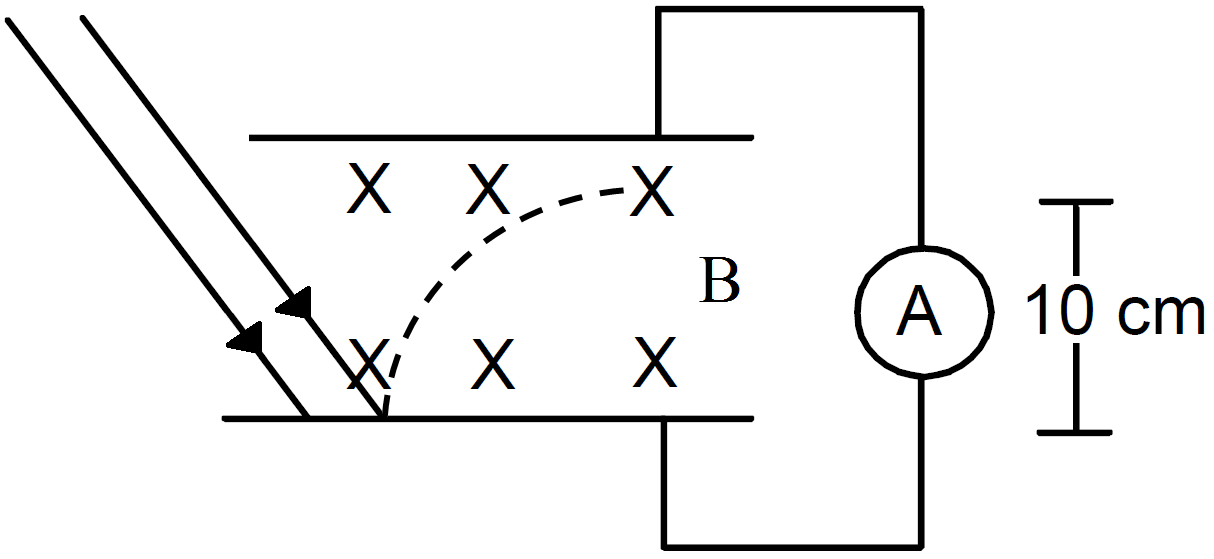
In an experiment on photoelectric effect, the emitter and the collector plates are placed et a separation of 10cm and are connected through en ammeter without any cell A magnetic field B exists parallel to the plates. The work function of the emitter is 2.39eV and the light incident on it has wavelengths between 400nm and 600nm. Find the minimum value of B for which the current registered by the ammeter is zero. Neglect any effect of space charge.

Three equal masses m are placed at the three corners of an equilateral triangle of side a. Find the force exerted by this system on another particle of mass m placed at,
  1. The mid-point of a side,
  2. At the centre of the triangle.
A coil has a resistance of $10\Omega$ and an inductance of 0.4 henry. It is connected to an AC source of $6.5\text{V},\frac{30}{\pi}\ \text{Hz}$ Find the average power consumed in the circuit.
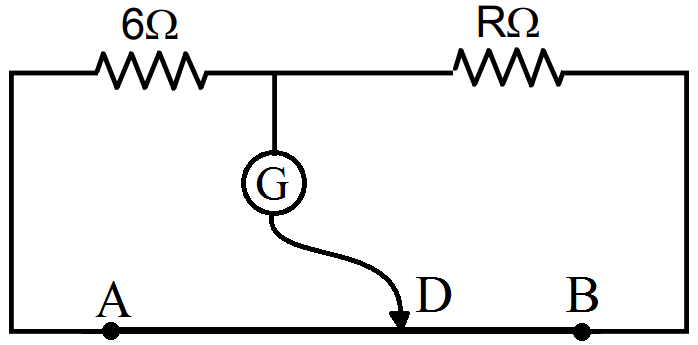
The potentiometer wire AB shown in figure. is 50cm long. When AD = 30cm, no deflection occurs in the galvanometer. Find R.

An air bubble of radius 2.0mm is formed at the bottom of a 3.3m deep river. Calculate the radius of the bubble as it comes to the surface. Atmospheric pressure = 1.0 × 10⁵ Pa and density of water = 1000kg/m-3.
Two coherent point sources S1 and S2 vibrating in phase emit light of wavelength $\lambda$. The separation between the sources is $2\lambda$. Consider a line passing through S2 and perpendicular to the line S1S2. What is the smallest distance from S2 where a minimum of intensity occurs?
Estimating the following two numbers should be interesting. The first number will tell you why radio engineers do not need to worry much about photons! The second number tells you why our eye can never ‘count photons’, even in barely detectable light.
  1. The number of photons emitted per second by a Medium wave transmitter of 10 kW power, emitting radiowaves of wavelength 500 m.
  2. The number of photons entering the pupil of our eye per second corresponding to the minimum intensity of white light that we humans can perceive (∼10–10 W m–2). Take the area of the pupil to be about 0.4 cm2, and the average frequency of white light to be about 6 × 1014 Hz.
A uniform ladder of length 10.0m and mass 16.0kg is resting against a vertical wall making an angle of 37° with it. The vertical wall is frictionless but the ground is rough. An electrician weighing 60.0kg climbs up the ladder. If he stays on the ladder at a point 8.00m from the lower end, what will be the normal force and the force of friction on the ladder by the ground? What should be the minimum coefficient of friction for the elctrician to work safely?
A lady uses +1.5D glasses to have normal vision from 25cm onwards. She uses a 20D lens as a simple microscope to see an object. Find the maximum magnifying power if she uses then microscope
  1. Together with her glass
  2. Without the glass. Do the answers suggest that an object can be more clearly seen through a microscope without using the correcting glasses?