Question
  1. Define standard enthalpy of formation. Explain why the enthalpy changes for the reaction given below are not enthalpies of formation of CaCO3 and HBr:
  1. $\text{CaO(s)}+\text{CO}_2(\text{g})\overrightarrow{\ \ \ \ \ \ \ \ }\ \text{CaCO}_3(\text{s});$ $\Delta_\text{r}\text{H}^\circ=-178.3\text{kJ mol}^{-1}$
  2. ​​​​​​​$\text{H}_2(\text{g})+\text{Br}_2(\text{g})\overrightarrow{\ \ \ \ \ \ \ }\ 2\text{HBr(g)};$ $\Delta_\text{r}\text{H}^\circ=-72.8\text{kJ mol}^{-1}$
  1. Use the bond enthalpies listed below to determine the enthalpy of reaction:

$\ \ \ \ \ \ \ \ \text{H}\\ \ \ \ \ \ \ \ \ \ |\\\text{H}-\text{C}-\text{H(g)}+2\text{O}=\text{O(g)}\overrightarrow{\ \ \ \ \ }\ \text{O}=\text{C}=\text{O(g)}\\ \ \ \ \ \ \ \ \ \ |\\ \ \ \ \ \ \ \ \ \text{H}\\+2\text{H}-\text{O}-\text{H(g)}$

Bond enthalpy $(\Delta\text{H}^\circ)/\text{kJ mol}^{-1}$ of C=O = 741; C-H = 414; H-O = 464; O=O = 498.
Answer

  1. Standard enthalpy of formation is defined as enthalpy change when 1 mole of compound is formed from the constituting elements in their standard states.
  1. Is not enthalpy of formation of CaCO3 because it is not being formed from constituting elements.
  2. Is not enthalpy of formation of HBr because 2 moles of HBr are being formed.
  1. $\ \ \ \ \ \ \ \ \text{H}\\\ \ \ \ \ \ \ \ \ |\\\text{H}-\text{C}-\text{H}+2\text{O}=\text{O(g)}\overrightarrow{\ \ \ \ \ \ }\text{O}=\text{C}=\text{O(g)}\\ \ \ \ \ \ \ \ \ \ |\\ \ \ \ \ \ \ \ \ \text{H}\\+2\text{H}-\text{O}-\text{H(g)}$

$\Delta\text{H}=$ Bond energy of reactants - Bond energy of products

$=2\text{B}_{\text{O}=\text{O}}+4\text{B}_{\text{C}-\text{H}}-2\text{B}_{\text{C}=\text{O}}-4\text{B}_{\text{O}-\text{H}}$

$=2\times498+4\times414-2\times741-4\times464$

$=(996+1656-1482-1856)$

$=-686\text{kJ mol}^{-1}$

Need a full question paper?

Generate a complete, print-ready paper with questions like this in minutes — across 16+ boards, with answer keys.

Start Generating Free

Similar questions

(i) Calculate the total number of electrons present in one mole of methane.
(ii) Find (a) the total number and (b) the total mass of neutrons in 7 mg of 14C. (Assume that mass of a neutron $=1.675 \times 10^{-27} kg$ )
(iii) Find (a) the total number and (b) the total mass of protons in 34 mg of $NH _3$ at STP.
Will the answer change if the temperature and pressure are changed?
8 Arrange benzene, n-hexane and ethyne in decreasing order of acidic behaviour. Also give reason for this behaviour.
If the photon of the wavelength 150pm strikes an atom and one of tis inner bound electrons is ejected out with a velocity of 1.5 × 10⁷ms –1, calculate the energy with which it is bound to the nucleus.
What is the equilibrium concentration of each of the substances in the equilibrium when the initial concentration of ICl was 0.78M?
$2\text{ICI (g)}\rightleftharpoons\text{I}_2\text{ (g) + Cl}_2\text{ (g)};\text{ K}_{\text{c}}=0.14$
Classify the following reactions in one of the reaction type studied in this unit.
  1. CH3CH2Br + HS- → CH3CH2SH + Br-
  2. (CH3)2 C = CH2 + HCl → (CH3)2 ClC-CH3
  3. CH3CH2Br + HO- → CH=CH2 + H2O + Br-
  4. (CH3)3 C-CH3OH + HBr → (CH3)2 CBrCH2CH2CH + H2O
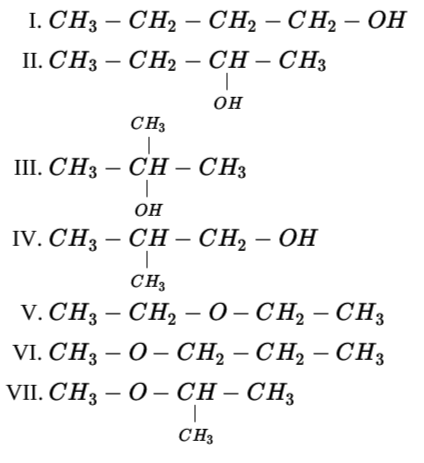
1. Identify the pairs of compounds which are functional group isomers.
Image
2. Explain, how is the electronegativity of carbon atoms related to their state of hybridization in an organic compound.
A neutral atom of an element has 2K, 8L and 5M electrons. Find out the following:
  1. Atomic number of the element.
  2. Total number of s-electrons.
  3. Total number of p-electrons.
  4. Number of protons in the nucleus.
  5. Valency of the element.
Extensive properties depend on the quantity of matter but intensive properties do not. Explain whether the following properties are extensive or intensive. Mass, internal energy, pressure, heat capacity, molar heat capacity, density, mole fraction, specific heat, temperature and molarity.
Write short notes on the following: (i) Hydroboration of alkenes (ii) Polymerisation of alkenes
Explain different types of oxidation reactions of alkenes with example.