Question
Define the following terms:
  1. Limiting molar conductivity.
  2. Fuel cell.

Answer

  1. The molar conductivity when concentration approaches to zero is called limiting molar conductivity.
  2. A fuel cell is a device which converts energy produced during the combustion of fuels like hydrogen, methane, methyl alcohol etc. directly into electrical energy. One such successful fuel cell is hydrogen-oxygen fuel cell.

Need a full question paper?

Generate a complete, print-ready paper with questions like this in minutes — across 16+ boards, with answer keys.

Start Generating Free

Similar questions

Express the relation among the cell constant, the resistance of the solution in the cell and the conductivity of the solution. How is the conductivity of a solution related to its molar conductivity?
Explain the following:
Vapour phase refining method is used for the purification of Ti.
Explain the following with suitable examples:
Ferrimagnetism.
Examine the given defective crystal:
$A^+$
$B^-$
$A^+$
$B^-$
$A^+$
$B^-$
$0$
$B^-$
$A^+$
$B^-$
$A^+$
$B^-$
$A^+$
$0$
$A^+$
$B^-$
$A^+$
$B^-$
$A^+$
$B^-$
Answer the following questions:
  1. What type of stoichiometric defect is shown by the crystal?
  2. How is the density of the crystal affected by this defect?
  3. What type of ionic substances show such defect?
Write equation for the synthesis of the given polymer: Taflon.
Explain the following items:
Avitaminosis.

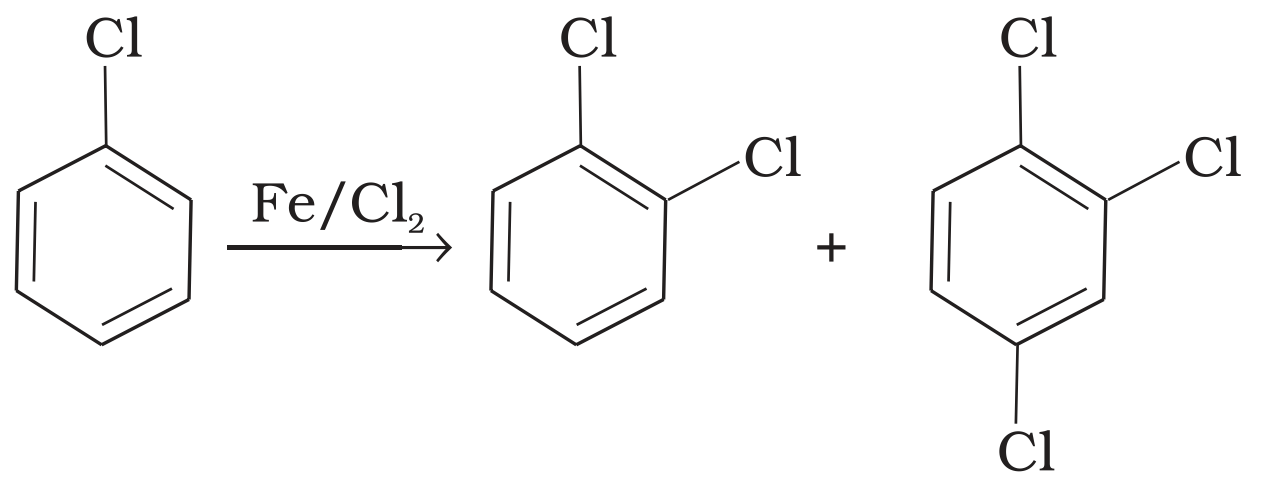
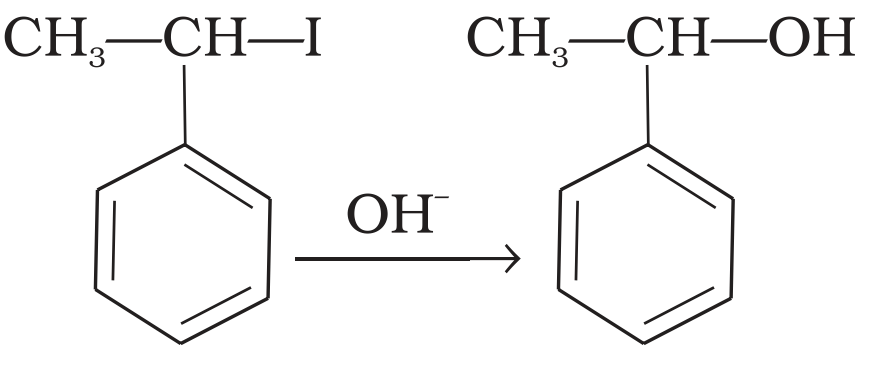
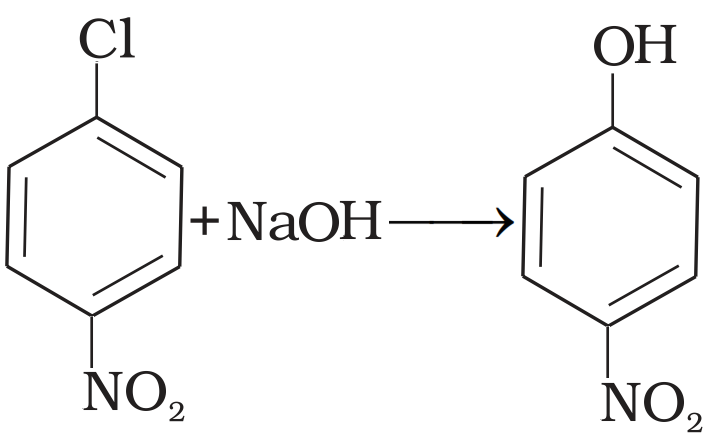
Match the reactions given in Column I with the names given in Column II.
  Column I   Column II
(i) (a) Nucleophilic aromatic substitution
(ii) $\text{CH}_3-\text{CH}==\text{CH}_2+\text{HBr}\xrightarrow{ \ \ \ \ \ }\text{CH}_3-\text{CH}-\text{CH}_3\ \ \ \ \ \ \ \ \ \ \ \ \ \ \ \ \ \ \ \ \ \ \ \ \ \ \ \ \ \ \ \ \ \ \ \ | \ \ \ \ \ \ \ \ \ \ \ \text{Br}$ (b) Electrophilic aromatic substitution
(iii) (c) Saytzeff elimination
(iv) (d) Electrophilic addition
(v) $\text{CH}_3\text{CH}_2\text{CH}\text{CH}_3\xrightarrow{\text{alc.KOH}}\text{CH}_3\text{CH}==\text{CH}\text{CH}_3\ \ \ \ \ \ \ |\ \ \ \ \ \ \ \ \ \ \ \ \ \ \ \ \text{Br}$ (e) Nucleophilic substitution $(S_N1)$
Explain the structure of amine compounds by drawing a diagram.
What happens when
i. a pressure greater than osmotic pressure is applied on the solution side separated from solvent by a semipermeable membrane?
ii. acetone is added to pure ethanol?
Give reasons for the following:
$a.$ The only oxidation state shown by Scandium is $+3.$
$b. [Ti(H_2O)_6]^{4+}$ is colourless.
$c. MnO$ is basic while $Mn_2O_7$ is acidic.