Question
Define the term ‘linearly polarised light’.
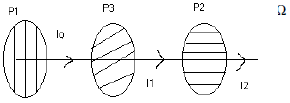
When’ does the intensity of transmitted light become maximum, when a polaroid sheet is rotated between two crossed polaroids?

Answer

When the vibrations of the electric field vector $(\overrightarrow{\text{E}})$ are confined to only one direction then light is called linearly polarized light.

Intensity of transmitted light is maximum when the Polaroid sheet makes an angle of 450 with the pass axis.

Alternate Answer

Need a full question paper?

Generate a complete, print-ready paper with questions like this in minutes — across 16+ boards, with answer keys.

Start Generating Free

Similar questions

Write the relation for the forces $\overrightarrow{F}$ acting on a charge carrier q moving with a velocity $\overrightarrow{V}$  through a magnetic field $\overrightarrow{B}$  in vector notation. Using this relation, deduce the conditions under which this force will be (1) maximum (2) minimum.
Answer the following questions:
Why is choke coil needed in the use of fluorescent tubes with acmains? Why can we not use an ordinary resistor instead of the choke coil?
Taking force, length and time to be the fundamental quantities find the dimensions of:
  1. Density.
  2. Pressure.
  3. Momentum.
  4. Energy.
Write conclusion of Oersted's experiment.
A neutron having kinetic energy 12.5eV collides with a hydrogen atom at rest. Nelgect the difference in mass between the neutron and the hydrogen atom and assume that the neutron does not leave its line of motion. Find the possible kinetic energies of the neutron after the event.
Derive the balance condition for Wheatstone Bridge.
Gravitational force or spring force is conservative force - explain.
Discuss the results of the Geiger-Marsden $\alpha$-particle scattering experiment with necessary graphs.
Answer the following question:
Quarks inside protons and neutrons are thought to carry fractional charges [(+2/3)e ; (–1/3)e]. Why do they not show up in Millikan’s oil-drop experiment?
Identify the electromagnetic waves whose wavelengths lie in the range:
  1. 10–11 m < $\lambda$ < 10–14 m
  2. 10–4 m < $\lambda$ < 10–6 m
Write one use for each.