Question
Define the term magnifying power of a simple microscope. How does it depend on the focal length of the lens used?

Answer

The magnifying power of a simple microscope is defined as the ratio of the angle subtended by the image at the eye to the angle subtended by the object at the eye if it is assumed to be placed at the least distance of distinct vision.
Shorter the focal length of the lens used, larger is its magnifying power.

Need a full question paper?

Generate a complete, print-ready paper with questions like this in minutes — across 16+ boards, with answer keys.
Start Generating Free

Similar questions

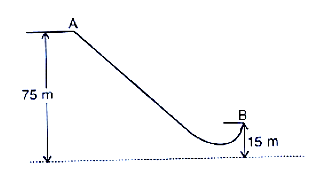
The diagram given below shows a ski jump. A skier weighing $60 kg$ stands at A at the top of ski jump. He moves from A to B and takes off for his jump at $B$.


(a) Calculate the change in the gravitational potential energy of the skier between $A$ and $B$.
(b) If $75 \%$ of the energy in part (a) becomes kinetic energy at B. Calculate the speed at which the skier arrives at B.
(Take $g =10 m s ^{-2}$ )
Two metallic blocks P and Q of masses in ratio 2: 1 are given the same amount of heat. If their temperature rise by the same amount, compare their specific heat capacities.
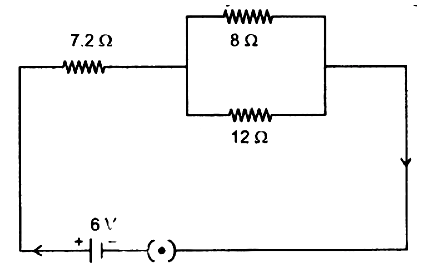
Three resistors are connected to a $6 V$ battery as shown in the figure given below:

Calculate:
(i) the equivalent resistance of the circuit.
(ii) total current in the circuit.
(iii) potential difference across the $7.2 Ω$ resistor.
Distinguish between a real and a virtual image.
How does the resistance of a wire depend on its radius? Explain your answer.
What happens to the atomic number of element when (i) An $\alpha$-particle, (ii) $A \beta$-particle 1 and (iii) $\gamma$-radiation is emitted?
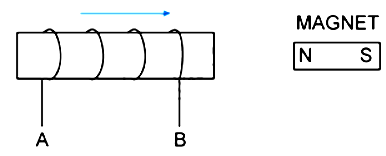
The diagram in shows a coil of several turns of copper wire near a magnet NS. The coil is moved in the direction of arrow shown in the diagram.


(i) In what direction does the induced current flow in the coil?
(ii) Name the law used to arrive at the conclusion in part (i).
(iii) How would the current in coil be altered if
(a) the coil has twice the number of turns,
(b) the coil was made to move three times fast?
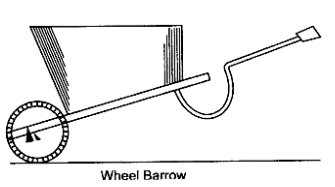
In the following diagram of a wheelbarrow, mark the fulcrum (F) and indicate the directions of load (L) and effort (E) with arrows.
Image
What class of lever is it? Give one more example of the same class of lever.
Calculate the amount of heat energy required to raise the temperature of $100 g$ of copper from $20^{\circ} C$ to $70^{\circ} C$. specific heat capacity of copper $=390 Jkg ^{-1} K ^{-1}$.
What do you understand by focal plane of a lens?