MCQ
Dehydration of the following in increasing order is:
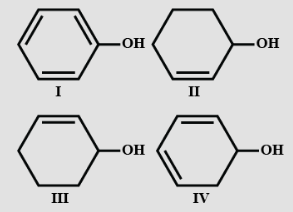
  • A
    I<II<III<IV
  • B
    II<III<IV<I
  • C
    I<III<II<IV
  • D
    I<IV<II<III

Answer

  1. I<II<III<IV

Explanation:

Phenol (I) is stable aromatic compound. So it is most stable. The diene (IV) undergoes quick dehydration because it will form stable phenol. The alkene (III) undergoes dehydration. less readily because it gives a more stable diene. Alcohol (II) undergoes much lesser dehydration to form alkene. So, order is: 4>3>2>1.

Need a full question paper?

Generate a complete, print-ready paper with questions like this in minutes — across 16+ boards, with answer keys.

Start Generating Free

Similar questions

$\begin{array}{*{20}{c}}
  {\begin{array}{*{20}{c}}
  {C{H_3\,\,}} \\ 
  {\,|\,\,\,\,\,\,\,\,\,\,} 
\end{array}\,\,\,\,\,\,\,\,\,} \\ 
  {C{H_3} - C - CH = C{H_2}\,\,} \\ 
  {\,|\,\,\,\,\,\,\,\,\,\,\,\,\,\,\,\,\,\,\,\,} \\ 
  {\,\,C{H_3}\,\,\,\,\,\,\,\,\,\,\,\,\,\,} 
\end{array}\xrightarrow[{{H_2}{O_2}|\mathop {OH}\limits^\Theta  }]{{{B_2}{H_6}|THF}}\,(Z)$ Major product
If two substances $A$ and $B$ have $P_A^0:\,P_B^0 = 1\,:\,2$ and have mole fraction in solution $1 : 2 $ then mole fraction of $A$ in vapours
Among the following, the number of halide$(s)$ which is/are inert to hydrolysis is ..........

$(A)$ $BF _{3}$

$(B)$ $SiCl _{4}$

$(C)$ $PCl _{5}$

$(D)$ $SF _{6}$

For any reaction, if we plot a graph between time '$t$' and $\log (a - x)$, a simple line is obtained. The order of reaction is
What is the value of $n-$ factor of $[Fe(CN)_6]^{-4}$ is the given reaction

${\left[ {Fe{{\left( {CN} \right)}_6}} \right]^{ - 4}}\,\xrightarrow{{MnO_4^ - /{H^ + }}}F{e^{ + 3}} + C{O_2} + NO_3^ - $

Barbiturates are hypnotic agents. Veronal is derivative of barbituric acid. It can be synthesis by following sequence, then structure of veronal $(P)$ is :

$CH_2(CO_2 Et)_2 $ $\xrightarrow[Et-I]{EtO^{\circleddash}} \,\,\xrightarrow[Et-I]{EtO^{\circleddash}}
\,\,\overset{Urea}{\rightarrow} $ $(P)$

Nickel steel contain $\%$  of $ Ni$ 
In which of the reaction carbanion is not formed as one of the intermediate 
Which of the following combination does not evolve $Cl_2$ gas?
For the feasibility of a redox reaction in a cell, the e.m.f. should be