Alcohols react both as nucleophiles as well as electrophiles. Write one reaction of each type and describe its mechanism.
Question types
Alcohols, Phenols, and Ethers question types
392 questions across 7 question groups — pick any mix to generate a Chemistry paper with step-by-step answer keys.
392
Questions
7
Question groups
5
Question types
01
2 Marks Questions
58 Q→023 Marks Question
12 Q→031 Marks Question
118 Q→04Case study (4 Marks)
10 Q→05M.C.Q (1 Marks)
164 Q→06Assertion (A) & Reason (B) MCQ
25 Q→075 Marks Questions
5 Q→Sample Questions
Alcohols, Phenols, and Ethers questions
One sample from each question group in this chapter. Select any group above to see the full set with answer keys.
View full solution →
Give the equations of reactions for the preparation of phenol from cumene.
Preparation of ethers by acid dehydration of secondary or tertiary alcohols is not a suitable method. Give reason.
Give structures of the products you would expect when each of the following alcohol reacts with
HCl –ZnCl2
- Butan-1-ol
- 2-Methylbutan-2-ol
Explain the fact that in aryl alkyl ethers (i) the alkoxy group activates the benzene ring towards electrophilic substitution and (ii) it directs the incoming substituents to ortho and para positions in benzene ring.
Illustrate with examples the limitations of Williamson synthesis for the preparation of certain types of ethers.
Give two reactions that show the acidic nature of phenol. Compare acidity of phenol with that of ethanol.
Identify the product of the following reaction:
View full solution →$ \ \ \ \ \ \ \ \ \ \text{CH}_3\\ \ \ \ \ \ \ \ \ \ \ \ \ \ \text{|}\\\text{CH}_3-\text{C}-\text{CH}_2-\text{Br}\xrightarrow{\stackrel{{}}{\hbox{Na}}\stackrel{{}}{\hbox{OH}}}\\ \ \ \ \ \ \ \ \ \ \ \ \ \ \text{|} \ \ \ \ \ \ \ \ \ \ \ \ \ \ \ \ \ \ \ \ \ \ \ \ \ \ \ \ \ \Delta\\ \ \ \ \ \ \ \ \ \ \text{CH}_3$
Ortho and para nitrophenols are more acidic than phenol. Draw the resonance structures of the corresponding phenoxide ions.
- Draw the structures of all isomeric alcohols of molecular formula C5H12O and give their IUPAC names.
- Classify the isomers of alcohols in question 11.3 (i) as primary, secondary and tertiary alcohols.
Write IUPAC names of the following compound:
View full solution →$\ \ \ \ \ \ \ \ \ \ \ \ \ \ \ \ \ \ \ \ \ \ \ \ \ \ \ \ \ \ \ \ \ \ \text{CH}_3\\\ \ \ \ \ \ \ \ \ \ \ \ \ \ \ \ \ \ \ \ \ \ \ \ \ \ \ \ \ \ \ \ \ \ \ |\\\text{CH}_3-\text{CH}-\text{CH}-\text{C}-\text{CH}_3\\\ \ \ \ \ \ \ \ \ \ \ \ \ \ |\ \ \ \ \ \ \ \ \ \ |\ \ \ \ \ \ \ \ \ |\\\ \ \ \ \ \ \ \ \ \ \ \ \ \text{CH}_3\ \ \ \ \text{OH}\ \ \ \ \text{CH}_3$
Write IUPAC names of the following compound:
View full solution →$\text{H}_3\text{C}-\text{CH}-\text{CH}_2-\text{CH}-\text{CH}-\text{CH}_2-\text{CH}_3\\\ \ \ \ \ \ \ \ \ \ \ \ \ \ |\ \ \ \ \ \ \ \ \ \ \ \ \ \ \ \ \ \ \ \ \ \ |\ \ \ \ \ \ \ \ \ \ |\\\ \ \ \ \ \ \ \ \ \ \ \ \ \text{OH}\ \ \ \ \ \ \ \ \ \ \ \ \ \ \ \ \ \text{OH}\ \ \ \ \ \text{C}_2\text{H}_5$
Give reason for the higher boiling point of ethanol in comparison to methoxymethane.
Write structures of the products of the following reactions:
View full solution →$\text{CH}_3-\text{CH}=\text{CH}_2\ \xrightarrow{\text{H}_2 \text{O}/\text{H}^+}$
Name the reagent used in the following reaction:
Oxidation of a primary alcohol to aldehyde.
Read the passage given below and answer the following questions: Lucas test is a test to differentiate between primary, secondary and tertiary alcohols. This test consists of treating an alcohol with Lucas' reagent, and turbidity, due to the formation of insoluble alkyl chloride, is observed. Lucas test is based on the difference in reacting of three classes of alcohols with hydrogen chloride via SN1 reaction. The different reactivity reflects the differing ease of formation of the corresponding carbocations. In these questions (Q. No. i-iv), a statement of assertion followed by a statement ofreason is given. Choose the correct answer out of the following choices.
- Assertion and reason both are correct statements and reason is correct explanation for assertion.
- Assertion and reason both are correct statements but reason is not correct explanation for assertion.
- Assertion is correct statement but reason is wrong statement.
- Assertion is wrong statement but reason is correct statement.
- Assertion: Equimolar mixture of cone. HCI and anhydrous ZnCl2 is called Lucas' reagent.
Reason: Lucas' reagent can be used to distinguish between methanol and ethanol.
- Assertion: 2-Methyl-2-butanol gives no turbidity with Lucas' reagent at room temperature.
Reason: It is a 3º alcohol.
- Assertion: Tertiary alcohols react fastest with Lucas' reagent by SN1 mechanism.
Reason: 3º carbocation is most stable.
- Assertion: Amongst the compounds, H2C = CHCH2OH (I), C6H5OH (II), CH3CH2CH2OH (III) and (CH3)3COH (IV), only (IV) reacts with Lucas' reagent at room temperature.
Reason: Tertiary alcohol gives turbidity immediately with Lucas' reagent.
- Assertion: Lucas test can be used to distinguish between 1-propanol and 2-propanol.
Reason: Lucas test is based upon the difference in reactivity of primary, secondary and tertiary alcohols with cone. HCI and anhyd. ZnCl2.
Read the passage given below and answer the following questions: Due to intermolecular hydrogen bonding, the boiling points of alcohols and phenols are much higher than those of corresponding haloalkanes, haloarenes, aliphatic and aromatic hydrocarbons. Among isomeric alcohols, the boiling points follow the order: primary > secondary > tertiary. Boiling points of ethers are much lower than those of isomeric alcohols. The solubility of alcohols in water decreases as the molecular mass of alcohols increases. Amongst isomeric alcohols solubility increases with branching. The solubility of phenols in water is much lower than that of alcohols. Lower ethers such as dimethyl ether and ethyl methyl ether are soluble in water, but the solubility decreases as the molecular mass increases. In these questions (Q. No. i-iv), a statement of assertion followed by a statement of reason is given. Choose the correct answer out of the following choices.
- Assertion and reason both are correct statements and reason is correct explanation for assertion.
- Assertion and reason both are correct statements but reason is not correct explanation for assertion.
- Assertion is correct statement but reason is wrong statement.
- Assertion is wrong statement but reason is correct statement.
- Assertion: Alcohols have higher boiling points than ethers of comparable molecular masses.
Reason: Alcohols and ethers are isomeric in nature.
- Assertion: The solubility of phenols in water is much lower than that of alcohols.
Reason: Phenols do not form H-bonds with water.
- Assertion: Among n-butane, ethoxyethane, 1-propanol and 2-propanol, the increasing order of boiling points is, 1-butanol < 1-propanol < ethoxyethane < n-butane.
Reason: Boiling point increases with increase in molecular mass.
- Assertion: Dimethyl ether and diethylether are soluble in water.
Reason: As the molecular mass increases, solubility of ethers in water decreases.
- Assertion: Butan-2-ol has higher boiling point than 2-methylpropan-2-ol.
Reason: Amongst isomeric alcohols, the boiling points decreases with branching.
Read the passage given below and answer the following questions:
An organic compound (A) having molecular formula C6H6O gives a characteristic colour with aqueous FeCl3 solution. (A) on treatment with CO2 and NaOH at 400K under pressure gives (B), which on acidification gives a compound (C). The compound (C) reacts with acetyl chloride to give (D) which is a popular pain killer.
The following questions are multiple choice questions. Choose the most appropriate answer:
An organic compound (A) having molecular formula C6H6O gives a characteristic colour with aqueous FeCl3 solution. (A) on treatment with CO2 and NaOH at 400K under pressure gives (B), which on acidification gives a compound (C). The compound (C) reacts with acetyl chloride to give (D) which is a popular pain killer.
The following questions are multiple choice questions. Choose the most appropriate answer:
- Compound (A) is:
- 2-Hexanol.
- Dimethyl ether.
- Phenol.
- 2-Methyl pentanol.
- Compound (C) is:
- Salicylic acid.
- Salicyladehyde.
- Benzoic acid.
- Benzaldehyde.
- Number of carbon atoms in compound (D) is:
- 7
- 6
- 8
- 9
- The conversion of compound (A) to (C) is known as:
- Reimer-Tiemann reaction.
- Kolbe's reaction.
- Schimdt reaction.
- Swarts reaction.
- Compound (A) on heating with compound (C) in presence of POCl3 gives a compound (D) which is used:
- In perfumery as a ftavouring agent
- As an antipyretic
- As an analgesic
- As an intestinal antiseptic.
Read the passage given below and answer the following questions:
A compound (X) containing C, H and O is unreactive towards sodium. It also does not react with Schiff s reagent. On refluxing with an excess of hydroiodic acid, (X) yields only one organic product ( Y). On hydrolysis, (Y) yields a new compound (Z) which can be converted into (Y) by reaction with red phosphorus and iodine. The compound (Z) on oxidation with potassium permanganate gives a carboxylic acid. The equivalent weight of this acid is 60.
The following questions are multiple choice questions. Choose the most appropriate answer:
View full solution →A compound (X) containing C, H and O is unreactive towards sodium. It also does not react with Schiff s reagent. On refluxing with an excess of hydroiodic acid, (X) yields only one organic product ( Y). On hydrolysis, (Y) yields a new compound (Z) which can be converted into (Y) by reaction with red phosphorus and iodine. The compound (Z) on oxidation with potassium permanganate gives a carboxylic acid. The equivalent weight of this acid is 60.
The following questions are multiple choice questions. Choose the most appropriate answer:
- The compound (X) is an:
- Acid.
- Aldehyde.
- Alcohol.
- Ether.
- The IUPAC name of the acid formed is:
- Methanoic acid.
- Ethanoic acid.
- Propanoic acid.
- Butanoic acid.
- Compound (Y) is:
- Ethyl iodide.
- Methyl iodide.
- Propyl iodide.
- Mixture of (a) and (b).
- Compound (Z) is:
- Methanol.
- Ethanol.
- Propanol.
- Butanol.
- Compound (X) on treatment with excess of Cl2 in presence of tight gives:
- $\propto-$ Chlorodiethyl ether.
- $\propto,\propto'-$ Dichlorodiethyl ether.
- Perchlorodiethyl ether.
- None of these.
Read the passage given below and answer the following questions: Williamson's synthesis is used for the preparation of symmetrical as well as unsymmerical ether. It is SN2 reaction mechanism. In Williamson's synthesis, 1º alkyl halide are used for preparation of ethers because 2º and 3º alkyl halide give alkene. Ethers are cleaved by hydrogen halides to alcohol and alkyl halide where alkyl halide is corresponding to that alkyl which has less number of carbon atom (it is because of less steric hindrance). In polar media unsymmetrical ether like tertiary butyl ethyl ether gives ethyl alcohol and tertiary butyl halide as reaction proceeds via carbocation. In these questions (Q. No. i-iv), a statement of assertion followed by a statement of reason is given. Choose the correct answer out of the following choices.
- Assertion and reason both are correct statements and reason is correct explanation for assertion.
- Assertion and reason both are correct statements but reason is not correct explanation for assertion.
- Assertion is correct statement but reason is wrong statement.
- Assertion is wrong statement but reason is correct statement.
- Assertion: Rate of reaction of alkyl halide in Williamson's synthesis reaction is 1ºRX > 2ºRX > 3ºRX.
Reason: It is a type of bimolecular substitution reaction (SN2).
- Assertion: T-Butyl methyl ether is not prepared by the reaction of t-butyl bromide with sodium methoxide.
Reason: Sodium methoxide is a weak nucleophile.
- Assertion: Williamson's synthesis method cannot be used for preparing diphenyl ether.
Reason: Aryl halides do not undergo nucleophilic substitution easily.
- Assertion: When isopropyl bromide is treated with sodium isopropoxide, di-isopropyl ether is obtained as a major product.
Reason: With secondary alkyl halides, both substitution and elimination occur.
- Assertion: Both symmetrical and unsymmetrical ethers can be prepared by Williamson's synthesis.
Reason: Williamson's synthesis is an example of nucleophilic substitution reaction.
Correct order of acidic strength.
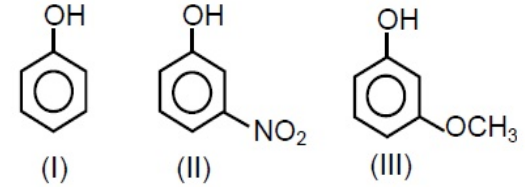
- AI > II > III
- BII > III > I
- CI>III>II
- DIII>II>I
The correct order of boiling point for primary (1), secondary (2) and tertiary (3) alcohols is:
- A1 > 2 > 3
- B3 > 2 > 1
- C2 > 1 > 3
- D2 > 3 > 1
Methanol can be prepared when:
- AIodomethane is heated with moist silver oxide.
- BIodomethane react with sodium in the presence of ether.
- CBoth A and B.
- DNone of these.
The correct reactivity order of alcohols towards H−X will be:
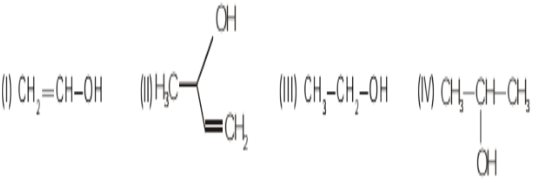
- AII>I>III>IV
- BIV>III>II>I
- CII>IV>I>III
- DII>IV>III>I
Which of the following name does not fit a real name?
- A3 -methyl 3 -hexanone
- B4 -methyl 3 -hexanone
- C3 -methyl 3 -hexanol
- D2 -methylcyclohexanone
Note: In the following questions a statement of assertion followed by a statement of reason is given. Choose the correct answer out of the following choices.
- Assertion and reason both are correct and reason is correct explanation of assertion.
- Assertion and reason both are wrong statements.
- Assertion is correct statement but reason is wrong statement.
- Assertion is wrong statement but reason is correct statement.
- Both assertion and reason are correct statements but reason is not correct explanation of assertion.
Assertion: Phenols give o- and p-nitrophenol on nitration with conc. HNO3 and H2SO4 mixture.
Reason: -OH group in phenol is o-, p-directing.
In these questions, a statement of assertion followed by a statement of reason is given. Choose the correct answer out of the following choices.
Reason: C2H5OH forms intermolecular H-bonding while CH3OCH3 forms intramolecular H-bonding.
- Assertion and reason both are correct statements and reason is correct explanation for assertion.
- Assertion and reason both are correct statements but reason is not correct explanation for assertion.
- Assertion is correct statement but reason is wrong statement.
- Assertion is wrong statement but reason is correct statement.
Reason: C2H5OH forms intermolecular H-bonding while CH3OCH3 forms intramolecular H-bonding.
Note: In the following questions a statement of assertion followed by a statement of reason is given. Choose the correct answer out of the following choices.
- Assertion and reason both are correct and reason is correct explanation of assertion.
- Assertion and reason both are wrong statements.
- Assertion is correct statement but reason is wrong statement.
- Assertion is wrong statement but reason is correct statement.
- Both assertion and reason are correct statements but reason is not correct explanation of assertion.
Assertion: Phenol forms 2, 4, 6–tribromophenol on treatment with Br2 in carbon disulphide at 273K.
Reason: Bromine polarises in carbon disulphide.
Note: In the following questions a statement of assertion followed by a statement of reason is given. Choose the correct answer out of the following choices.
- Assertion and reason both are correct and reason is correct explanation of assertion.
- Assertion and reason both are wrong statements.
- Assertion is correct statement but reason is wrong statement.
- Assertion is wrong statement but reason is correct statement.
- Both assertion and reason are correct statements but reason is not correct explanation of assertion.
Assertion: Ethanol is a weaker acid than phenol.
Reason: Sodium ethoxide may be prepared by the reaction of ethanol with aqueous NaOH.
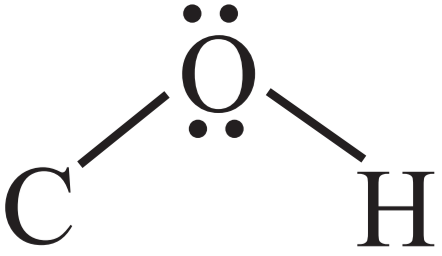 Bond angle is less than the normal tetrahedral bond angle.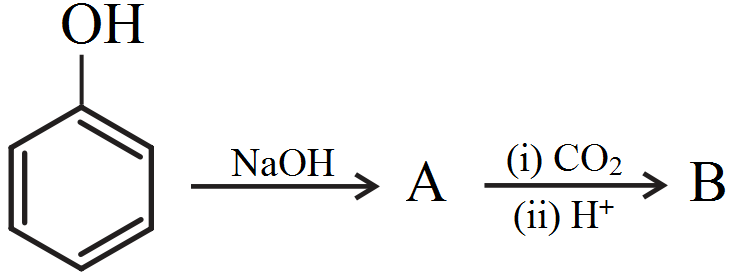

Answer the following question:
How will you convert phenol to benzoic acid?
How will you convert phenol to benzoic acid?
An aromatic compound ‘A’ on treatment with CHCl3/ KOH gives two compounds ‘B’ and ‘C’. Both B and C give the same product ‘D’ when distilled with zinc dust. Oxidation of D gives E having molecular formula C7H6O2. The sodium salt of E on heating with sodalime gives F which may also be obtained by distilling A with zinc dust. Identify A to F.
Answer the following question:
Write mechanism of the reaction of HI with methoxymethane.
Write mechanism of the reaction of HI with methoxymethane.
Generate a Alcohols, Phenols, and Ethers paper free
Pick question groups from the list above, set marks and difficulty, and export a branded PDF with step-by-step answer keys. First 3 chapters free — no signup.