MCQ
Density of antinodes in stationary wave is:
  • A
    Maximum
  • B
    Minimum
  • C
    Maximum change
  • Minimum change

Answer

Correct option: D.
Minimum change
(D)

Need a full question paper?

Generate a complete, print-ready paper with questions like this in minutes — across 16+ boards, with answer keys.
Start Generating Free

Similar questions

The velocity of a bullet is reduced from $200\,m/s$ to $100\,m/s $ while travelling through a wooden block of thickness $10\,cm$. The retardation, assuming it to be uniform, will be 
A solid sphere of mass $500\,g$ and radius $5\,cm$ is rotated about one of its diameter with angular speed of $10\,rad \, s ^{-1}$. If the moment of inertia of the sphere about its tangent is $x \times 10^{-2}$ times its angular momentum about the diameter. Then the value of $x$ will be ..............
Select the correct statements:
  1. A simple harmonic motion is necessarily periodic.
  2. A simple harmonic motion is necessarily oscillatory.
  3. An oscillatory motion is necessarily periodic.
  4. A periodic motion is necessarily oscillatory.
Water is flowing with a velocity of $2\,m/s$ in a horizontal pipe where cross-sectional area is $2 \times 10^{-2}\, m^2$ at pressure $4 \times 10^4\, pascal$. The pressure at cross-section of area $0.01\, m^2$ in pascal will be
If the collision frequency of hydrogen molecules in a closed chamber at $27^{\circ} \mathrm{C}$ is $\mathrm{Z}$, then the collision frequency of the same system at $127^{\circ} \mathrm{C}$ is :
If $|\,\vec A + \vec B\,|\, = \,|\,\vec A\,| + |\,\vec B\,|$, then angle between $\vec A$ and $\vec B$ will be ....... $^o$
Statement $-1$: Two particles moving in the same direction do not lose all their energy in a completely inelastic collision.
Statement $-2$ : Principle of conservation of momentum holds true for all kinds of collisions.
$A$ bal $A$ collides elastically with another identical ball $B$ initially at rest $A$ is moving with velocity of $10m/ s$ at an angle of $60^o$ from the line joining their centres. Select correct alternative :
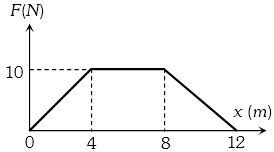
A particle of mass $0.1 \,kg$ is subjected to a force which varies with distance as shown in fig. If it starts its journey from rest at $x = 0$, its velocity at $x = 12\,m$ is .......... $m/s$
A ball whose density is $0.4 × 10^3 kg/m^3$ falls into water from a height of $9 cm$ . To what depth does the ball sink........ $cm$