MCQ
If $|\,\vec A + \vec B\,|\, = \,|\,\vec A\,| + |\,\vec B\,|$, then angle between $\vec A$ and $\vec B$ will be ....... $^o$
  • A
    $90$
  • B
    $120$
  • $0$
  • D
    $60$

Answer

Correct option: C.
$0$
c
(c) Resultant of two vectors $\overrightarrow A $ and $\overrightarrow B $ can be given by

$\overrightarrow R = \overrightarrow A + \overrightarrow B $

$|\overrightarrow R |\, = \,|\overrightarrow A + \overrightarrow B |\, = \sqrt {{A^2} + {B^2} + 2AB\cos \theta } $

If $\theta = 0^\circ $ then $|\overrightarrow R |\, = A + B$$ = \,|\overrightarrow A | + |\overrightarrow B |$

Need a full question paper?

Generate a complete, print-ready paper with questions like this in minutes — across 16+ boards, with answer keys.
Start Generating Free

Similar questions

The position of a particle moving along $x$-axis is given by $x=10 t-2 t^2$. Then the time $(t)$ at which it will momently come to rest is .......... $s$
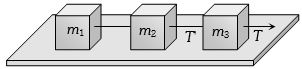
Three blocks of masses ${m_1},\,{m_2}$ and ${m_3}$ are connected by massless strings as shown on a frictionless table. They are pulled with a force ${T_3} = 40\,N$. If ${m_1} = 10\,kg,\,{m_2} = 6\,kg$ and ${m_3} = 4\,kg$, the tension ${T_2}$ will be ........ $N$
Two interfering waves have the same wavelength, frequency, and amplitude. They are traveling in the same direction but are $90^o$ out of phase. Compared to the individual waves, the resultant wave will have the same.
Two soap bubbles $\mathrm{A}$ and $\mathrm{B}$ are kept in a closed chamber where the air is maintained at pressure $8 \mathrm{~N} / \mathrm{m}^2$. The radii of bubbles $\mathrm{A}$ and $\mathrm{B}$ are $2 \mathrm{~cm}$ and $4 \mathrm{~cm}$, respectively. Surface tension of the soap-water used to make bubbles is $0.04 \mathrm{~N} / \mathrm{m}$. Find the ratio $n_{\mathrm{B}} / n_{\mathrm{A}}$, where $n_{\mathrm{A}}$ and $n_{\mathrm{B}}$ are the number of moles of air in bubbles $\mathrm{A}$ and $\mathrm{B}$, respectively. [Neglect the effect of gravity.]
A boy aims a gun at a target from a point, at a horizontal distance of $100m.$ If the gun can impart a horizontal velocity of $500\ ms^{-1}$ to the bullet, the height above the target where he must aim his gun, in order to hit it is $($Take $g = 10\ ms^{-2})$
A body is released from the top of a tower of height $H\, metre$. After $2\, seconds$ it is stopped and then instantaneously released. What will be its height after next $2\, seconds$ ?
The degrees of freedom of a stationary rigid body about its axis will be
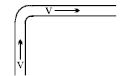
A fire hydrant delivers water of density $\rho $ at a volume rate $L$. The water travels vertically upward through the hydrant and then does $90^o$ turn to emerge horizontally at speed $V$. The pipe and nozzle have uniform cross-section throughout. The force exerted by the water on the corner of the hydrant is
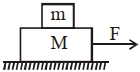
Two blocks $( m =0.5\, kg$ and $M =4.5\, kg$ ) are arranged on a horizontal frictionless table as shown in figure. The coefficient of static friction between the two blocks is $\frac{3}{7} .$ Then the maximum horizontal force that can be applied on the larger block so that the blocks move together is ......... $N.$ (Round off to the Nearest Integer) [Take g as $9.8\, ms ^{-2}$ ]
For circular motion, if ${\vec a_t},\,{\vec a_c},\,\vec r$ and $\vec v$ are tangential acceleration, centripetal acceleration, radius vector and velocitym respectively, then find the wrong relation