Question
Derive a relation for work done in a gravitational field. Using it, (i) find potential difference between a pair of points. (ii) express whether gravitational force is conservative or non-conservative.

Answer

The gravitational force of attraction between M and m when x is the distance between their centres is given by

$\text{F} =\frac{\text{GMm}}{\text{x}^2}$

Suppose the body be moved through a distance dx, therefore, work done is given by,

$\text{dW}=\text{Fdx}=\frac{\text{GMm}}{\text{x}^2}\text{dx}$

When the body is brought from infinity to some distance r,

we write, $\int\text{dW}=\int^\limits{\text{x}=\text{r}}_\limits{\text{x}=\infty}\frac{\text{GMm}}{\text{x}^2}\text{dx}$

$\text{or }\text{W}=\text{GMm}\Big[\frac{-1}{\text{x}}\Big]^{\text{r}}_{\infty}$

$=-\text{GMm}\Big[\frac{1}{\text{r}}-\frac{1}{\infty}\Big]=\frac{-\text{GMm}}{\text{r}}$

This amount of work done is the change in the potential energy of the body.

$=-\text{GMm}\Big[\frac{1}{\text{r}}-\frac{1}{\infty}\Big]=\frac{-\text{GMm}}{\text{r}}$

Gravitational potential

$\text{V}=\frac{\text{U}}{\text{m}}=\frac{-\text{GM}}{\text{r}}$

The general expression for gravitational potential due to the earth (mass M) at

  1. Distance r is, V $=\frac{-\text{GM}}{\text{r}}$

Potential at a point A (ra$=-\frac{\text{GM}}{\text{r}_{\text{a}}}$

Potential at a point B (rb$=-\frac{\text{GM}}{\text{r}_{\text{b}}}$

$\therefore$ Difference in Potential between the points

$=-\text{GM}\Big(\frac{1}{\text{r}_{\text{a}}}-\frac{1}{\text{r}_{\text{b}}}\Big)$

  1. Since work done against gravitational force is (a) independent of path and dependent only on the initial and final points and (b) the work done in a closed path is zero, it is a conservative force.

Need a full question paper?

Generate a complete, print-ready paper with questions like this in minutes — across 16+ boards, with answer keys.
Start Generating Free

Similar questions

A satellite orbits the earth at a height of 400km above the surface. How much energy must be expended to rocket the satellite out of the earth’s gravitational influence? Mass of the satellite = 200kg; mass of the earth = 6.0 × 1024kg; radius of the earth = 6.4 × 10⁶m; G = 6.67 × 10⁻¹¹N m2 kg-2.
Derive an equation for the distance covered by a uniformly accelerated body in nth second of its motion. A body travels half its total path in the last second of its fall from rest. Calculate the time of its fall.
Six point masses of mass m each are at the vertices of a regular hexagon of side l. Calculate the force on any of the masses.
A parallel beam of light of wavelength 100nm passes through a sample of atomic hydrogen gas in ground state. (a) Assume that when a photon supplies some of its energy to a hydrogen atom, the rest of the energy appears as another photon. Neglecting the light emitted by the excited hydrogen atoms in the direction of the incident beam, what wavelengths may be observed in the transmitted beam? (b) A radiation detector is placed near the gas to detect radiation coming perpendicular to the incident beam. Find the wavelengths of radiation that may be detected by the detector.
From a uniform disk of radius R , a circular hole of radius $\frac{R}{2}$ is cut out. The centre of the hole is at $\frac{R}{2}$ from the centre of the original disc. Locate the centre of gravity of the resulting flat body.
Ten small planes are flying at a speed of 150km/h in total darkness in an air space that is 20 × 20 × 1.5km 3 in volume. You are in one of the planes, flying at random within this space with no way of knowing where the other planes are. On the average about how long a time will elapse between near collision with your plane. Assume for this rough computation that a safety region around the plane can be approximated by a sphere of radius 10m.
What are the methods of heat transmission? Describe them and explain their practical applications.
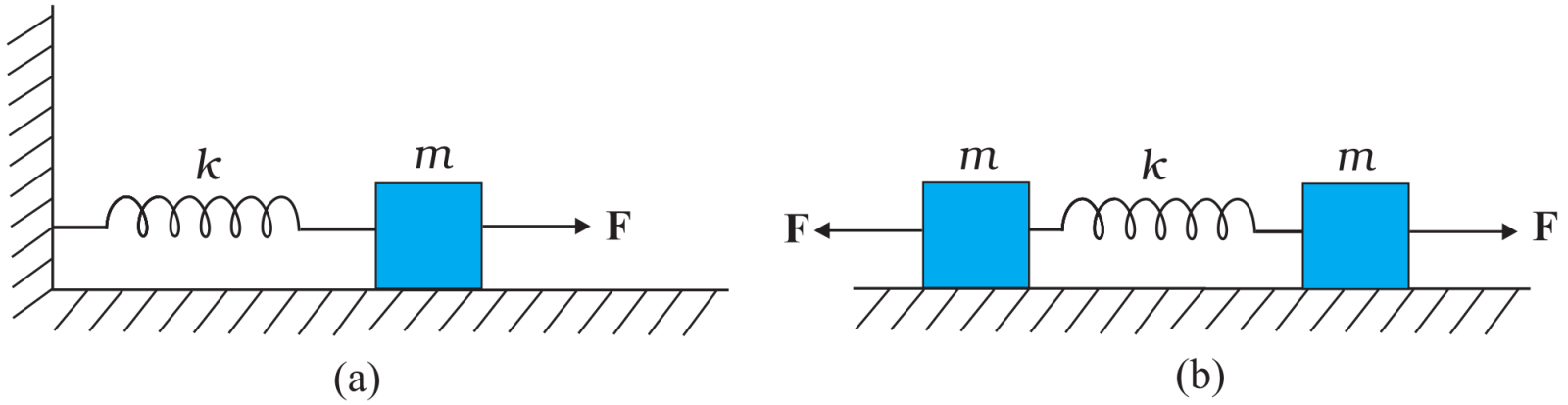
Figure (a) shows a spring of force constant k clamped rigidly at one end and a mass m attached to its free end. A force F applied at the free end stretches the spring. Figure (b) shows the same spring with both ends free and attached to a mass m at either end. Each end of the spring in Fig. (b) is stretched by the same force F.

If the mass in Fig. (a) and the two masses in Fig. (b) are released, what is the period of oscillation in each case?

A load of 31.4kg is suspended from a wire of radius 10-3m and density 9 × 10³kg/ m3. Calculate the change in temperature of the wire if 75% of the work done is converted into heat. The Young's modulus and the specific heat capacity of the material of the wire are 9.8 × 10¹⁰N/ m2 and 490J/ kg/ k respectively.
A large steel wheel is to be fitted on to a shaft of the same material. At 27°C, the outer diameter of the shaft is 8.70cm and the diameter of the central hole in the wheel is 8.69cm. The shaft is cooled using ‘dry ice’. At what temperature of the shaft does the wheel slip on the shaft? Assume coefficient of linear expansion of the steel to be constant over the required temperature range: asteel = 1.20 × 10⁻⁵ K–1.