Question
Derive an expression for capillary rise for a liquid having a concave meniscus.

Answer

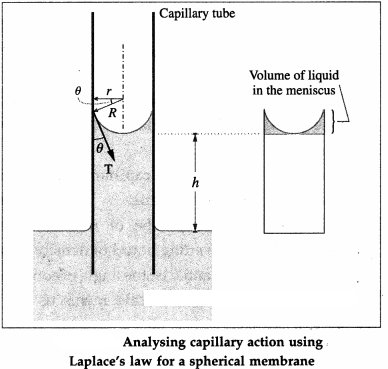
Consider a capillary tube of radius r partially immersed into a wetting liquid of density p. Let the capillary rise be h and θ be the angle of contact at the edge of contact of the concave meniscus and glass. If R is the radius of curvature of the meniscus then from the figure, $r = R \cos \theta .$​​​​​​​

Image
Surface tension T is the tangential force per unit length acting along the contact line. It is directed into the liquid making an angle θ with the capillary wall. We ignore the small volume of the liquid in the meniscus. The gauge pressure within the liquid at a depth h, i.e., at the level of the free liquid surface open to the atmosphere, is
$\rho – \rho _o = \rho gh …. (1)$
By Laplace’s law for a spherical membrane, this gauge pressure is
$\rho-\rho_{\circ}=\frac{2 T}{R} \ldots . .(2)$
$\therefore h \rho g =\frac{2 T}{R}=\frac{2 T \cos \theta}{r}$
$\therefore h =\frac{2 T \cos \theta}{r \rho g} \ldots . .(3)$
Thus, narrower the capillary tube, the greater is the capillary rise.
From Eq. (3),
$T =\frac{h \rho r g}{2 T \cos \theta} \ldots$ (4)
Equations (3) and (4) are also valid for capillary depression h of a non-wetting liquid. In this case, the meniscus is convex and θ is obtuse. Then, cos θ is negative but so is h, indicating a fall or depression of the liquid in the capillary. T is positive in both cases.
[Note : The capillary rise h is called Jurin height, after James Jurin who studied the effect in 1718. For capillary rise, Eq. (3) is also called the ascent formula.]

Need a full question paper?

Generate a complete, print-ready paper with questions like this in minutes — across 16+ boards, with answer keys.
Start Generating Free

Similar questions

Potential energy of a particle performing linear S.H.M is $0.1 \pi ^2 x^2$ joule. If mass of the particle is $20\ g$, find the frequency of S.H.M.
When a resistance of $12 \Omega$ is connected across a cell, its terminal potential difference is balanced by $120 cm$ of a potentiometer wire. When a resistance of $18 \Omega$ is connected across the same cell, the balancing length is $150 cm$. Find the balancing length when the cell is in open circuit. Also calculate the internal resistance of the cell.
Obtain an expression for the acceleration of a particle performing circular motion. Explain its two components.
OR
For a particle performing uniform circular motion, $\vec{v}=\vec{\omega} \times \vec{r}$. Obtain an expression for the linear acceleration of a particle performing non-uniform circular motion.
OR
In circular motion, assuming $\vec{v}=\vec{\omega} \times \vec{r}$, obtain an expression for the resultant acceleration of a particle in terms of tangential and radial components.
State any two applications of Pascal's law.
Briefly explain their working.
A sound wave in a certain fluid medium is reflected at an obstacle to form a standing wave. The distance between two successive nodes is $3.75\ cm.$ If the velocity of sound is $1500\ m/s,$ find the frequency.
Draw the circuit diagram to study the characteristic of the transistor in common emitter mode. Draw the input and output characteristics.
A cycle wheel with $10$ spokes, each of length $0.5 m$, is moved at a speed of $18 \ km / h$ in a plane normal to the Earth's magnetic induction of $3.6 \times 10^{-5} T$. Calculate the emf induced between
$(i)$ the axle and the rim of the cycle wheel
$(ii)$ ends of a single spoke and ten spokes.
State first law of thermodynamics.
Explain the electrical behaviour of conductors and insulators on the basis of free and bound charges inside the materials.
A $dc$ ammeter and an $ac$ hot $-$ wire ammeter are connected to a circuit in series. When a direct current is passed through the circuit, the $dc$ ammeter shows $6 A$. When a pure alternating current is passed, the $ac$ ammeter shows $8 A$. What will be the reading of each ammeter if the direct and alternating currents pass simultaneously through the circuit?