Motion in a Plane — Physics STD 11 Science — Question
Maharashtra BoardEnglish MediumSTD 11 SciencePhysicsMotion in a Plane4 Marks
Question
Derive an expression for centripetal acceleration of a particle performing uniform circular motion.
✓
Answer
Expression for centripetal acceleration by calculus method:
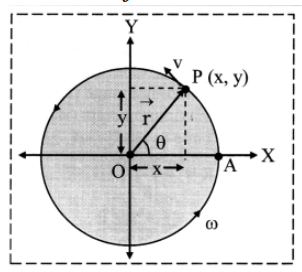
$i)$ Suppose a particle is performing $\text{U.C.M}$ in anticlockwise direction.
The co$-$ordinate axes are chosen as shown in the figure.
Let,
$A =$ initial position of the particle which lies on positive $X-$axis
$P =$ instantaneous position after time $t$
$\theta=$ angle made by radius vector
$\omega=$ constant angular speed
$\vec{r}=$ instantaneous position vector at time $t$
$ii)$ From the figure,
$\vec{r}=\hat{i} x+\hat{j} y$
where, $\hat{i}$ and $\hat{j}$ are unit vectors along $X-$axis and $Y-$axis respectively.
$iii)$ Also, $x=r \cos \theta$ and $y=r \sin \theta$
$\therefore \vec{r}=[r \hat{i} \cos \theta+r \hat{j} \sin \theta]$
But $\theta=\omega t$
$\therefore \vec{r}=[r \hat{i} \cos \omega t+r \hat{j} \sin \omega t]\ \ \ ......(1)$
$iv)$ Velocity of the particle is given as rate of change of position vector.
$ \therefore \vec{v}=\frac{\overrightarrow{d r}}{d t} =\frac{d}{d t}[r \hat{i} \cos \omega t+r \hat{j} \sin \omega t]$
$ =r\left[\frac{d}{d t} \cos \omega t\right] \hat{i}+r\left[\frac{d}{d t} \sin \omega t\right] \hat{j}$
$\therefore \vec{v}=-r \omega \hat{i} \sin \omega t+r \omega \hat{j} \cos \omega t$
$\therefore \vec{v}=r \omega(-\hat{i} \sin \omega t+\hat{j} \cos \omega t)$
$v.$ Further, instantaneous linear acceleration of the particle at instant $t$ is given by,
$\vec{a}=\frac{\overrightarrow{d v}}{d t}=\frac{d}{d t}[r \omega(-\hat{i} \sin \omega t+\hat{j} \cos \omega t)]$
$=r \omega\left[\frac{d}{d t}(-\hat{i} \sin \omega t+\hat{j} \cos \omega t)\right]$
$=r \omega\left[\frac{d}{d t}(-\sin \omega t) \hat{i}+\frac{d}{d t}(\cos \omega t) \hat{j}\right]$
$=r \omega(-\omega \hat{ i } \cos \omega t-\omega \hat{j} \sin \omega t)$
$=-r \omega^2(\hat{ i } \cos \omega t+\hat{j} \sin \omega t)$
$\therefore \vec{a}=-\omega^2(r \hat{i} \cos \omega t+r \hat{j} \sin \omega t)\ \ \ \ ....(2)$
$vi)$ From equation $(1)$ and $(2),$
$\vec{a}=-\omega^2 \vec{r}\ \ \ \ \ ....(3)$
Negative sign shows that direction of acceleration is opposite to the direction of position vector.
Equation $(3)$ is the centripetal acceleration.
$vii)$ Magnitude of centripetal acceleration is given by,
$a=\omega^2 r$
$viii)$ The force providing this acceleration should also be along the same direction,
hence centripetal.
$\therefore \overrightarrow{ F }= m \overrightarrow{ a }=- m \omega^2 \overrightarrow{ r }$
This is the expression for the centripetal force on a particle undergoing uniform circular motion.
$ix)$ Magnitude of $F=m \omega^2 r=\frac{ mv ^2}{r}=m \omega v$
Need a full question paper?
Generate a complete, print-ready paper with questions like this in minutes — across 16+ boards, with answer keys.