Question
Derive an expression for decrease in potential energy when a charge flows through an external resistance in a circuit.

Answer

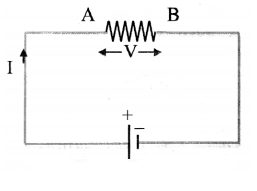
i. Consider a resistor AB connected to a cell in a circuit with current flowing from A to B.
Image
ii. The cell maintains a potential difference V between the two terminals of the resistor, higher potential at $A$ and lower at $B$.
iii. Let Q be the charge flowing in time $\Delta t$ through the resistor from A to B .
iv. The potential difference $V$ between the two points $A$ and $B$, is equal to the amount of work (W) done to carry a unit positive charge from $A$ to $B$.
$\therefore V =\frac{W}{Q}$
v. The cell provides this energy through the charge $Q$, to the resistor $A B$ where the work is performed.
vi. When the charge $Q$ flows from the higher potential point $A$ to the lower potential point $B$, there is decrease in its potential energy by an amount
$\Delta U = QV = I \Delta tV$
where $I$ is current due to the charge $Q$ flowing in time $\Delta t$.

Need a full question paper?

Generate a complete, print-ready paper with questions like this in minutes — across 16+ boards, with answer keys.
Start Generating Free

Similar questions

Two bodies undergo one$-$dimensional, inelastic, head$-$on collision. Obtain an expression for the magnitude of impulse.
Obtain derivatives of the following functions:
$(i) x \sin x$
$(ii) x^4 + \cos x$
$(iii) x/\sin x$
What is Young’s modulus? Describe an experiment to find out Young’s modulus of material in the form of a long straight wire.
What are some commonly known facts about magnetism?
A metal sphere cools at the rate of $0.05^{\circ} C / s$ when its temperature is $70^{\circ} C$ and at the rate of $0.025^{\circ} C / s$ when its temperature is $50^{\circ} C$. Determine the temperature of the surroundings and find the rate of cooling when the temperature of the metal sphere is $40^{\circ} C$.
State Newton’s formula for velocity of sound.
Explain, how two vectors are subtracted. Find their resultant by using triangle law of vector addition.
A hose pipe used for gardening is ejecting water horizontally at the rate of 0.5 m/s. Area of the bore of the pipe is 10 cm2. Calculate the force to be applied by the gardener to hold the pipe horizontally stationary.
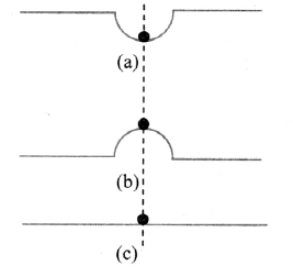
The figure below shows three situations of a ball at rest under the action of balanced forces. Is the bail in mechanical equilibrium? Explain how the three situations differ.
Image
Mass of an Oxygen molecule is $5.35 \times 10^{-26} \ kg$ and that of a Nitrogen molecule is $4.65 \times 10^{-26} \ kg.$ During their Brownian motion $($random motion$)$ in air, an Oxygen molecule travelling with a velocity of 400 m/s collides elastically with a nitrogen molecule travelling with a velocity of $500 \ m/s$ in the exactly opposite direction. Calculate the impulse received by each of them during collision. Assuming that the collision lasts for
$1 \ ms,$ how much is the average force experienced by each molecule?