Question
Derive an expression for the difference in tensions at the highest and lowest point for a particle performing the vertical circular motion.
Answer

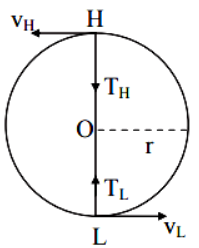
i. Suppose a body of mass 'm' performs V.C.M on a circle of radius $r$ as shown in the figure.
Image
ii. Let,
$T _{ L }=$ tension at the lowest point
$T _{ H }=$ tension at the highest point
$V_L=$ velocity at the lowest point
$v_H=$ velocity at the highest point
iii. At lowest point $L$,
$T _{ L }=\frac{ mv _{ L }^2}{ r }+ mg$
At highest point $H _{\text {, }}$
$T _{ H }=\frac{ mv _{ H }^2}{ r }- mg$
iv. Subtracting (1) by (2),
$ T _{ L }- T _{ H }=\frac{ mv _{ L }^2}{ r }+ mg -\left(\frac{ mv _{ H }^2}{ r }- mg \right)$
$=\frac{ m }{ r }\left( v _{ L }^2- v _{ H }^2\right)+2 mg$
$\therefore T _{ L }- T _{ H }=\frac{ m }{ r }\left( v _{ L }^2- v _{ H }^2\right)+2 mg \ldots \ldots \ldots . .(3) $
$v$. By law of conservation of energy,
$ ( P . E + K . E ) \text { at } L =( P . E + K . E ) \text { at } H$
$\therefore 0+\frac{1}{2} mv _{ L }^2= mg \cdot 2 r +\frac{1}{2} mv _{ H }^2$
$\therefore \frac{1}{2} m \left( v _{ L }^2- v _{ H }^2\right)= mg \cdot 2 r$
$\therefore v _{ L }^2- v _{ H }^2=4 gr \ldots \ldots . .(4) $
vi. From equation (3) and (4),
$ T _{ L }- T _H=\frac{ m }{ r }(4 gr )+2 mg =4 mg +2 mg$
$\therefore T _{ L }- T _{ H }=6 mg $

Need a full question paper?

Generate a complete, print-ready paper with questions like this in minutes — across 16+ boards, with answer keys.

Start Generating Free

Similar questions

In an adiabatic expansion of a gas, the final volume of the gas is double the initial volume. If the initial pressure of the gas is $105 Pa$, find the final pressure of the gas. $(\gamma=5 / 3)$
Obtain an expression for the orbital magnetic moment of an electron rotating about the nucleus in an atom.
Explain the working of the PNP transistor?
Four moles of a gas expand isothermally at $300 K$. If the final pressure of the gas is $80 \%$ of the initial pressure, find the work done by the gas on its surroundings. ( $R=8.314 J / mol . K )$
Determine the change in wavelength of light during its passage from air to glass. If the refractive index of glass with respect to air is 1.5 and the frequency of light is \(3.5 \times 10^{14} Hz\), find the wave number of light in glass. [Velocity of light in air, \(c=3 \times 10^8 m / s\) ]
Show that the average energy of the molecules of a gas is directly proportional to the absolute temperature of the gas.
In Young's double$-$slit experiment, the two slits separated by $4\ mm$ are illuminated by light of wavelength $6400 A$. Interference fringes are obtained on a screen placed at a distance of $60\ cm$ from the slits. Find the change in the fringe width if the separation between the slits is $(i)$ increased by $1\ mm\ (ii)$ decreased by $1\ mm$.
The kinetic energy per unit mass of a certain gas at $300 \mathrm{~K}$ is $1.3 \times 10^5 \mathrm{~J} / \mathrm{kg}$. What will be the kinetic energy per unit mass of the gas at $600 \mathrm{~K}$ ?
When $2 \times 10^{10}$ electrons are transferred from one conductor to another, a potential difference of 20 V appears between the conductors. Find the capacitance of the two conductors.
The mean free path of a gas molecule is $60 \mathrm{~nm}$ when the density of the gas is $1.2 \mathrm{~kg} / \mathrm{m}^3$. What will be the mean free path if the density is reduced to $0.8 \mathrm{~kg} / \mathrm{m}^3$ ?