Question
Explain the working of the PNP transistor?

Answer

Working of p-n-p transistor:
  1. The majority of charge carriers in the emitter of the p-n-p transistor are holes.
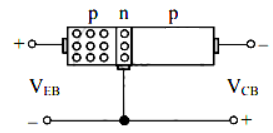
  2. A typical biasing of a transistor is shown in figure (a). In this, the emitter-base junction is forward biased while the collector-base junction is reverse biased.
    Image
    Figure (a)
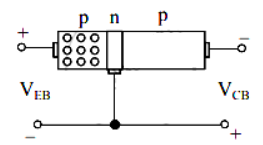
  3. At the instant when the EB junction is forward biased, holes in the emitter region have not entered the base region as shown in figure (b).
    Image
    Figure (b)
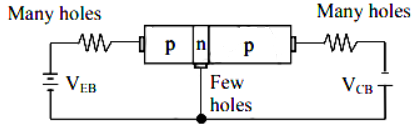
  4. When the biasing voltage $V_{BE}$​​​​​​​ is greater than the barrier potential $(0.6 – 0.7 V$ for Si transistors), many holes enter the base region and form the emitter current $I_E​​​​​​​$​​​​​​​ as shown in figure (c).
    Image
    Figure (c)
v. These holes can either flow through the base circuit and constitute the base current $\left( I _{ B }\right)$, or they can also flow through the collector circuit and contribute towards the collector current ( $I _{ C }$ ).
vi. The base is thin and lightly doped, the base current is only $5 \%$ of $I _{ E }$.
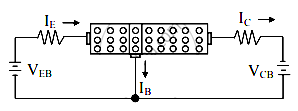
vii. Holes injected from the emitter into the base diffuse into the collector-base depletion region due to the thin base region. When the holes enter the collector-base depletion region, they are pushed into the collector region by the electric field at the collector-base depletion region. The collector current ( $l _{ C }$ ) flows through the external circuit as shown in figure (d). The collector's current $I _{ C }$ is about $95 \%$ of $I _{ E }$.​​​​​​​​​​​​​​

Figure (d)
From the figure, we can conclude that $I_E = I_B + I_C​​​​​​​$ Since the base current IB is very small we can write $I_C ≈ I_E.$

Need a full question paper?

Generate a complete, print-ready paper with questions like this in minutes — across 16+ boards, with answer keys.
Start Generating Free

Similar questions

Derive an expression for kinetic energy of a rotating body.
The maximum velocity of a particle performing linear SHM is $0.16 m / s$. If its maximum acceleration is $0.64 m / s ^2$, calculate its period.
What is the advantage of a radial magnetic field in a moving-coil galvanometer and how is it produced?
You can charge a glass or rubber rod by holding one end of the rod and rubbing the other end with a silk cloth. But you cannot charge a copper rod in the same way. Explain.
Explain Biot Savart's Law.
Calculate the kinetic energy
(i) per mole
(ii) per unit mass
(iii) per molecule of nitrogen at STP. [Molar mass of nitrogen $=28 \times 10^{-3} \mathrm{~kg} / \mathrm{mol}, \mathrm{R}=8.314$
$
\left.\mathrm{J} / \mathrm{mol} . \mathrm{K}, \mathrm{K}_{\mathrm{B}}=1.38 \times 10^{-23} \mathrm{~J} / \mathrm{K}\right]
$
A tuning fork C produces 6 beats/second- with another tuning fork D of frequency $320 Hz$. When a little wax is put on the prongs of $D$, the number of beats reduces to 4 per second. Find the frequency of $C$.
An emf of \(91 mV\) is induced in the windings of a coil, when the current in a nearby coil is increasing at the rate of \(1.3 A / s\), what is the mutual inductance \(( M )\) of the two coils in \(mH\) ?
A long cylindrical conductor of radius $2 cm$ carries a charge of $5 \mu C / m$ and is kept in a
medium of dielectric constant 10. Find the electric field intensity at a point $1 m$ from the axis of the cylinder.
$\left[\frac{1}{4 \pi+10}=9 \times 10^9 \frac{ N - m ^2}{ C ^2}\right]$
A proton and an $\alpha$-particle are accelerated from rest through the same potential difference. Compare their final speeds. Charge on an $\alpha$-particle $=2 \times$ charge on a proton, mass of an $\alpha$ particle $=4 \times$ mass of a proton.