Question
Derive an expression for the net torque on a rectangular current carrying loop placed in a uniform magnetic field with its rotational axis perpendicular to the field.
Answer

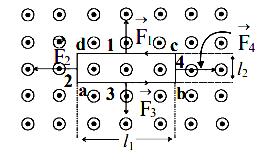
i. Consider rectangular loop abcd placed in a uniform magnetic field $\overrightarrow{ B }$ such that the sides ab and $c d$ are perpendicular to the magnetic field $\overrightarrow{ B }$ but the sides bc and da are not, as shown in figure (a) below:

Fig (a): Loop abcd placed in a uniform
ii. The force $\overrightarrow{ F }_4$ on side 4 (bc) will be $\overrightarrow{ F }_4= II _2 B \sin \left(90^{\circ}\right.$ $\theta)$
iii. The force $\overrightarrow{ F }_2$ on side 2 (da) will be equal and opposite to $\overrightarrow{ F }_4$ and both act along the same line. Thus, $\overrightarrow{ F }_2$ and $\overrightarrow{ F }_4$ will cancel out each other.
iv. The magnitudes of forces $\overrightarrow{ F }_1$ and $\overrightarrow{ F }_3$ on sides 1 (cd) and $3( ab )$ will be $\|_1 B \sin 90^{\circ}$ i.e., $\|_1 B$. These two forces do not act along the same line and hence they produce a net torque.
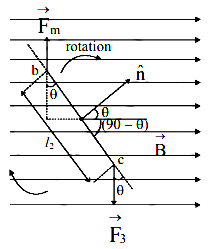
v. This torque results into rotation of the loop so that the loop is perpendicular to the direction of $\vec{B}$, the magnetic field.

Fig (b): Side view of the loop abcd at an angle $\theta$ vi. Now the moment arm is $\frac{1}{2}\left(l_2 \sin \theta\right)$ about the central axis of the loop. Hence, the torque $\tau$ due to forces $\overrightarrow{ F }_1$ and $\overrightarrow{ F }_3$ will be
$ \tau=\left( Il _1 B \frac{1}{2} l _2 \sin \theta\right)+\left( Il _1 B \frac{1}{2} l _2 \sin \theta\right)$
$= I l_1 l _2 B \sin \theta $
vii. If the current-carrying loop is made up of multiple turns $N$, in the form of a flat coil, the total torque will be
$\tau^{\prime}= N \tau= NIl _1 l _2 B \sin \theta$
$\tau^{\prime}=(N I A) B \sin \theta$; where $A$ is the are enclosed by the coil $=I_1 I_2$
This is the required expression.

Need a full question paper?

Generate a complete, print-ready paper with questions like this in minutes — across 16+ boards, with answer keys.

Start Generating Free

Similar questions

In an adiabatic compression of a gas with $\gamma=1.4$, the final pressure is double the initial pressure. If the initial temperature of the gas is $300 K$, find the final temperature.
On the basis of molecular theory explain the phenomenon of surface tension
Calculate the mean free path of a gas molecule with diameter $4 \mathring A$ if the pressure of the gas is $1.013 \times 10^5 \mathrm{~N} / \mathrm{m}^2$ and the temperature is $27^{\circ} \mathrm{C}$. (The Boltzmann constant, $\mathrm{k}_{\mathrm{B}}=1.38 \times 10^{-23}$ $\mathrm{J} / \mathrm{K})$
A body of surface area $100 \mathrm{~cm}^2$ radiates energy $3000 \mathrm{~J}$ in 10 minutes at a certain constant temperature. The radiant power of a perfect blackbody maintained at the same temperature is $2500 \mathrm{~W} / \mathrm{m}^2$. Find the the radiant power and emissivity of the body.
Using Ampere's Law, derive an expression for the magnetic induction inside an ideal solenoid carrying a steady current.
The displacement of a particle of a medium when sound wave propagates is represented by $y=A \cos (a x+b t)$ where $A, a$ and $b$ are positive constants. The wave is reflected by an obstacle situated at $x=0$.
1. What is the wavelength and frequency of the incident wave?
2. Write the equation of the reflected wave.
State the expression for the energy stored in'the magnetic field of an inductor. Hence, define its self inductance.
State an expression for the moment of inertia of a solid sphere about its diameter. Write the expression for the corresponding radius of gyration.
The energy of a photon is 2 eV. Find its frequency and wavelength.
A long solenoid has 1500 turns $/ m$. A coil C having cross sectional area 25 cm 2 and 150 turns $\left( N _{ C }\right)$ is wound tightly around the centre of the solenoid. If a current of 3.0A flows through the solenoid, calculate :
(a) the magnetic flux density at the centre of the solenoid,
(b) the flux linkage in the coil C ,
(c) the average emf induced in coil C if the direction of the current in the solenoid is reversed in a time of 0.5 s . ( $\mu_0=$ $\left.4 \pi \times 10^{-7} H / m \right)$