Question
Derive integrated rate equation for first order reaction containing gaseous components.

Answer

$\rightarrow$ Let us consider a typical first order gas phase reaction.
$\rightarrow \ce{A(g) \rightarrow B(g) + C(g)}$
$\rightarrow$ Let $p_i$ be the initial pressure of $A$ and $p_t$ the total pressure at time $' t\ '$. Integrated rate equation for such a reaction can be derived as
$\rightarrow$ Total pressure $p _{ t }= p _{ A }+ p _{ B }+ p _{ C } ($pressure units$)$
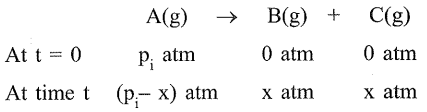
$\rightarrow p _{ A }, p _{ B }$ and $p _{ C }$ are partial pressures of $A , B$ and $C$ respectively. If $x$ atm can be the decrease in pressure of $A$ at time $t$ and one mole each of $B$ and $C$ is being formed. The increase in pressure of $B$ and $C$ will also be $X$ atm each
Image
where, $p_i$ is the initial pressure at time $t=0$
$p _{ t }=\left( p _{ i }- x \right)+ x + x = p _{ i }+ x$
$x =\left( p _{ t }- p _{ i }\right)$
where, $p_A=p_i-x=p_i-\left(p_t-p_i\right)=2 p_i-p_t$
$k =\left(\frac{2.303}{ t }\right)\left(\log \frac{ p _{ i }}{ p _{ A }}\right)$
$ =\frac{2.303}{ t } \log \frac{ p _{ i }}{2 p _{ i }- p _{ t }}$

Need a full question paper?

Generate a complete, print-ready paper with questions like this in minutes — across 16+ boards, with answer keys.
Start Generating Free

Similar questions

What is activation energy? Explain with the help of graph by suitable example
Give reasons :
(i) Carbon-oxygen bond length in phenol is slightly less than that of methanol.
(ii) The $C - O - C$ bond angle present in ether is greater than the tetrahedral angle.
(iii) The boiling point of isomeric alcohols decreases with increase in branching.
  1. Explain the following giving suitable examples:
  1. Sandmeyer’s reaction.
  2. Coupling reaction of a diazonium salt.
  1. Explain the observed $K_b$ order:
$\ce{Et_2NH > Et_3N > EtNH_2}$ in aqueous solution.
How can diethyl ether be prepared from
i. ethyl iodide
ii. ethyl alcohol?
Why is the boiling point of an ether lower than that of the isomeric alcohols.

Complete the following giving the structures:
Square complexes of $MX_2A_2$ type with coordination number of $4$ exhibit geometrical isomerism whereas tetrahedral complexes with similar composition do not. Why?
An antifreeze solution is prepared from $222.\  6g$ of ethylene glycol $\ce{(C_2H_4(OH)_2)}$ and $200g$ of water. Calculate the molality of the solution. If the density of this solution be $1.072\ g\  mL^{-1},$ what will be the molarity of the solution?
If 200 mol of $H _2$ (at NTP) and 0.60 g of Cu are obtained by passing electric current in the solution of acidified water and $CuSO _4$ respectively in two electrolytic cell connected in series, then what will be the equivalent weight of Cu ?
Thermodynamic feasibility of the reaction alone cannot decide the rate of the reaction. Explain with the help of one example.
Give the structures of $A$ and $B$ in the following sequence of reactions:
  1. $\text{CH}_3\text{COOH}\xrightarrow[\Delta]{\text{NH}_3\ \ \ }\text{A}\ \ \ \xrightarrow{\text{NaOBr}}\text{B}$
  2. $\text{C}_6\text{H}_5\text{No}_2\xrightarrow{\text{Fe}/ \text{ HCl}}\text{A}\ \ \ \ \ \xrightarrow[0^\circ-5^\circ\text{C}]{\text{NaNo}_2+\text{HCl}}\text{B}$
  3. $\text{C}_6\text{H}_5\text{N}_2^+\text{Cl}^{-}\xrightarrow[\Delta]{\text{CuCN}}\text{A}\ \ \ \ \xrightarrow{\text{H}_2\text{O}/\text{ H}^+}\text{B}$