Question
Derive integrated rate equation for first order reaction containing gaseous components.
Answer

→ Let us consider a typical first order gas phase reaction.
→ A(g) → B(g) + C(g)
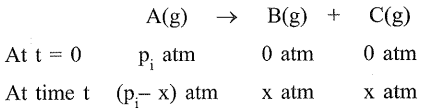
→ Let $p_i$ be the initial pressure of $A$ and $p_t$ the total pressure at time ' $t$ '. Integrated rate equation for such a reaction can be derived as
→ Total pressure $p _{ t }= p _{ A }+ p _{ B }+ p _{ C }$ (pressure units)
→ $p _{ A }, p _{ B }$ and $p _{ C }$ are partial pressures of $A , B$ and $C$ respectively. If $x$ atm can be the decrease in pressure of $A$ at time $t$ and one mole each of $B$ and C is being formed. The increase in pressure of B and C will also be X atm each
Image
where, $p_i$ is the initial pressure at time $t=0$
$
\begin{array}{l}
p _{ t }=\left( p _{ i }- x \right)+ x + x = p _{ i }+ x \\
x =\left( p _{ t }- p _{ i }\right)
\end{array}
$
where, $p_A=p_i-x=p_i-\left(p_t-p_i\right)=2 p_i-p_t$
$
\begin{aligned}
k & =\left(\frac{2.303}{ t }\right)\left(\log \frac{ p _{ i }}{ p _{ A }}\right) \\
& =\frac{2.303}{ t } \log \frac{ p _{ i }}{2 p _{ i }- p _{ t }}
\end{aligned}
$

Need a full question paper?

Generate a complete, print-ready paper with questions like this in minutes — across 16+ boards, with answer keys.

Start Generating Free

Similar questions

  1. Draw the pyranose structure of glucose.
  2. What type of linkage is present in proteins?
  3. Give one example each for water-soluble vitamins and fat-soluble vitamins.
The following data were obtained during the first order thermal decomposition of SO2Cl2 at a constant volume:
SO2Cl2(g) $\rightarrow$SO2(g) + Cl2(g)
Experiment
Time/s–1
Total pressure/atm
1
0
0.4
2
100
0.7
Calculate the rate constant.
(Given: log4 = 0.6021, log2 = 0.3010).
Give information about C-O-H bond angle in alcohol, phenol and ether with suitable example.
  1. For the complex [Fe(H2O)6]3+, write the hybridization, magnetic character and spin of the complex. (At. number: Fe = 26)
  2. Draw one of the geometrical isomers of the complex [Pt(en)2Cl2]2+ which is optically inactive.
Write the reactions involved when D-glucose is treated with the following reagents:
  1. Br2 water
  2. H2N-OH
  3. (CH3CO)2O
Complete the following giving the structures of major organic products.
$(\text{CH}_3)_3-\text{C}-\text{Br}\xrightarrow{\text{Mg}}\ .......\ \xrightarrow{\text{H}_2\text{O}}\ ......$
Although +3 oxidation states is the characteristic oxidation state of lanthanoids but cerium shows +4 oxidation state also. Why?
  1. Describe the following giving suitable examples:
  1. Cannizzaro reaction.
  2. Aldol condensation.
  1. ​​​​​​​Give a chemical test to distinguish between ethanal and propanal.
  1. Explain the following giving suitable examples:
  1. Sandmeyer’s reaction.
  2. Coupling reaction of a diazonium salt.
  1. Explain the observed Kb order:

Et2NH>Et3N>EtNH2 in aqueous solution.

Benzene and toluene form ideal solution over the entire range of composition. The vapour pressure of pure benzene and naphthalene at 300 K are 50.71 mm Hg and 32.06 mm Hg respectively. Calculate the mole fraction of benzene in vapour phase if 80 g of benzene is mixed with 100 g of naphthalene.