Question
Derive the equation for the torque acting on a current carrying loop placed at an angle $\theta$ with uniform magnetic field $(\vec{B})$.
Answer

Image
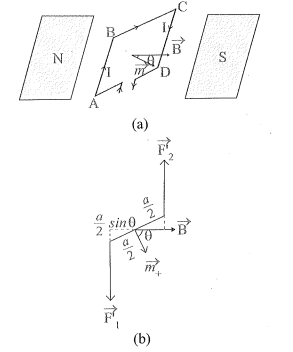
→As shown in the figure (a), the coil is placed in such a way that the magnetic field marks an angle $\theta$ with normal to the coil.
→The current passing through the coil is I. The length and width of the coil are $a$ and $b$ respectively.
→The force on the arm BC of the coil due to the current is $F _1= I a B \cos \theta$ and the force on the $\operatorname{arm} AD$ is $F _2= I a B \cos \theta$.
→Since, both these forces are equal, opposite and act along the axis of the coil, the resultant force and torque is zero.
→Similarly, the force acting perpendicular to the side AB and CD of the coil is $F _1{ }^{\prime}= F _2{ }^{\prime}= I b B$ respectively.
→Since, these two forces are equal in magnitude and opposite to each other the net force is zero. But they are non collinear, they form a couple, so a torque is exerted on the coil.
→From the figure (b) the torque acting on the coil.
$\begin{aligned}
\tau & =\left( F _1{ }^{\prime}\right) \frac{a}{2} \sin \theta+\left( F _2{ }^{\prime}\right)\left(\frac{a}{2}\right) \sin \theta \\
\therefore \tau & = I b B\left(\frac{a}{2}\right) \sin \theta+ I b B\left(\frac{a}{2}\right) \sin \theta \\
\therefore \quad \tau & =2 I b B \frac{a}{2} \sin \theta \\
\therefore \tau & = IB (a b) \sin \theta
\end{aligned}$
But $a b= A$ is the area of the rectangle.
$\therefore \tau= IAB \sin \theta$
→Vector form, $\vec{\tau}=I \vec{A} \times \vec{B}$
→But the magnetic dipole moment $\vec{m}= I \overrightarrow{ A }$
→The direction of the magnetic dipole moment is in the direction of area vector.
→Thus, torque acting on the coil $\vec{\tau}=\vec{m} \times \overrightarrow{ B } \ldots$
→If there are N turns in the coil then the torque is $\tau= NIAB \sin \theta$
Where, NIA $=m$ (magnetic moment)

Need a full question paper?

Generate a complete, print-ready paper with questions like this in minutes — across 16+ boards, with answer keys.

Start Generating Free

Similar questions

A charge of $3.14 \times 10^{-6}C$ is distributed uniformly over a circular ring of radius $20.0\ cm.$ The ring rotates about its axis with an angular velocity of $60.0 rad/s.$ Find the ratio of the electric field to the magnetic field at a point on the axis at a distance of $5.00\ cm$ from the centre.
Three identical capacitors $C_1, C_2$ and $C_3$ of capacitance $6 \mu F$ each are connected to a $12 V$ battery as shown.
Find:
  1. charge on each capacitor.
  2. equivalent capacitance of the network.
  3. energy stored in the network of capacitors.
Find the ratio of the linear momenta of two particles of masses $1.0\ kg$ and $4.0\ kg$ if their kinetic energies are equal.
A toroid has a core $($non$-$ferromagnetic$)$ of inner radius $25 \ cm$ and outer radius $26 \ cm,$ around which $3500$ turns of a wire are wound. If the current in the wire is $11 A,$ what is the magnetic field,
  1. Outside the toroid,
  2. Inside the core of the toroid and,
  3. In the empty space surrounded by the toroid.
In a Coolidge tube, electrons strike the target and stop inside it. Does the target get more and more negatively charged as time passes?
Draw the circuit diagram of a full wave rectifier and explain its working. Also, give the input and output waveforms.
A diver having a moment of inertia of $6.0\ kg-m^2$ about an axis through its centre of mass rotates at an angular speed of $2\ rad/s$ about this axis. If he folds his hands and feet to decrease the moment of inertia to $5.0\ kg-m^2,$ what will be the new angular speed?
A long, straight wire carrying a current of $1.0A$ is placed horizontally in a uniform magnetic field $B = 1.0 \times 10^{-5}T$ pointing vertically upward figure. Find the magnitude of the resultant magnetic field at the points $P$ and $Q,$ both situated at a distance of $2.0\ cm$ from the wire in the same horizontal plane.
In a p-n junction, a potential barrier of 250meV exists across the junction. A hole with a kinetic energy of 300meV approaches the junction. Find the kinetic energy of the hole when it crosses the junction if the hole approached the junction.
  1. From the p-side.
  2. From the n-side.
Two charged conducting spheres of radii $a$ and $b$ are connected to each other by a wire. What is the ratio of electric fields at the surfaces of the two spheres? Use the result obtained to explain why charge density on the sharp and pointed ends of a conductor is higher than on its flatter portions.