Question
Derive the equation (formula) showing the relationship between electric field and electric potential.

Answer


Image
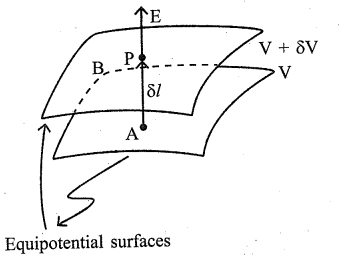
As shown in the fig., two equipotential surfaces A and B are very close to each other. Magnitudes of electric potentials on them are V and $V +\delta V$ respectively.
→Here, $\delta V$ is change in electric potential in the direction of electric field $\vec{E}$.
→Point $P$ is present on surface B. And the perpendicular distance from surface A to point P is $\delta l$.
→The amount of work done in taking a unit positive charge on the perpendicular line from surface B to surface A is equal to $|\vec{E}| \delta l$. This work is equal to the electric potential difference between surfaces $A$ and $B$, which is $V_A-V_B$.
$\begin{array}{l}
\therefore|\overrightarrow{ E }| \delta l=\Delta V = V _{ A }- V _{ B } \\
\therefore|\overrightarrow{ E }| \cdot \delta l= V -( V +\delta V ) \\
=-\delta V \\
\therefore \quad|\vec{E}|=-\frac{\delta V }{\delta l} \\
\end{array}$
→Here, $\delta V$ is negative, so taking $-\delta V$ in place of $\delta V$,
$|\overrightarrow{ E }|=\frac{\delta V }{\delta l}$    

Need a full question paper?

Generate a complete, print-ready paper with questions like this in minutes — across 16+ boards, with answer keys.
Start Generating Free

Similar questions

Write magnitude and direction of force acting on poles of bar magnet placed in a magnetic field.
Length of a metallic wire is 1 m and its area of cross-section is A square meters. If this wire is stretched to double its length, then by how much percent will its resistance increase?
Verify that the units weber and volt-second are the same.
A farsighted person cannot see objects placed closer to 50cm. Find the power of the lens needed to see the objects at 20cm.
Why do stable nuclei never have more protons than neutrons?
A curve is represented by $\text{y}=\sin\text{x}.$ If x is changed from $\frac{\pi}{3}$ to $\frac{\pi}{3}+\frac{\pi}{100},$ find approximately the change in y.
A coil of N turns is wound tightly in the form of a spiral whose internal and external radii $r_1$ are $r_2$ and respectively. Current $I$ is flowing through the coil, then calculate the magnetic field at the center.
Define the term ‘power loss’ in a conductor of resistance R carrying a current I. In what form does this power loss appear? Show that to minimise the power loss in the transmission cables connecting the power stations to homes; it is necessary to have the connecting wires carrying current at enormous high values of voltage.
Can there be a potential difference between two adjacent conductors carrying the same charge?
A boy puts a heavy box of mass M on his head and jumps down from the top of a multistoried building to the ground. How much is the force exerted by the box on his head during his free fall? Does the force greatly increase during the period he balances himself after striking the ground?