Question
Why do stable nuclei never have more protons than neutrons?

Answer

Stable nuclei never have more protons than neutrons because protons are positively charged and repel one another electrically. This repulsion becomes so great in nuclei with more than 10 protons or so, that an excess of neutrons which produce only attractive forces, is required for stability.

Need a full question paper?

Generate a complete, print-ready paper with questions like this in minutes — across 16+ boards, with answer keys.
Start Generating Free

Similar questions

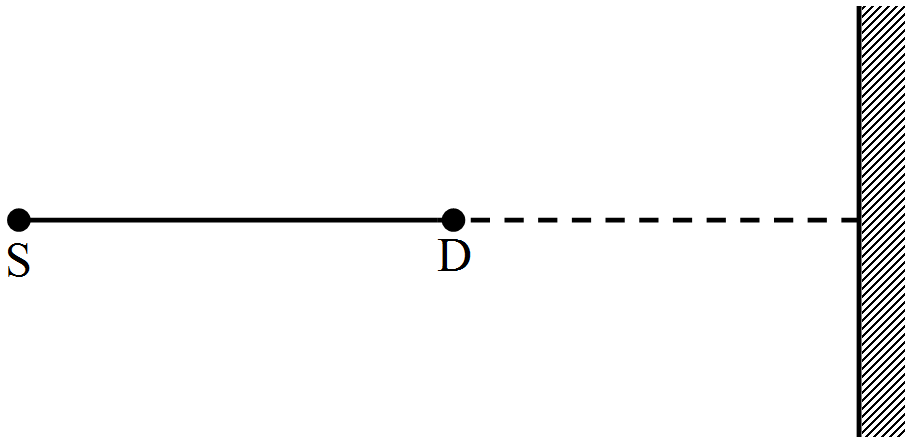
A source of sound S and a detector D are placed at some distance from one another. A big cardboard is placed near the detector and perpendicular to the line SD as shown in figure, It is gradually moved away and it is found that the intensity changes from a maximum to a minimum as the board is moved through a distance of 20cm. Find the frequency of the sound emitted. Velocity of sound in air is 336m/s.

Name two substances out of which magnetic susceptibility of one is positive and of other negative. What does negative magnetic susceptibility represent?
A small source of sound vibrating at frequency 500Hz is rotated in a circle of radius $\frac{100}{\pi}\text{cm}$ at a constant angular speed of 5.0 revolutions per second. A listener situates himself in the plane of the circle. Find the minimum and the maximum frequency of the sound observed. Speed of sound in air = 332m/s.
Consider a circuit containing an ideal battery connected to a resistor. Do "work done by the battery" and "the thermal energy developed" represent two names of the same physical quantity?
Radioactive 131I has a half-life of 8.0 days. A sample containing 131I has activity $20\mu\text{Ci}$ at t = 0.
  1. What is its activity at t = 4 days?
  2. What is its decay constant at t = 4.0 days?
What is linear magnification? Obtain equation of linear magnification for mirror.
The instantaneous voltage from an ac source is given by $\text{E}=300\sin314\text{t};$ what is the rms voltage of the source.
Give expression for induced emf in AC generator. Discuss, with fogure, how this emf changes with time during one rotation of coil.
Three capacitors each of capacitance 9 pF are connected in series.
  1. What is the total capacitance of the combination?
  2. What is the potential difference across each capacitor if the combination is connected to a 120 V supply?
Find the intensity at a point on a screen in Young’s double slit experiment where the interfering waves of equal intensity have a path difference of (i) $\lambda/4$, and (ii) $\lambda/3$.