Question
Derive the expression for force per unit length between two long straight parallel current carrying conductors. Hence define one ampere.

Answer


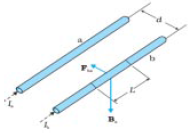
Figure shows two long parallel conductors $a$ and $b$ separated by $a$ distance $d$ and carrying $($parallel$)$ currents $I_a$ and $I _b,$ respectively.
The conductor $'a\ '$ produces, the same magnetic field $B$ a at all points along the conductor $'b\ '$.
The right-hand rule tells us that the direction of this field is downwards $($when the conductors are placed horizontally$)$. Its magnitude is given by
$\text{B}_{\alpha} = \frac{\mu_\circ\text{I}_{\alpha}}{2\pi\text{d}}$
The conductor $'b\ '$ carrying a current $I _b$ will experience a sideways force due to the field $B_a$.
The direction of this force is towards the conductor $'a\ '$.
We label this force as $F_{ba},$ the force on a segment $L$ of $'b\ '$ due to $'a\ '.$ The magnitude of this force is given by
$\int_{ba} = \text{I}_{b}\text{LB}_{a}$
$ = \frac{\mu_\circ\text{I}_{a}\text{I}_{b}}{2\pi\text{d}}\text{L}$
Let $\int_{ba}$ represent the magnitude of the force $\text{F}_{ba}$ per unit length.
$\int_{ba} = \frac{\mu_\circ\text{I}_{a}\text{I}_{b}}{2\pi\text{d}}$
One ampere: The ampere is the value of that steady current which, when maintained in each of the two very long, straight, parallel conductors of negligible cross $-$ section, and placed one metre apart in vacuum, would produce on each of these conductors a force equal to $2 \times 10^{–7}$ newton per metre of their length.

Need a full question paper?

Generate a complete, print-ready paper with questions like this in minutes — across 16+ boards, with answer keys.
Start Generating Free

Similar questions

A tank is filled with water to a height of $12.5 \ cm$. The apparent depth of a needle lying at the bottom of the tank is measured by a microscope to be $9.4 \ cm$. What is the refractive index of water? If water is replaced by a liquid of refractive index $1.63$ up to the same height, by what distance would the microscope have to be moved to focus on the needle again?
Consider a thin target $\left(10^{-2} m\right.$ square, $10^{-3} m$ thickness $)$ of sodium, which produces a photocurrent of $100 \mu A$ when a light of intensity $100 W / m ^2(\lambda=660 nm)$ falls on it. Find the probability that a photoelectron is produced when a photon strikes a sodium atom. $[$Take density of $Na =0.97 \ kg / m ^3 ].$
  1. Distinguish between a conductor and a semi conductor on the basis of energy band diagram.
  2. The following figure shows the input waveforms (A, B) and the output waveform (Y) of a gate. Identify the gate, write its truth table and draw its logic symbol.
  1. A point charge q moving with speed v enters a uniform magnetic field B that is acting into the plane of the paper as shown. What is the path followed by the charge q and in which plane does it move?
  2. How does the path followed by the charge get affected if its velocity has a component parallel to $\overrightarrow{\text{B}}$?
  3. If an electric field $\overrightarrow{\text{E}}$ is also applied such that the particle continues moving along the original straight line path, what should be the magnitude and direction of the electric field $\overrightarrow{\text{E}}$?
Write Huygen's principle and explain how a new spherical wave front is formed after a very small time interval.
  1. In the following diagram, which bulb out of $B_1$ and $B_2$ will glow and why?
  1. Draw a diagram of an illuminated $p-n$ junction solar cell.
  2. Explain briefly the three processes due to which generation of emf takes place in a solar cell.
Explain, with the help of a nuclear reaction in each of the following cases, how the neutron to proton ratio changes during (i) alpha-decay (ii) beta-decay?
Rate of change of electric field in the region between the plates of capacitor is $1.5 \times 10^{12} Vm ^{-1} s^{ 1 }$. If circular plate of capacitor has a radius of 55 mm , then find the magnitude of displacement current.
A metallic rod of length ‘l’ is rotated with a frequency ‘v’, with one end hinged at the centre and the other end at the circumference of a circular metallic ring, about an axis passing through the centre and perpendicular to the plane of the ring. A constant and uniform magnetic field B parallel to the axis is present everywhere.
  1. Obtain the expression for the emf induced between the centre and the ring.
  2. Given that the rod has resistance ‘R’, then how much power will be generated?
Define radioactivity.