Question
Write Huygen's principle and explain how a new spherical wave front is formed after a very small time interval.

Answer

• Huygen's principle :
"Every point or particle of a wavefront behaves as an independent secondary source, emits by itself secondary spherical waves. After a very small time interval the surface tangential to all such secondary spherical wavelets gives the position and shape of the new wavefront."
[Alternatively, "Each point of the wavefront is the source of a secondary disturbance and the wavelets emanating from these points spread out in all directions with the speed of the wave. These wavelets emanating from the wavefront are usually referred to as secondary wavelets and if we draw a common tangent to all these spheres, we obtain the new position of the wave front at a later time."]
Image
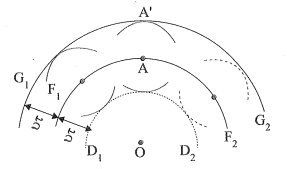
As shown in the Fig, $F _1 F_2$ represents the spherical wave front (with O as Centre) at $t=0$.
As per Huygen's principle each point on the wavefront behaves as a secondary source and the waves emanating from these point spread equally in all directions at the speed of wave. If we wish to determine the shape of the wave front at $t=\tau$, we draw spheres of radius $v \tau$ from each point on the spherical wave front where $v$ represents the speed of the waves in the medium.
If we now draw a common tangent to all these spheres, we obtain the new position of the wave front at $t =\tau$.
The new wavefront is shown in the Fig. as $G _1 G _2$, which is again a spherical with point ' O ' as centre.

Need a full question paper?

Generate a complete, print-ready paper with questions like this in minutes — across 16+ boards, with answer keys.
Start Generating Free

Similar questions

Can an electromagnetic wave be polarised?
Explain the series connection of capacitors.
Write the S.I. unit and dimensional formula for the permittivity of free space ?
The focal lengths of a convex lens for red, yellow and violet rays are 100cm, 98cm and 96cm respectively. Find the dispersive power of the material of the lens.
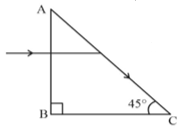
A light ray entering a right $-$ angled prism undergoes refraction at the face $AC$ as shown in Figure
$(I)$ What is the refractive index of the material of the prism in Figure?

Image
$(II) (a)$ If the side $AC$ of the above prism is now surrounded by a liquid of refractive index $\frac{2}{\sqrt{3}}$ as shown in Figure, determine if the light ray continues to graze along the interface $AC$ or undergoes total internal reflection or undergoes refraction into the liquid.

Image
$(b)$ Draw the ray diagram to represent the path followed by the incident ray with the corresponding angle values.
$($Given $,\sin ^{-1}\left(\frac{\sqrt{2}}{\sqrt{3}}\right)=54.6^{\circ} )$
How will establish displacement current of 6 A between the plates of a capacitor of capacitance $6 \mu F$ ?
How is the spacing between fringes in a double slit experiment affected if:
a. the slits separation is increased,
b. the colour of light used is changed from red to blue,
c. the whole apparatus is submerged in a oil of refractive index 1.2?
Justify your anwer in each case.
Figure shows a light rod of length l rigidly attached to a small heavy block at one end and a hook at the other end. The system is released from rest with the rod in a horizontal position. There is a fixed smooth ring at a depth h below the initial position of the hook and the hook gets into the ring as it reaches there. What should be the minimum value of h so that the block moves in a complete circle about the ring?
The half$-$life of $^{14}_6\text{C}$ is $5700$ years. What does it mean? Two radioactive nuclei $X$ and $Y$ initially contain an equal number of atoms. Their half$-$lives are $1$ hour and $2$ hours respectively. Calculate the ratio of their rates of disintegration after two hours.
A point charge $+10\  \mu\ C$ is a distance $5\ cm$ directly above the centre of a square of side $10\ cm,$ as shown in Fig. $1.34.$ What is the magnitude of the electric flux through the square?
$($Hint: Think of the square as one face of a cube with edge $10\ cm.)$