Question
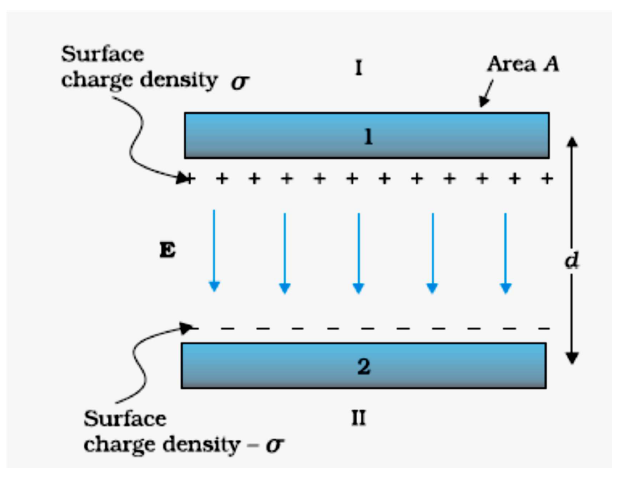
  1. Derive the expression for the capacitance of a parallel plate area A and plate separation d.
  2. Two charged spherical conductors of radii Rand R2 when conducting wire acquire charges q1 and qrespectively. surface charge densities in terms of their radii.

Answer

  1.  

Electric field between the plates of capacitor E = $\frac{\sigma}{\varepsilon_{0}} =\frac{\text{Q}}{\text{A}\varepsilon_{0}}$

$\therefore$ potential difference

$\text{V} = \text{Ed} = \frac{\text{Qd}}{\text{A}\varepsilon_{0}}$

Capacitance

$\text{C} = \frac{\text{Q}}{\text{V}} = \frac{\varepsilon_{0}\text{A}}{\text{d}}$

  1. When the two charged spherical conductors are connected by a conducting wire , they acquire the same potential

i.e $\frac{\text{Kq}_{1}}{\text{R}_{1}} = \frac{\text{Kq}_{2}}{\text{R}_{2}}\Rightarrow\frac{\text{q}_{1}}{\text{q}_{2}} = \frac{\text{R}_{1}}{\text{R}_{2}}$

Hence, ratio of surface charge densities

$\frac{\sigma_{1}}{\sigma_{2}} = \frac{\text{q}_{1}/4\pi\text{R}_{1}^{2}}{\text{q}_{2}/4\pi\text{R}_{2}^{2}}$

$ = \frac{\text{q}_{1}\text{R}_{2}^{2}}{\text{q}_{2}\text{R}_{1}^{2}}$

$ = \frac{\text{R}_{1}}{\text{R}_{2}}\times\frac{\text{R}_{2}^{2}}{\text{R}_{1}^{2}} = \frac{\text{R}_{2}}{\text{R}_{1}}.$
Need a full question paper?

Generate a complete, print-ready paper with questions like this in minutes — across 16+ boards, with answer keys.

Start Generating Free

Similar questions

A particle of mass m is projected with a speed u at an angle $\theta$ with the horizontal. Find the torque of the weight of the particle about the point of projection when the particle is at the highest point.
A laser beam has intensity 2.5 × 10¹⁴Wm-2. Find amplitudes of electric and magnetic fields in the beam.
A charge of 1.0C is placed at the top of your college building and another equal charge at the top of your house. Take the separation between the two charges to be 2.0km. Find the force exerted by the charges on each other. How many times of your weight is this force?
The ground state energy of hydrogen atom is –13.6 eV.
  1. What is the kinetic energy of an electron in the 2nd excited state?
  2. If the electron jumps to the ground state from the 2nd excited state, calculate the wavelength of the spectral line emitted.
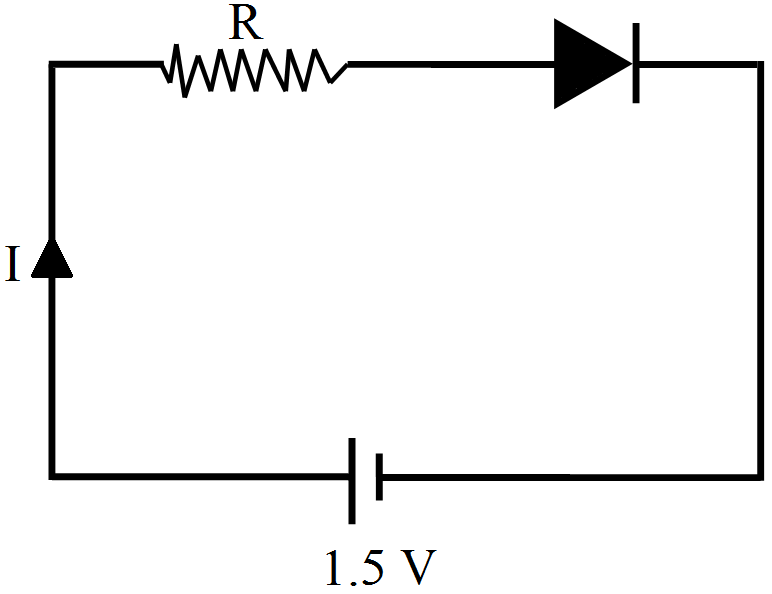
A p-n junction germanium diode when forward biased has a drop of 0.3V which is assumed to be independent of current. The current in excess of 10mA through the diode produces a large Joule-heating which damages (burns) the diode. If we want to use a 1.5V battery to forward-bias the diode, what should be the value of resistor used in series with the diode, so that the maximum current does not exceed 6mA?

An electron and a photon each have a wavelength of 1.00 nm. Find:
  1. Their momenta,
  2. The energy of the photon, and
  3. The kinetic energy of electron.
A steel wire of original length 1m and cross-sectional area 4.00mm2 is clamped at the two ends so that it lies horizontally and without tension. If a load of 2.16kg is suspended from the middle point of the wire, what would be its vertical depression? Y of the steel = 2.0 × 10¹¹N/m2 Take g = 10m/s2.
In one-dimensional elastic collision of equal masses, the velocities are interchanged. Can velocities in a onedimensional collision be interchanged if the masses are not equal?
Draw the circuit diagram of a common emitter amplifier using n-p-n transistor. What is the phase differnece between the input signal and output voltage? State two reasons why a common emitter amplifier is preferred to a common base amplifier.
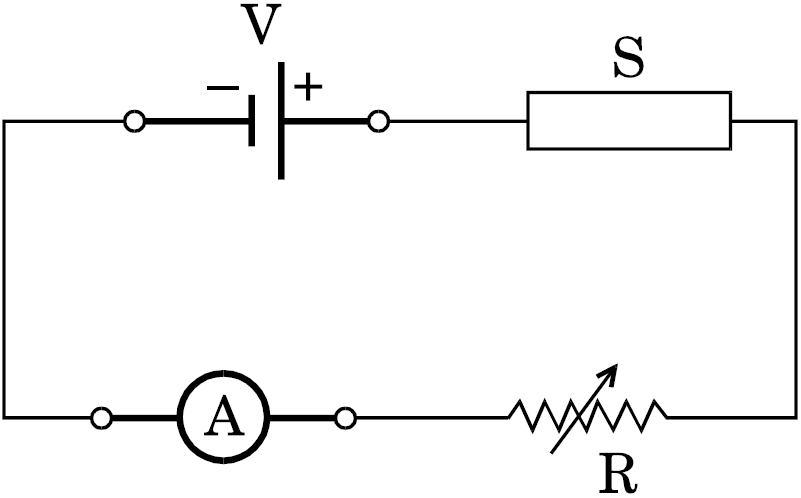
  1. In the following diagram ‘S’ is a semiconductor. Would you increase or decrease the value of R to keep the reading of the ammeter A constant when S is heated? Give reason for your answer.

  1. Draw the circuit diagram of a photodiode and explain its working. Draw its I - V characteristics.