Question
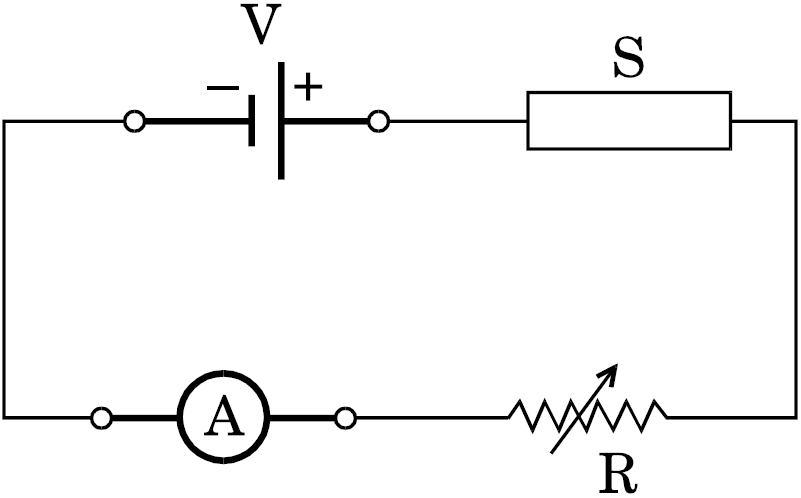
  1. In the following diagram ‘S’ is a semiconductor. Would you increase or decrease the value of R to keep the reading of the ammeter A constant when S is heated? Give reason for your answer.
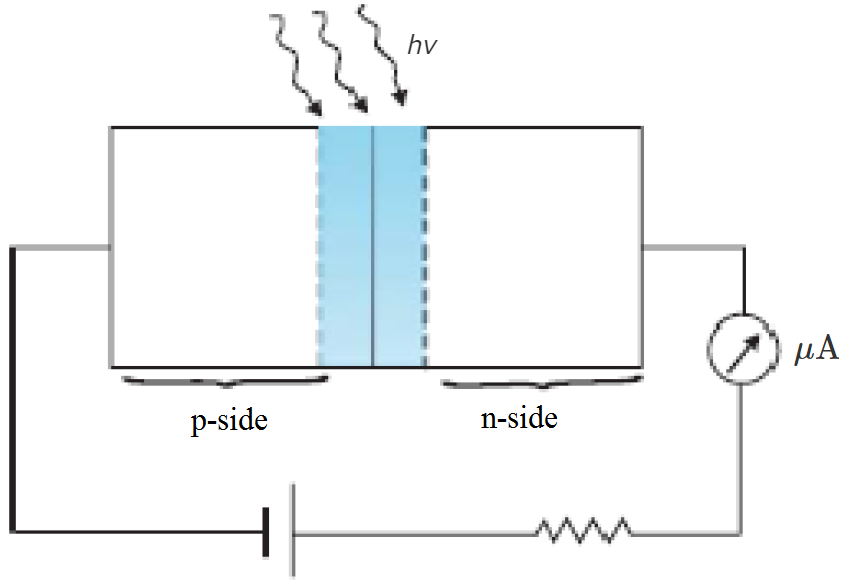
  1. Draw the circuit diagram of a photodiode and explain its working. Draw its I - V characteristics.
Answer

  1. R would be increased.

Resistance of S (a semi conductor) decreases on heating.

  1. Photodiode diagram:

When the photodiode is illuminated with light (photons) (with energy (hv) greater than the energy gap (Eg) of the semiconductor), then electron-hole pairs are generated due to the absorption of photons. Due to junction field, electrons and holes are separated before they recombine. Electrons are collected on n-side and holes are collected on p-side giving rise to an emf. When an external load is connected, current flows.

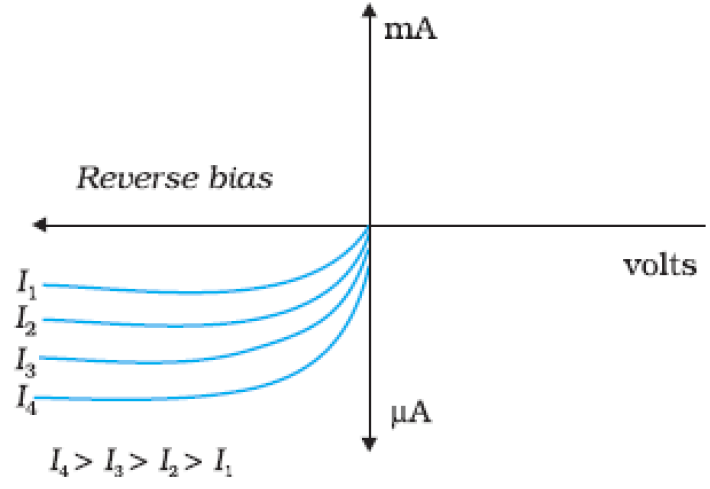
V-I Characteristics of the diode:

Need a full question paper?

Generate a complete, print-ready paper with questions like this in minutes — across 16+ boards, with answer keys.

Start Generating Free

Similar questions

The magnetic field due to a long straight wire has been derived in terms of $\mu_0,$ i and d. Express this in terms of $\in_0,$ C, i and d.
Three resistors $1\ \Omega,\ 2\ \Omega\ \text{and}\ 3\ \Omega$ are combined in series. What is the total resistance of the combination?
If the combination is connected to a battery of emf 12 V and negligible internal resistance, obtain the potential drop across each resistor.
Draw a graph showing the variation of binding energy per nucleon with mass number for different nuclei. Explain, with the help of this graph, the release of energy by the process of nuclear fusion.
A wheel of moment of inertia 0.500kg-m2 and radius 20.0cm is rotating about its axis at an angular speed of 20.0rad/s. It picks up a stationary particle of mass 200g at its edge. Find the new angular speed of the wheel.
Answer the following:
  1. Name the em waves which are produced during radioactive decay of a nucleus. Write their frequency range.
  2. Welders wear special glass goggles while working. Why? Explain.
  3. Why are infrared waves often called as heat waves? Give their one application.
The magnetic field B inside a long solenoid, carrying a current of 5.00A, is 3.14 × 10⁻²T. Find the number of turns per unit length of the solenoid.
A long, straight wire carries a current. Is Ampere's law valid for a loop that does not enclose the wire? That encloses the wire but is not circular?
Give brief explanation of a semi-conductor diode.
Electrons are continuously in motion within a conductor but there is no current in it unless some source of potential is applied across its ends. Give reason.
In a hydrogen atom, the electron and proton are bound at a distance of about 0.53 $\mathring{\text{A}}$:
  1. Estimate the potential energy of the system in eV, taking the zero of the potential energy at infinite separation of the electron from proton.
  2. What is the minimum work required to free the electron, given that its kinetic energy in the orbit is half the magnitude of potential energy obtained in (a)?
  3. What are the answers to (a) and (b) above if the zero of potential energy is taken at 1.06 Å separation?