Question
  1. Derive the expression for the torque acting on the rectangular current carrying coil of a galvanometer. Why is the magnetic field made radial?
  2. An $\alpha-$particle is accelerated through a potential difference of 10kV and moves along x-axis. It enters in a region of uniform magnetic field $B = 2 \times 10^{–3}T$ acting along y-axis. Find the radius of its path. (Take mass of $\alpha-$particle $= 6.4 \times 10^{–27}kg$).
Answer

  1.  

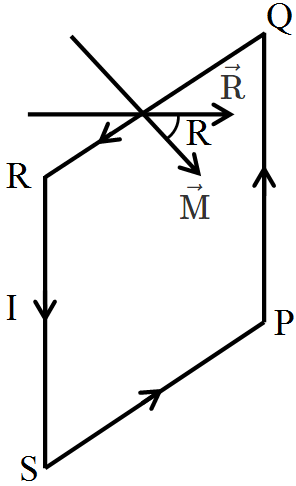
$\text{PQ}=\text{RS}=1$
$\text{PS}=\text{QR}=\text{b}$
Area $\text{A}=\text{lb}$
$\vec{\text{M}}\times\vec{\text{IA}}$
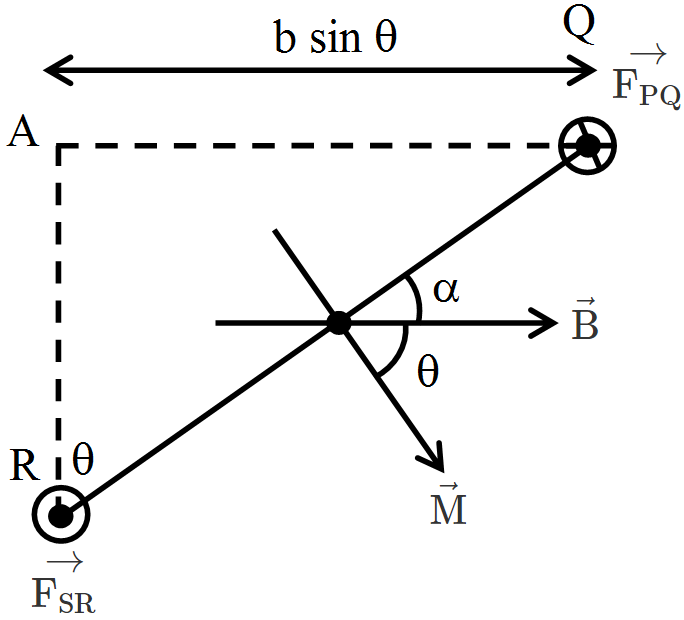
$\overrightarrow{\text{F}_{\text{PQ}}}=\text{IlB}\otimes$
$\overrightarrow{\text{F}_{\text{RS}}}=\text{IlB}\ominus$
$\overrightarrow{\text{F}_{\text{QR}}}=\text{IbB}\sin(90^\circ-\theta)=\text{IbB}\cos\theta\text{ up}$
$\overrightarrow{\text{F}_{\text{SP}}}=\text{IbB}\sin(90^\circ-\theta)=\text{IbB}\cos\theta\text{ down}$
Only $\overrightarrow{\text{F}_{\text{PB}}}\ \& \ \overrightarrow{\text{F}_{\text{RS}}}$ form a couple to apply torque on loop,

$\tau=\text{MB}\sin\theta$
Magnetic field is taken radial in Galvanometer coil in order to create $\theta=90^\circ$ at every orientation of coil in the magnetic field so that current varies linearly with deflection.
  1. $\text{qV}=\frac{1}{2}\text{mv}^2$
$\Rightarrow\text{v}=\sqrt{\frac{2\text{qV}}{\text{m}}}$
$\because\vec{\text{v}}=\text{vi}\perp\vec{\text{B}}(=\text{Bj})$
$\therefore$ Particle deflects along circular path of radius $\text{r}=\frac{\text{mv}}{\text{qB}}=\frac{\text{m}}{\text{qB}}\sqrt{\frac{2\text{qv}}{\text{m}}}=\frac{1}{\text{B}}\sqrt{\frac{2\text{mv}}{\text{q}}}$
$\text{r}=\frac{1}{2\times10^{-3}}\sqrt{\frac{2\times6.4\times10^{-27}\times10^4}{2\times1.6\times10^{-19}}}$
$=\frac{1}{2\times10^{-3}}\times2\times10^{-2}$
$=10^1\text{m}=10\text{m}.$

Need a full question paper?

Generate a complete, print-ready paper with questions like this in minutes — across 16+ boards, with answer keys.

Start Generating Free

Similar questions

A hole of radius $r_1$ is made centrally in a uniform circular disc of thickness d and radius $r_2.$ The inner surface $($a cylinder of length d and radius $r_1)$ is maintained at a temperature $\theta_1$ and the outer surface $($a cylinder of length d and radius $r_2)$ is maintained at a temperature $\theta_2(\theta_1>\theta_2).$ The thermal conductivity of the material of the disc is K. Calculate the heat flowing per unit time through the disc.
Two convex lenses, each of focal length 10cm, are placed at a separation of 15cm with their principal axes coinciding,
  1. Show that a light beam coming parallel to the principal axis diverges as it comes out of the lens system.
  2. Find the location of the virtual image formed by the lens system of an object placed far away.
  3. Find the focal length of the equivalent lens.
(Note that the sign of the focal length is positive although the lens system actually diverges a parallel beam incident on it).
An object is placed at a distance of 30cm from a converging lens of focal length 15cm. A normal eye (near point 25cm, far point infinity) is placed close to the lens on the other side.
  1. Can the eye see the object clearly?
  2. What should be the minimum separation between the lens and the eye so that the eye can clearly see the object?
  3. Can a diverging lens, placed in contact with the converging lens, help in seeing the object clearly when the eye is close to the lens?
Quite often, connecting wires carrying currents in opposite directions are twisted together in using electrical appliances. Explain how it avoids unwanted magnetic fields.

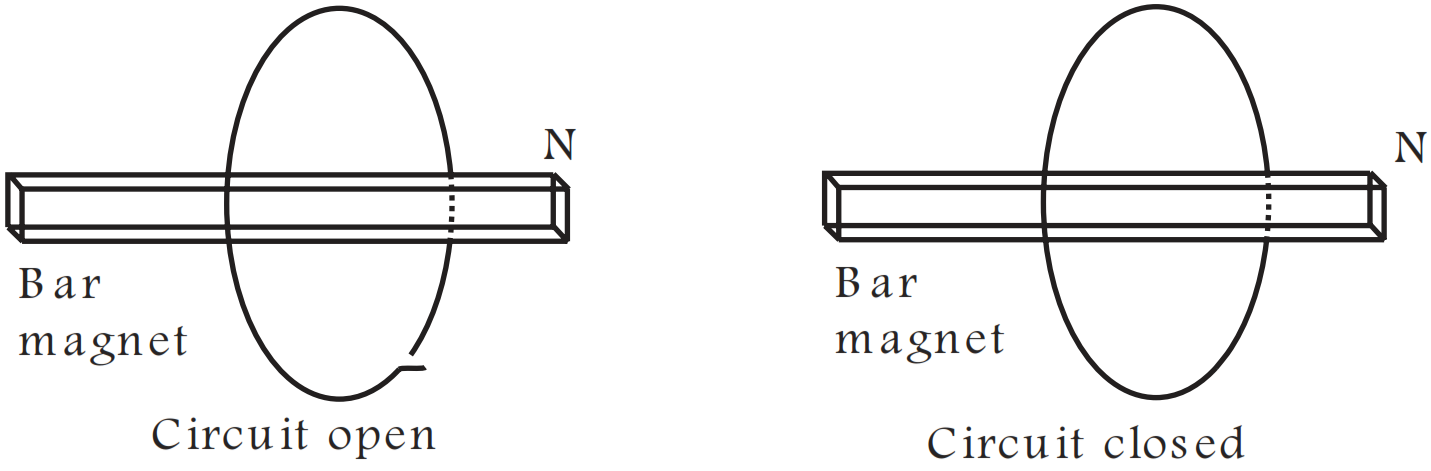
Consider a magnet surrounded by a wire with an on/off switch S (Fig). If the switch is thrown from the off position (open circuit) to the on position (closed circuit), will a current flow in the circuit? Explain.
The magnitude F of the force between two straight parallel current carrying conductors kept at a distance d apart in air is given by:
$\text{F}=\frac{\mu_0\text{I}_1\text{I}_2}{2\pi\text{d}}$
Where $I_1$ and $I_2$ are the currents flowing through the two wires.
Use this expression, and the sign convention that the:
“Force of attraction is assigned a negative sign and Force of repulsion is assigned a positive sign”.
Draw graphs showing dependence of F on:
  1. $I_1 I_2 $ when d is kept constant.
  2. d when the product $I_1 I_2$ is maintained at a constant positive value.
  3. d when the product $I_1 I_2$ is maintained at a constant negative value.
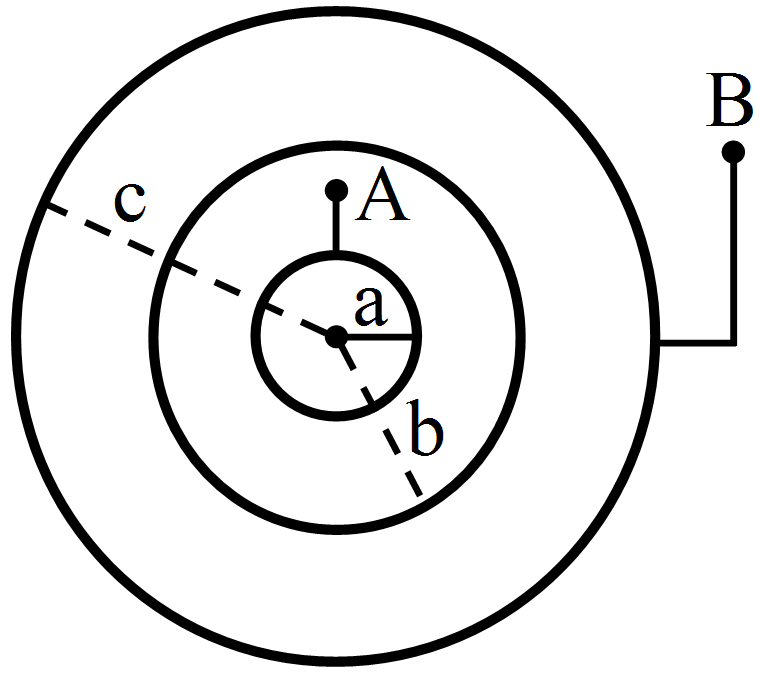
Consider an assembly of three conducting concentric spherical shells of radii a, b and c as shown in figure. Find the capecitance of the assembly between the poima A and B
A spherical ball of surface area $20cm^2$ absorbs any radiation that falls on it. It is suspended in a closed box maintained at 57°C.
  1. Find the amount of radiation falling on the ball per second.
  2. Find the net rate of heat flow to or from the ball at an instant when its temperature is 200°C. Stefan constant $= 6.0 \times 10^{-8}Wm^{-2}K^{-4}.$
Is it possible that in a Coolidge tube characteristic $\text{L}_\alpha$ X-rays are emitted but not $\text{K}_\alpha$ X-rays?
Explain the shortcomings of Rutherford's Atomic Model.###Write two shortcomings of Rutherford's Atomic Model.