Gujarat BoardEnglish MediumSTD 12 SciencePhysicsELECTROSTATIC POTENTIAL AND CAPACITANCE3 Marks
Question
Derive the formula (/ equation) of capacitance for a paralled plate capacitor.
✓
Answer
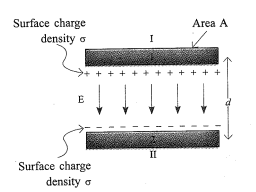
→A capacitor made up of two large parallel conducting plates kept at a small distance is called parallel plate capacitor. →Two parallel conducting plates are arranged parallel to each other as shown in figure. Area of each plate is A and perpendicular distance between the two plates is $d$. Charge on them is + Q and - Q respectively. →Surface charge density on both the plates is $\sigma\left(=\frac{ Q }{ A }\right)$ and $-\sigma$ respectively. → Here the separation (d) between two plates is very small compared to the area of the plates. ( $d^2 \ll<$ A) Therefore, the electric field between the two plates can be considered uniform (So that we can use the formula $E=\frac{\sigma}{2 \varepsilon_0}$ to find out electric field due to both plates.) Electric field in the region above plate I , $E ^{\prime}=\frac{\sigma}{2 \varepsilon_0}-\frac{\sigma}{2 \varepsilon_0}=0$ →Electric field in the region below plate II, $E ^{\prime \prime}=\frac{\sigma}{2 \varepsilon_0}-\frac{\sigma}{2 \varepsilon_0}=0$
→Electric field in the region above plate I, $E ^{\prime}=\frac{\sigma}{2 \varepsilon_0}-\frac{\sigma}{2 \varepsilon_0}=0$
→Electric field in the region below plate $\Pi$, $E ^{\prime \prime}=\frac{\sigma}{2 \varepsilon_0}-\frac{\sigma}{2 \varepsilon_0}=0$
→Electric field in the region between two plates, $\begin{array}{l} \therefore E =\frac{\sigma}{2 \varepsilon_0}+\frac{\sigma}{2 \varepsilon_0} \\ \therefore E =\frac{\sigma}{\varepsilon_0} \\ \therefore E =\frac{ Q }{\varepsilon_0 A} \end{array}$ $\left(\because \sigma=\frac{ Q }{ A }\right)$
→Direction of this electric field is from +ve plate to -ve plate. →The electric field is limited to the region between two plates and is uniform in that entire region.
Need a full question paper?
Generate a complete, print-ready paper with questions like this in minutes — across 16+ boards, with answer keys.