Question
In order to emit the electron from the metallic surface, which physical methods are used to give the minimum energy? Explain.

Answer

The minimum energy can be given by one of the following methods :
I. Thermionic emission
II. Field emission
III. Photoelectric emission.
I. Thermionic emission : Through thermionic emission, sufficient thermal energy can be given to the free electrons, so that they can come out of the metal.
II. Field emission : A strong electric field of the order of $10^8$ volts applied on a metal can emit electrons from the metal surface. As occurs in a spark plug.
III. Photoelectric emission : When light of appropriate frequency falls on a metal surface, electrons are emitted. These light generated electrons are called photoelectrons.

Need a full question paper?

Generate a complete, print-ready paper with questions like this in minutes — across 16+ boards, with answer keys.
Start Generating Free

Similar questions

The spectrum of a star in the visible and the ultraviolet region was observed and the wavelength of some of the lines that could be identified were found to be:
$824\mathring{\text{A}},970\mathring{\text{A}},1120\mathring{\text{A}},2504\mathring{\text{A}},5173\mathring{\text{A}},6100\mathring{\text{A}}$
Which of these lines cannot belong to hydrogen atom spectrum? (Given Rydberg constant $\text{R}=1.03\times10^7\text{m}^{-1}$ and $\frac{1}{\text{R}}=970\mathring{\text{A}}$ Support your answer with suitable calculations.
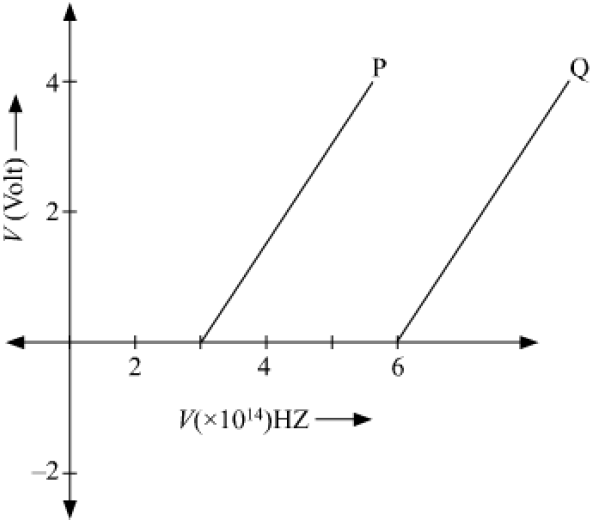
In the study of a photoelectric effect the graph between the stopping potential V and frequency v of the incident radiation on two different metals P and Q is shown below

  1. Which one of the two metals has higher threshold frequency?
  2. Determine the work function of the metal which has greater value.
  3. Find the maximum kinetic energy of electron emitted by light of frequency 8 × 10¹⁴ Hz for this metal.
A sinusoidal voltage of peak value 283 V and frequency 50 Hz is applied to a series LCR circuit in which $R =3 \Omega, L=25.48 mH$ and $C =796 \mu F$. Find
(a) The impedance of the circuit.
(b) The phase difference between the voltage across the source and the current.
(c) The power dissipated in the circuit.
A block at rest explodes into three equal parts. Two parts start moving along X and Y axes respectively with equal speeds of 10m/s. Find the initial velocity of the third part.

A man uses a concave mirror for shaving. He keeps his face at a distance of 25cm from the mirror and gets an image which is 1.4 times enlarged. Find the focal length of the mirror.
Find the magnetic field B due to a semicircular wire of radius 10.0cm carrying a current of 5.0A at its centre of curvature.
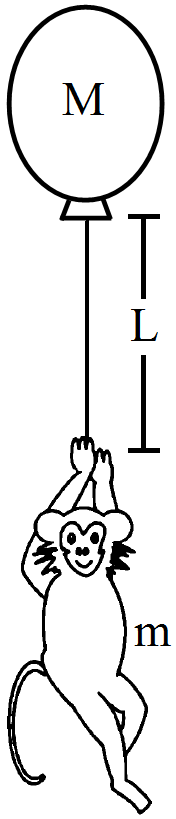
The balloon, the light rope and the monkey shown in figure are at rest in the air. If the monkey reaches the top of the rope, by what distance does the balloon descend ? Mass of the balloon = M, mass of the monkey = m and the length of the rope ascended by the monkey = L.

A circular coil of radius 8.0cm and 20 turns is rotated about its vertical diameter with an angular speed of 50rad s–1 in a uniform horizontal magnetic field of magnitude 3.0 × 10⁻²T. Obtain the maximum and average emf induced in the coil. If the coil forms a closed loop of resistance 10Ω, calculate the maximum value of current in the coil. Calculate the average power loss due to Joule heating. Where does this power come from?
Calculate the ratio of the angular momentum of the earth about its axis due to its spinning motion to that about the sun due to its orbital motion. Radius of the earth = 6400km and radius of the orbit of the earth about the sun = 1.5 × 10⁸km.
Explain with proper diagram, the application of a $p$ - $n$ junction diode as a halfwave rectifier.