Question
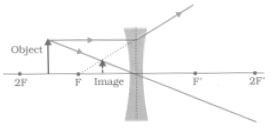
Derive the lens formula,  $\frac{1}{\text{f}} = \frac{1}{\text{v}} - \frac{1}{\text{u}}$ for a concave lens, using the necessary ray diagram.
Two lenses of powers 10 D and – 5 D are placed in contact.
  1. Calculate the power of the new lens.
  2. Where should an object be held from the lens, so as to obtain a virtual image of magnification 2?

Answer

Diagram:

Derivation: $\frac{1}{\text{v}} -\frac{1}{\text{u}} = \frac{1}{\text{f}}$

  1. $\text{Power} = \text{P}_{1} + \text{P}_{2}$

$ = 10 - 5 = 5\text{D}$

  1. f = 20 cm

 $\text{m} = \frac{\text{v}}{\text{u}} = 2$

$\frac{1}{\text{f}} =\frac{1}{\text{v}} - \frac{1}{\text{u}}$

$\text{u} = -10\text{cm}.$

Need a full question paper?

Generate a complete, print-ready paper with questions like this in minutes — across 16+ boards, with answer keys.

Start Generating Free

Similar questions

A travelling wave is produced on a long horizontal string by vibrating an end up and down sinusoidally. The amplitude of vibration is 1.0cm and the displacement becomes zero 200 times per second. The linear mass density of the string is 0.10kg/m and it is kept under a tension of 90N.
  1. Find the speed and the wavelength of the wave.
  2. Assume that the wave moves in the positive x-direction and at t = 0, the end x = 0 is at its positive extreme position. Write the wave equation.
  3. Find the velocity and acceleration of the particle at x - 50cm at time t = 10ms.
A sound wave of frequency 100Hz is travelling in air. The speed of sound in air is 350m/s.
  1. By how much is the phase changed at a given point in 2.5ms?
  2. What is the phase difference at a given instant between two points separated by a distance of 10.0cm along the direction of propagation?
The position, velocity and acceleration of a particle executing simple harmonic motion are found to have magnitudes 2cm, 1m/s and 10m/s2 at a certain instant. Find the amplitude and the time period of the motion.
Define the following :
(a) Total internal reflection
(b) Diffraction of light
(c) Refraction of light.
A 6 volt battery of negligible internal resistance is connected across a uniform wire AB of length 100cm. The positive terminal of another battery of emf 4V and internal resistance $1\Omega$ is joined to the point A, as shown in the figure. Take the potential at B to be zero. (a) What are the potentials at the points A and C? (b) At which point D of the wire AB, the potential is equal to the potential at C? (c) If the points C and D are connected by a wire, what will be the current through it? (d) If the 4V battery is replaced by a 7.5V battery, what would be the answers of parts (a) and (b)?

A uniform chain of length L and mass M overhangs a horizontal table with its two third part on the table. The friction coefficient between the table and the chain is $\mu.$ Find the work done by the friction during the period the chain slips off the table.
Suppose the space between the two inner shells of the previous problem is filled with a dielectric of dielectric coastant K. Find the capacitance of the system between A and B.
The short-wavelength limit shifts by 26pm when the operating voltage in an X-ray tube is increased to 1.5 times the original value. What was the original value of the operating voltage?
The coil of an electric bulb takes 40 watts to start glowing. If more than 40W is supplied, 60% of the extra power is converted into light and the remaining into heat. The bulb consumes 100W at 220V. Find the percentage drop in the light intensity at a point if the supply voltage changes from 220V to 200V.
Two circular coils of radii 5.0cm and 10cm carry equal currents of 21 A. The coils have 50 and 100 turns reepectively and are placed in such a way that their planes as well as the centres coincide. Find the magnitude of the magnetic field B at the common centre of the coils if the currents in the coils are (a) in the same sense (b) in the opposite sense.