Question
Derive the relation between surface tension and surface energy per unit area.

Answer

Surface tension tries to decrease the surface area of a liquid. For increasing surface area, the work has to be done against the surface tension and it is stored in the surface molecules in the form of potential energy

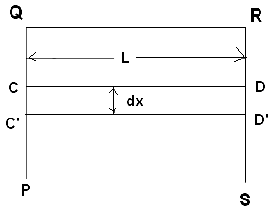
Consider a rectangular frame PQRS having a movable wire CD. Let $Q R=C D=L$. If a soap film is formed on the frame CQRD, then the surface tension will try to pull the wire inward by a force $F$.
$\text { Surface tension }=\frac{\text { Force }}{\text { free Length }}$
$F=\text { Surface tension } \times \text { Free length }$
$\therefore F=T \times(2 L)$
If the wire is pulled out to C' $D$ ' through distance ' $d x$ '.
$\therefore$ Work done $= F . dx$
$\therefore W = T (2 Ldx )$
But increase in area $=d A=2 Ldx$
Surface energy is defined as the work done per unit area to increase the free surface area, under isothermal conditions.
$\therefore \text { Surface energy }=\frac{\text { Work done }}{\text { Free surface area }}=\frac{W}{ dA }=\frac{T(2 L d x)}{2 L d x}=T$
$\therefore$ Surface tension is also equal to the surface energy per unit area.
 

Need a full question paper?

Generate a complete, print-ready paper with questions like this in minutes — across 16+ boards, with answer keys.
Start Generating Free

Similar questions

What are the conditions for obtaining good interference pattern? Give reasons.
A motor draws more current when it starts than when it runs at its full (i.e., operating) speed. Explain.###When a pump or refrigerator (or other large motor) starts up, lights in the same circuit dim briefly.
An $\text{LCR}$ series combination has $R=10 \Omega_r L =1 mH$ and $C =2 \mu F$. Determine $(i)$ the resonant frequency $(ii)$ the current in the circuit $(iii)$ voltages across $L$ and $C$, when an alternating voltage of rms value $10 mV$ operating at the resonant frequency is applied to the series combination.
A particle executes SHM with amplitude $10 cm$ and period $10 s$. Find the velocity and acceleration of the particle at a distance of $5 cm$ from the equilibrium position.
Show that currents in two long, straight, parallel wires exert forces on each other. Derive the expression for the force per unit length on each conductor.
The lower end of a capillary tube of diameter $1 \mathrm{~mm}$ is dipped $10 \mathrm{~cm}$ below the water surface in a beaker. What pressure is required to blow a hemispherical air bubble at the lower end of the tube? Present your answer rounded off to 4 significant figures. [Surface tension $=0.072$ $\mathrm{N} / \mathrm{m}$, density $=10^3 \mathrm{~kg} / \mathrm{m}^3$, atmospheric pressure $\left.=101.3 \mathrm{kPa}, \mathrm{g}=9.8 \mathrm{~m} / \mathrm{s}^2\right]$
Show that a linear $S.H.M$. is the projection of a $U.C.M$. along any of its diameter.
A water molecule is made up of two hydrogen atoms and one oxygen atom, with a total of 10 electrons and 10 protons. The molecule is modelled as a dipole with an effective separation $d=3.9 \times 10^{-12} m$ between its positive and negative particles. What is the electric potential energy stored in the dipole? What does the sign of your answer mean?
Explain the production of beats and deduce analytically the expression for beats frequency.

Define gauge pressure.
When is gauge pressure (i) positive (ii) negative?
Give two examples where gauge pressure is more relevant.