Question
Describe an experiment to show that sound cannot pass through vacuum.
Answer


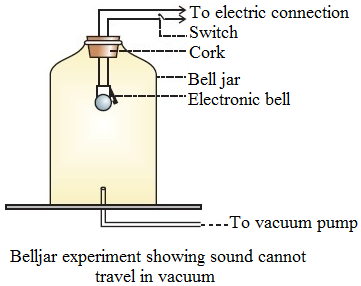
Sound cannot travel through vacuum. This can be shown by the following experiment:
  1. A ringing electric bell is placed inside an air tight glass jar containing air. We can hear the sound of ringing bell clearly. Thus, when air is present as medium in the bell jar, sound can travel through it and reach our ears.
  2. The bell jar containing ringing bell is placed over the plate of a vacuum pump. Air is gradually removed from the bell jar by switching on the vacuum pump. As more and more air is removed from the bell jar, the sound of ringing bell becomes fainter and fainter. And when all the air is removed from the bell jar, no sound can be heard at all. Thus, when vacuum is created in the bell jar, then the sound of ringing bell placed inside it cannot be heard.
This shows that sound cannot travel through vacuum.

Need a full question paper?

Generate a complete, print-ready paper with questions like this in minutes — across 16+ boards, with answer keys.

Start Generating Free

Similar questions

Pragya tested the solubility of three different substances at different temperatures and collected the data as given below (results are given in the following table, as grams of substance dissolved in 100 grams of water to form a saturated solution).
Substance Dissolved  Temperature in K
283 293 313 333 353
Solubility
Potassium nitrate 21 32 62 106 167
Sodium chloride 36 36 36 37 37
Potassium chloride 35 35 40 46 54
Ammonium chloride 24 37 41 55
66
  1. What mass of potassium nitrate would be needed to produce a saturated solution of potassium nitrate in 50 grams of water at 313K?
  2. Pragya makes a saturated solution of potassium chloride in water at 353K and leaves the solution to cool at room temperature. What would she observe as the solution cools? Explain.
  3. Find the solubility of each salt at 293K. Which salt has the highest solubility at this temperature?
  4. What is the effect of change of temperature on the solubility of a salt?
Give an illustrated account of nucleus.
How will you determine the boiling point of water experimentally? Draw a neat and labelled diagram.
You are given a mixture of water, groundnut oil and common salt. How will you separate groundnut oil and common salt from it?
How is the power related to the speed at which a body can be lifted$?$ How many kilograms will a man working at the power of $100W,$ be able to lift at constant speed of $1ms^{-1}$ vertically$?\ (g = 10ms^{-2})$
Describe with a diagram the fluid mosaic organisation of the plasma membrane.
What do you mean by passive and active transport? Write a note on diffusion.
Write short note on the following:
  1. Golgi apparatus.
  2. Mitochondria.
Distinguish between longitudinal and transverse waves.
Explain the various methods of crop improvement. Name one improved variety of Rice, Maize, Soybean, Sunflower and Mustard.