Question
Pragya tested the solubility of three different substances at different temperatures and collected the data as given below (results are given in the following table, as grams of substance dissolved in 100 grams of water to form a saturated solution).
Substance Dissolved  Temperature in K
283 293 313 333 353
Solubility
Potassium nitrate 21 32 62 106 167
Sodium chloride 36 36 36 37 37
Potassium chloride 35 35 40 46 54
Ammonium chloride 24 37 41 55
66
  1. What mass of potassium nitrate would be needed to produce a saturated solution of potassium nitrate in 50 grams of water at 313K?
  2. Pragya makes a saturated solution of potassium chloride in water at 353K and leaves the solution to cool at room temperature. What would she observe as the solution cools? Explain.
  3. Find the solubility of each salt at 293K. Which salt has the highest solubility at this temperature?
  4. What is the effect of change of temperature on the solubility of a salt?
Answer

  1. Mass of potassium nitrate required to produce a saturated solution in 100g of water at 313K = 62g
Mass of potassium nitrate required to produce a saturated solution in 50g of water = ?
Required amount = 62 × 50100 = 31
Hence 31g of potassium nitrate is required.
  1. When the solution cools down, Pragya observes salt crystals of potassium chloride precipitating.
  1. Solubility of each salt at 293K is as follows:
  • Potassium nitrate → 21g
  • Sodium chloride → 36g
  • Potassium chloride → 35g
  • Ammonium chloride → 24g
It is observed that the potassium chloride salt has the highest amount of solubility when compared to any other salt at 293K.
  1. Effect of change of temperature in the solubility of salts:
It is observed from the given table that the solubility of the salt increases with the increase in temperature. This means that when a salt reaches its saturation point at a particular temperature, more salt can be dissolved yet by increasing the temperature of the solution.

Need a full question paper?

Generate a complete, print-ready paper with questions like this in minutes — across 16+ boards, with answer keys.

Start Generating Free

Similar questions

Describe the method of separating a mixture containing common salt, sand and ammonium chloride.
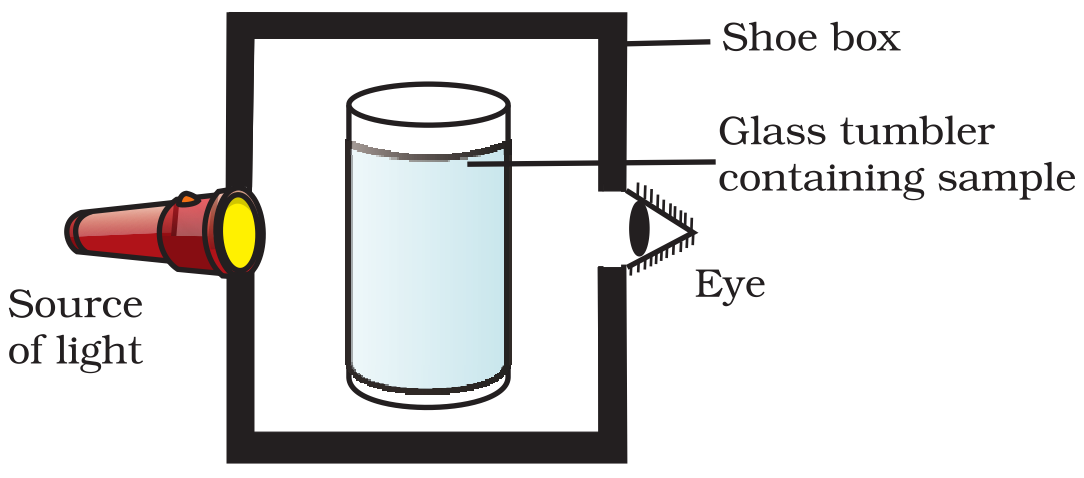
A group of students took an old shoe box and covered it with a black paper from all sides. They fixed a source of light $($a torch$)$ at one end of the box by making a hole in it and made another hole on the other side to view the light. They placed a milk sample contained in a beaker/ tumbler in the box as shown in the they were amazed to see that milk taken in the tumbler was illuminated. They tried the same activity by taking a salt solution but found that light simply passed through it?
  1. Explain why the milk sample was illuminated. Name the phenomenon involved.
  2. Same results were not observed with a salt solution. Explain.
  3. Can you suggest two more solutions which would show the same effect as shown by the milk solution?
Write the cations and anions present, if any, in the following:
  1. $CH_3COONa$
  2. $NaCl$
  3. $H_2$
  4. $NH_4NO_3$
How does the force of attraction between the two bodies depend upon their masses and distance between them? A student thought that two bricks tied together would fall faster than a single one under the action of gravity. Do you agree with his hypothesis or not? Comment.
A train travels the first 15km at a uniform speed of 30 km/h; the next 75km at a uniform speed of 50km/h; and the last 10km at a uniform speed of 20km/h.
Calculate the average speed for the entire train journey.
The atom of an element $X$ has $7$ electrons in its $M$ shell:
  1. Write the electronic configuration of element $X$.
  2. What is the atomic number of element $X$?
  3. Is it a metal or a non$-$metal?
  4. What type of ion will be formed by an atom of element $X$? Write the symbol of the ion formed.
  5. What could element $X$ be?
How is an ion different from an atom? How is cation different from anion?
Discuss the method of separating a mixture containing chalk powder, iron fillings and naphthalene.
Explain how, nitrogen, oxygen and argon gases are separated form air.
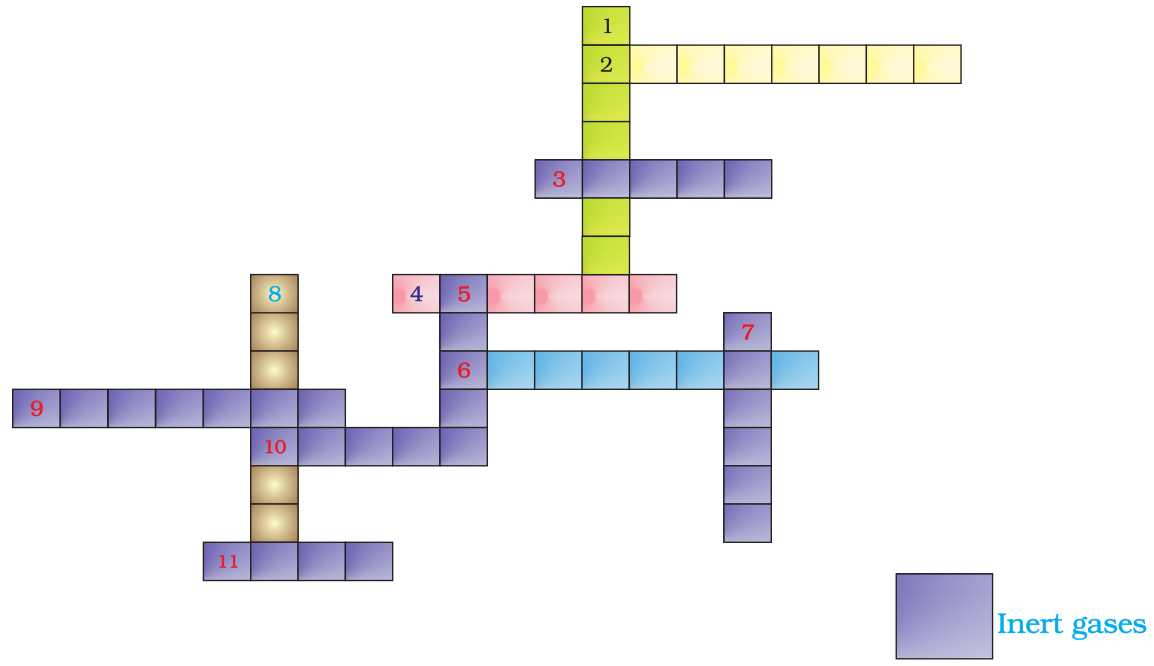
In this crossword puzzle (Figure), names of 11 elements are hidden. Symbols of these are given below. Complete the puzzle.
  1. Cl
  2. H
  3. Ar
  4. O
  5. Xe
  6. N
  7. He
  8. F
  9. Kr
  10. Rn
  11. Ne