Question
Describe detailed information on classification of carbohydrates.

Answer

Carbohydrates are classified on the basis of their behaviour on hydrolysis. They have been broadly divided into following 3 groups
(i) Monosaccharide compounds :
"A carbohydrate that can not be hydrolysed further to give simpler unit of polyhydroxy aldehyde or ketone is called a monosaccharide."
About 20 monosaccharides are known to occur in nature. Some common examples are glucose, fructose, ribose, etc.
(ii) Oligosaccharide compounds :
"Carbohydrates that yield two to ten monosaccharide units, on hydrolysis are called oligosaccharides."
They are further classified as disaccharides, trisaccharides, tetrasaccharides, etc., depending upon the number of monosaccharides they provide on hydrolysis.
Amongst these the most common are disaccharides. The two monosaccharide units obtained on hydrolysis of a disaccharide may be same or different.
For example, one molecule of sucrose on hydrolysis gives one molecule of glucose and one molecule of fructose where as maltose gives two molecules of only glucose.
(iii) Polysaccharide compounds:
"Carbohydrate which yield a large number of monosaccharide units on hydrolysis are called polysaccharides."
Some common examples are starch, cellulose, glycogen, gums etc. Polysaccharides are not sweet in taste. Hence, they are also called non- sugars.
Need a full question paper?

Generate a complete, print-ready paper with questions like this in minutes — across 16+ boards, with answer keys.

Start Generating Free

Similar questions

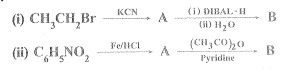
Give the structures of A and B in the following reactions
Image
The following reaction, $\text{A}_{(\text{g})}\xrightarrow{\ \ \triangle\ \ \ }\text{P}_{(\text{g})}+\text{Q}_{(\text{g})}+\text{R}_{(\text{g})},$ follows first order kinetics. The half-life period of this reaction is $69.3s$ at $500^\circ C$. The gas A is enclosed in a container at $500^\circ C$ and at a pressure of $0.4$ atm.
The following questions are multiple choice questions. Choose the most appropriate answer:
  1. The rate constant for the reaction is:
  1. $0.4s^{-1}$
  2. $0.02s^{-1}$
  3. $0.01s^{-1}$
  4. $0.3s^{-1}$
  1. The pressure of the gas $A$ after $230$ s will be:
  1. $0.04$ atm
  2. $0.36$ atm
  3. $0.4$ atm
  4. $0.036$ atm
  1. The total pressure of the system after $230$ swill be:
  1. $2.15$ atm
  2. $1.12$ atm
  3. $0.4$ atm
  4. $3.08$ atm
  1. The plot ofln[A] vs twill be:
  1. Linear with slope $= k$
  2. Linear with intercept $= In[A]_0$
  3. Linear with slope $= In[A]_0$
  4. Linear with intercept $= [A]_0$
  1. Which of the following is not an example of first order reaction?
  1. $\text{C}_2\text{H}_{4(\text{g})}+\text{H}_{2(\text{g})}\rightarrow\text{C}_2\text{H}_{6(\text{g})}$
  2. $2\text{N}_2\text{O}_{5(\text{g})}\rightarrow4\text{NO}_{2(\text{g})}+\text{O}_{2(\text{g})}$
  3. $2\text{N}\text{H}_{3(\text{g})}\xrightarrow[\triangle]{\text{pt}}\text{N}_{2(\text{g})}+3\text{H}_{2(\text{g})}$
  4. $2\text{N}_2\text{O}_{(\text{g})}\xrightarrow{\ \ \triangle\ \ }2\text{N}_{2(\text{g})}+\text{O}_{2(\text{g})}$
Read the passage given below and answer the following questions:
Interhalogen compounds are formed when halogen group elements react with each other. These are the compounds which consist of two or more different elements of group$-17$. A halogen with large size and low electronegativity reacts with an element of group$-17$ with small size and high electronegativity. As the ratio of radius of larger and smaller halogen increases, the number of atoms in a molecule also increases.
The following questions are multiple choice questions. Choose the most appropriate answer:
  1. The stability of interhalogen compounds follows the order.
  1. $IF_3 > BrF_3 > CIF_3$
  2. $CIF_3 > BrF_3 > IF_3$
  3. $BrF_3 > IF_3 > CIF_3$
  4. $CIF_3 > IF_3 > BrF_3$
  1. Identify the correct match from the following.
  1. $[ICI_2]^- - $ bent.
  2. $IF_7 $- pentagonal bipyramidal.
  3. $CIF_3 $- trigonal planar.
  4. $[BrF_4]^-$ - square pyramidal.
  1. In $XA_5$, the central atom has $($both $X$ and $A$ are halogens$).$
  1. $5$ bond pairs and no lone pairs.
  2. $5$ bond pairs and one lone pair.
  3. $6$ bond pairs and no lone pairs.
  4. $4$ bond pairs and one lone pair.
  1. In the known interbalogen compounds, the maximum number of atoms are,
  1. $4$
  2. $5$
  3. $8$
  4. $7$
  1. Which of the following is not the characteristic of interhalogen compounds.
  1. They are more reactive than halogens.
  2. They are quite unstable but none of them is explosive.
  3. They are covalent in nature.
  4. They have low boiling points and are highly volatile.
Read the passage given below and answer the following questions:
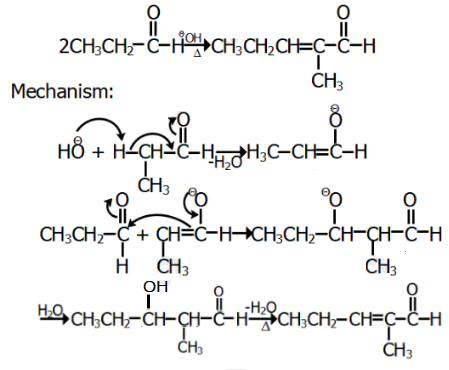
The addition reaction of enol or enolate to the carbonyl functional group of aldehyde or ketone is known as aldol addition. The β-hydroxyaldehyde or ββ-hydroxyketone so obtained undergo dehydration in second step to produce a conjugated enone. The first part of reaction is an addition reaction and the second part is an elimination reaction. Carbonyl compound having αα-hydrogen undergoes aldol condensation reaction.
  1. Condensation reaction is the reverse of which of the following reaction?
  1. Lock and key hypothesis
  2. Oxidation
  3. Hydrolysis
  4. Glycogen formation
  1. Which of the following compounds would be the main product of an aldol condensation of acetaldehyde and acetone?
  1. $CH_3CH=CHCHO$
  2. $CH_3CH=CHCOCH_3$
  3. $(CH_3)_2C=CHCHO$
  4. $(CH_3)_2C=CHCOCH_3$
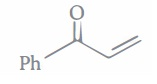
  1. Which combination of carbonyl compounds gives phenyl vinyl ketone by an aldol condensation?
  1. Acetophenone and Formaldehyde
  2. Acetophenone and acetaldehyde
  3. Benzaldehyde and acetaldehyde
  4. Benzaldehyde and acetone
  5. Which of the following will undergo aldol condensation?
  1. $HCHO$
  2. $CH_3CH_2OH$
  3. $C_6H_5CHO$
  4. $CH_3CH_2CHO$
Read the passage given below and answer the following questions:
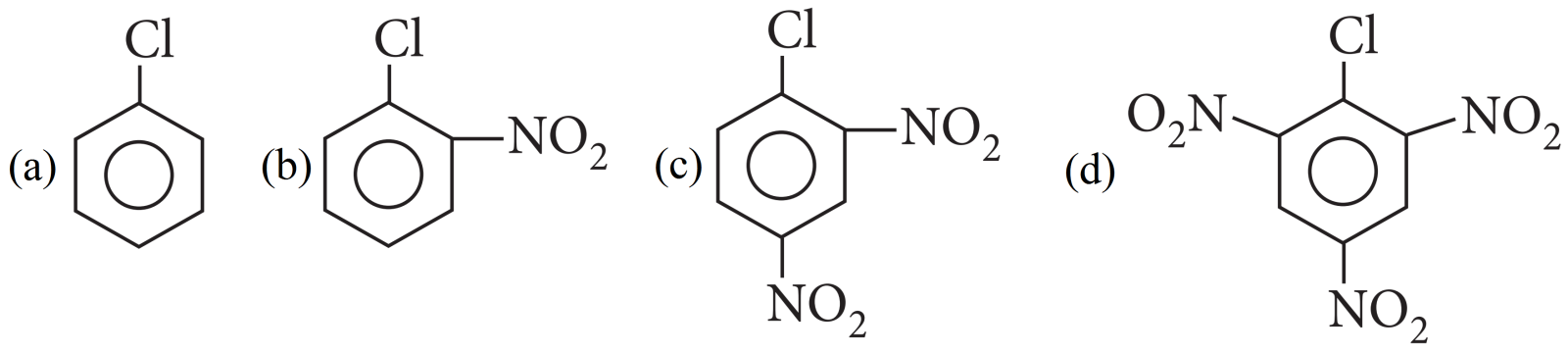
Haloarenes are less reactive than haloalkanes. The low reactivity of haloarenes can be attributed to:
  • Resonance effect.
  • $sp^2$ hybridisation of C - X bond.
  • Polarity of C - X bond
  • Instability of phenyl cation (formed by self-ionisation of haloarene).
  • Repulsion between the electron rich attacking nucleophiles and electron rich arenes.
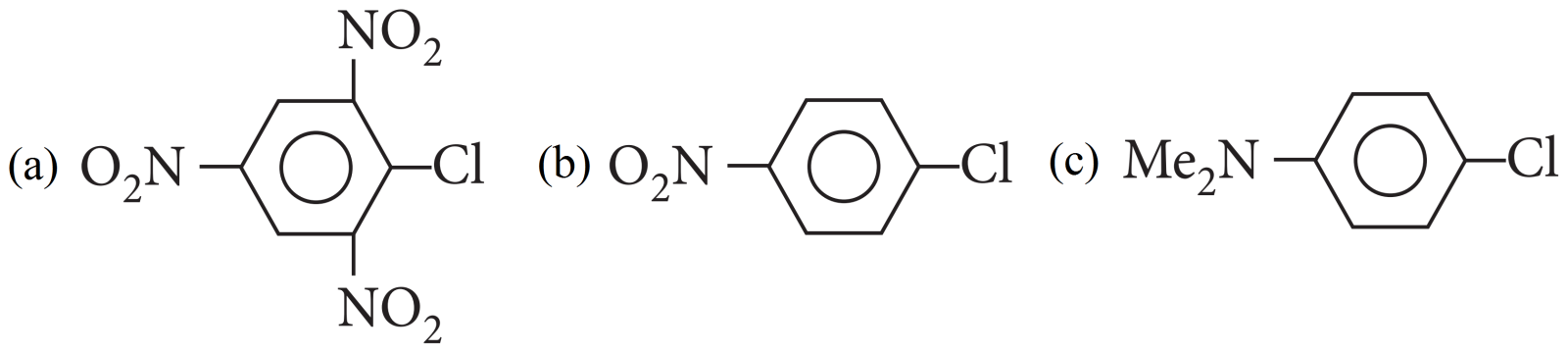
Reactivity of haloarenes can be increased or decreased by the presence of certain groups at certain positions for example, nitro ($-NO_{^2}$) group at o/ p positions increases the reactivity of haloarenes towards nucleophilc substitution reactions.
The following questions are multiple choice questions Choose the most appropriate answer:
  1. Aryl halides are less reactive towards nucleophilic substitution reaction as compared to alkyl halides due to
  1. The formation of less stable carbonium ion.
  2. Resonance stabilisation.
  3. Larger carbon-halogen bond.
  4. Inductive effect.
  1. Which of the following aryl halides is the most reactive towards nucleophilic substitution?
  1. Which one of the following will react fastest with aqueous $NaOH$?
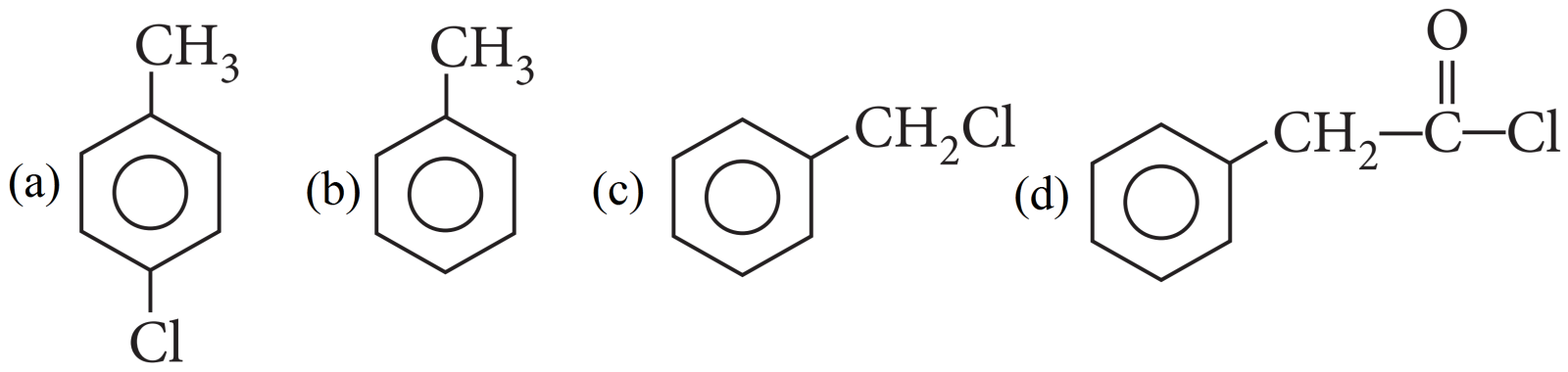
  1. Which chloro derivative of benzene among the followings would undergo hydrolysis most readily with aqueous sodium hydroxide to furnish the corresponding hydroxy derivative?
  1. $C_6H_5Cl$
  1. The reactivity of the compounds (i) $MeBr$, (ii) $PhCH_2Br$, (iii) $MeCI$, (iv) $p-MeOC_6H_4Br$ decreases as:
  1. (i) > (ii) > (iii) > (iv)
  2. (iv) > (ii) > (i) > (iii)
  3. (iv) > (iii) > (i) > (ii)
  4. (ii) > (i) > (iii) > (iv)
In these questions, a statement of assertion followed by a statement of reason is given. Choose the correct answer out of the following choices.
Assertion: In chemisorption, adsorption keeps on increasing with temperature.
Reason: Chemisorption increases with increase of pressure.
Read the passage given below and answer the following questions:
Nitric acid reacts with most of the metals (except noble metals like gold and platinum) and non-metals. Towards its reaction with metals. $HNO_3$ acts as an acid as well as an oxidising agent. Like other acids, $HNO_3$ liberate nascent hydrogen from metals which further reduces the nitric acid into number of products like $NO, NO_2, N_{2O}$ or $NH_3.$ The different stages of reduction of nitric acid are:
$\ \ _{+5}\ \ \ \ \ \ \ \ \ \ \ \ \ \ \ \ \ \ _{+4}\ \ \ \ \ \ \ \ \ \ \ \ \ \ \ \ \ \ _{+2}\ \ \ \ \ \ \ \ \ \ \ \ \ \ \ _{+1}\ \ \ \ \ \ \ \ \ \ \ \ \ \ \ \ \ _{-3}\\\text{HNO}_3\xrightarrow{\ \ \ \ +\text{e}\ \ \ \ }\text{NO}_2\xrightarrow{\ \ \ \ +2\text{e}^-}\text{NO}\xrightarrow[\text{NaOH}]{\ \ \ \ +\text{e}^-}\text{N}_2\text{O}\xrightarrow{\ \ \ \ +4\text{e}^-}\text{NH}_3$
The product of the reduction of $HNO_3$ depends upon the nature of the metal, concentration of nitric acid and temperature.
The following questions are multiple choice questions. Choose the most appropriate answer:
  1. Which of the following reactions is used to prepare laughing gas?
  1. $Pb +$ dil. $HNO_3 \rightarrow$
  2. $Hg +$ dil. $HNO_3 \rightarrow$
  3. $Zn +$ dil. $HNO_3 \rightarrow$
  4. $Cu +$ dil. $HNO_3 \rightarrow$
  1. Gold and platinum does not dissolve in $HNO_3$ but soluble in $1 : 3$ mixture of $HNO_3$ and $HCl$ due to the formation of respectively.
  1. $Au(NO_3)_2, [Pt(NO_3)_2]$
  2. $H[AuCl_4J, H_2[PtCl_6]$
  3. $[AuCl_6]^{2-}, [PtCl_2)^{2-}$
  4. $[Au(NO_3)_4], [Pt(NO_3)_6]^{2-}$
  1. Identify B in the following reaction.
$\text{Cu}+\text{HNO}_{3{\text{(conc.)}}}\xrightarrow{\ \ \ \ }\ \ \ \ \ \ (\text{A})\ \ \ \ \ \ \ +\ \ \ \ \ \ \ (\text{B})+\text{H}_2\text{O}\\\ \ \ \ \ \ \ \ \ \ \ \ \ \ \ \ \ \ \ \ \ \ \ \ \ \ \ \ \ \ \ \ {\text{Deep blue colour}}\ \ \ \ \ \ \ \text{Gas}$
  1. $NO_2$
  2. $N_2$
  3. $NO$
  4. $N_2O$
  1. In which of the following reactions $HNO_3$ will not act as an oxidising agent?
  1. $HNO_3 + H_2SO_4 \rightarrow$
  2. $HNO_3 + FeS0_4 + H_2S0_4 \rightarrow$
  3. $KI + HNO_3 \rightarrow$
  4. $Au + HNO_3\rightarrow$
  1. When dil. $HNO_3$ reacts with Hg, which gas will liberate?
  1. $N_2$
  2. $O_2$
  3. $NO$
  4. $NO_2$
Read the passage given below and answer the following questions:
Due to intermolecular hydrogen bonding, the boiling points of alcohols and phenols are much higher than those of corresponding haloalkanes, haloarenes, aliphatic and aromatic hydrocarbons. Among isomeric alcohols, the boiling points follow the order: primary > secondary > tertiary. Boiling points of ethers are much lower than those of isomeric alcohols. The solubility of alcohols in water decreases as the molecular mass of alcohols increases. Amongst isomeric alcohols solubility increases with branching. The solubility of phenols in water is much lower than that of alcohols. Lower ethers such as dimethyl ether and ethyl methyl ether are soluble in water, but the solubility decreases as the molecular mass increases.
In these questions (Q. No. i-iv), a statement of assertion followed by a statement of reason is given. Choose the correct answer out of the following choices.
  1. Assertion and reason both are correct statements and reason is correct explanation for assertion.
  2. Assertion and reason both are correct statements but reason is not correct explanation for assertion.
  3. Assertion is correct statement but reason is wrong statement.
  4. Assertion is wrong statement but reason is correct statement.
  1. Assertion: Alcohols have higher boiling points than ethers of comparable molecular masses.
Reason: Alcohols and ethers are isomeric in nature.
  1. Assertion: The solubility of phenols in water is much lower than that of alcohols.
Reason: Phenols do not form H-bonds with water.
  1. Assertion: Among n-butane, ethoxyethane, 1-propanol and 2-propanol, the increasing order of boiling points is, 1-butanol < 1-propanol < ethoxyethane < n-butane.
Reason: Boiling point increases with increase in molecular mass.
  1. Assertion: Dimethyl ether and diethylether are soluble in water.
Reason: As the molecular mass increases, solubility of ethers in water decreases.
  1. Assertion: Butan-2-ol has higher boiling point than 2-methylpropan-2-ol.
Reason: Amongst isomeric alcohols, the boiling points decreases with branching.
Read the passage given below and answer the following questions:
When a protein in its native form, is subjected to physical changes like change in temperature or chemical changes like change in pH, the hydrogen bonds are disturbed. Due to this, globules unfold and helix get uncoiled and protein loses its biological activity. This is called denaturation of protein.
The denaturation causes change in secondary and tertiary structures but primary structures remains intact. Examples of denaturation of protein are coagulation of egg white on boiling, curdling of milk, formation of cheese when an acid is added to milk.
The following questions are multiple choice questions. Choose the most appropriate answer:
  1. Mark the wrong statement about denaturation of proteins.
  1. The primary structure of the protein does not change.
  2. Globular proteins are converted into fibrous proteins.
  3. Fibrous proteins are converted into globular proteins.
  4. The biological activity of the protein is destroyed.
  1. Which structure(s) of proteins remains(s) intact during denaturation process?
  1. Both secondary and tertiary structures.
  2. Primary structure only.
  3. Secondary structure only.
  4. Tertiary structure only.
  1. $\alpha$-helix and $\beta$-pleated structures of proteins are classified as:
  1. Primary structure.
  2. Secondary structure.
  3. Tertiary structure.
  4. Quaternary structure.
  1. Cheese is a:
  1. Globular protein.
  2. Conjugated protein.
  3. Denatured protein.
  4. Derived protein.
  1. Secondary structure of protein refers to:
  1. Mainly denatured proteins and structure of prosthetic groups.
  2. Three-dimensional structure, especially the bond between amino acid residues that are distant from each other in the polypeptide chain.
  3. Linear sequence of amino acid residues in the polypeptide chain.
  4. Regular folding patterns of continuous portions of the polypeptide chain.
In these questions, a statement of assertion followed by a statement of reason is given. Choose the correct answer out of the following choices.
Assertion: Colloidal particles show Brownian movement.
Reason: Brownian movement arises because of the impact of the molecules of the dispersion medium with the colloidal particles.