Question
Read the passage given below and answer the following questions:
Due to intermolecular hydrogen bonding, the boiling points of alcohols and phenols are much higher than those of corresponding haloalkanes, haloarenes, aliphatic and aromatic hydrocarbons. Among isomeric alcohols, the boiling points follow the order: primary > secondary > tertiary. Boiling points of ethers are much lower than those of isomeric alcohols. The solubility of alcohols in water decreases as the molecular mass of alcohols increases. Amongst isomeric alcohols solubility increases with branching. The solubility of phenols in water is much lower than that of alcohols. Lower ethers such as dimethyl ether and ethyl methyl ether are soluble in water, but the solubility decreases as the molecular mass increases.
In these questions (Q. No. i-iv), a statement of assertion followed by a statement of reason is given. Choose the correct answer out of the following choices.
  1. Assertion and reason both are correct statements and reason is correct explanation for assertion.
  2. Assertion and reason both are correct statements but reason is not correct explanation for assertion.
  3. Assertion is correct statement but reason is wrong statement.
  4. Assertion is wrong statement but reason is correct statement.
  1. Assertion: Alcohols have higher boiling points than ethers of comparable molecular masses.
Reason: Alcohols and ethers are isomeric in nature.
  1. Assertion: The solubility of phenols in water is much lower than that of alcohols.
Reason: Phenols do not form H-bonds with water.
  1. Assertion: Among n-butane, ethoxyethane, 1-propanol and 2-propanol, the increasing order of boiling points is, 1-butanol < 1-propanol < ethoxyethane < n-butane.
Reason: Boiling point increases with increase in molecular mass.
  1. Assertion: Dimethyl ether and diethylether are soluble in water.
Reason: As the molecular mass increases, solubility of ethers in water decreases.
  1. Assertion: Butan-2-ol has higher boiling point than 2-methylpropan-2-ol.
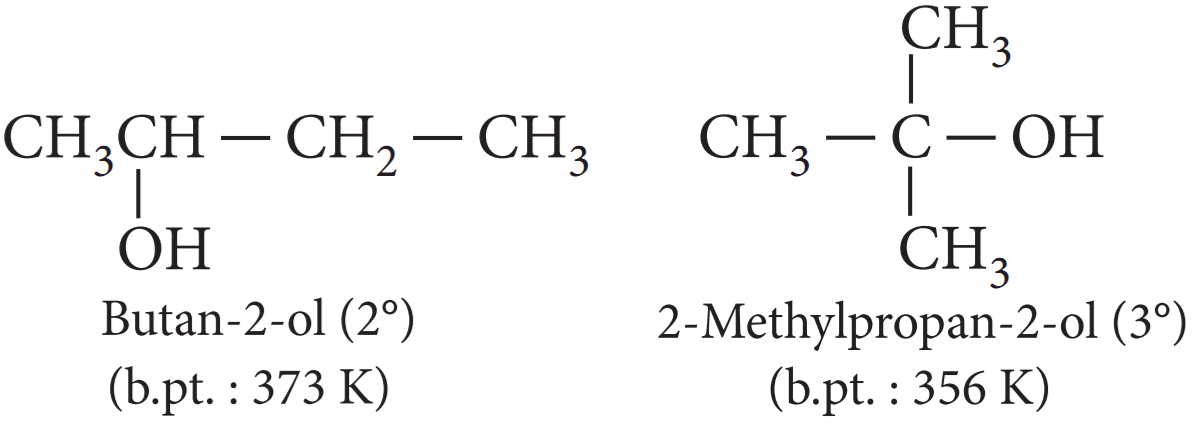
Reason: Amongst isomeric alcohols, the boiling points decreases with branching.

Answer

  1. (b) Assertion and reason both are correct statements but reason is not correct explanation for assertion.
Explanation:

Due to the presence of intermolecular H-bondi ng in alcohols, they have higher boiling points than isomeric ethers.
  1. (c) Assertion is correct statement but reason is wrong statement.
​​​​​​​Explanation:

Like alcohols, phenols also form H-bond with water. But the solubility of phenols in water is much lower than that of alcohols because of the larger non-polar hydrocarbon part (benzene ring) present in their molecules.
  1. (d) Assertion is wrong statement but reason is correct statement.
​​​​​​​​​​​​​​​​​​​​​Explanation:

Boiling point increases with increase in molecular mass so, 1-butanol has higher boiling point than 1-propanol. Ethers do not form hydrogen bonds thus, they have lower boiling points than the corresponding alcohols.

Due to weak dipole-dipole interactions, the boiling points of lower ethers are only slightly higher than those of the n-alkanes having comparable molecular masses,

Thus, the increasing order of boiling points is n-butane < ethoxyethane < 1-propanol < l-butanol.
  1. (b) Assertion and reason both are correct statements but reason is not correct explanation for assertion.
​​​​​​​​​​​​​​​​​​​​​​​​​​​​Explanation:

The solubility of lower ethers in water is due to the formation of H-bonds between water and ether molecules. As the molecular mass increases, the solubility of ethers in water decreases due to corresponding increase in the hydrocarbon portion of the molecule.
  1. (a) Assertion and reason both are correct statements and reason is correct explanation for assertion.
​​​​​​​​​​​​​​​​​​​​​​​​​​​​​​​​​​​Explanation:


Amongst isomeric alcohols,the boiling points decrease with branching due to a corresponding decrease in surface area.

Need a full question paper?

Generate a complete, print-ready paper with questions like this in minutes — across 16+ boards, with answer keys.

Start Generating Free

Similar questions

Read the passage given below and answer the following questions:
A chlorocompound $(A)$ on reduction with $Zn-Cu$ and ethanol gives the hydrocarbon $(B)$ with five carbon atoms. When $(A)$ is dissolved in dry ether and treated with sodium metal it gave $2, 2, 5, 5 -$ tetramethylhexane. The treatment of $(A)$ with alcoholic $KCN$ gives compound $( C).$
The following questions are multiple choice questions. Choose the most appropriate answer:
  1. The compound $(A)$ is:
  1. $1-$chloro$-2, 2-$dimethylpropane.
  2. $1-$chloro$-2, 2-$dimethyl butane.
  3. $1-$chloro$-2-$methyl butane.
  4. $2-$chloro$-2-$methyl butane.
  1. The reaction of $(C)$ with Na, $C_2H_5OH$ gives:
  1. $(CH_3)_3C CH_2CONH_2$
  2. $(CH_3)_3C NH_2$
  3. $(CH_3)_3C CH_2CH_2NH_2$
  4. $(CH_3)_2CHCH_2NH_2$
  1. The reaction of $(C)$ with Na, $C_2H_5OH$ is called:
  1. Gilman reaction.
  2. Mendius reaction.
  3. Grooves process.
  4. Swart's reaction.
  1. The reaction of $(A)$ with aq. $KOH$ will preferably favour:
  1. $S_N1$ mechanism.
  2. $S_N2$ mechanism.
  3. $E_1$ mechanism.
  4. $E_2$ mechanism.
  1. Compound $(B)$ is:
  1. $N-$pentane.
  2. $2, 2-$dimethylpropane.
  3. $2-$methylbutane.
  4. None of these.
Read the passage given below and answer the following questions:
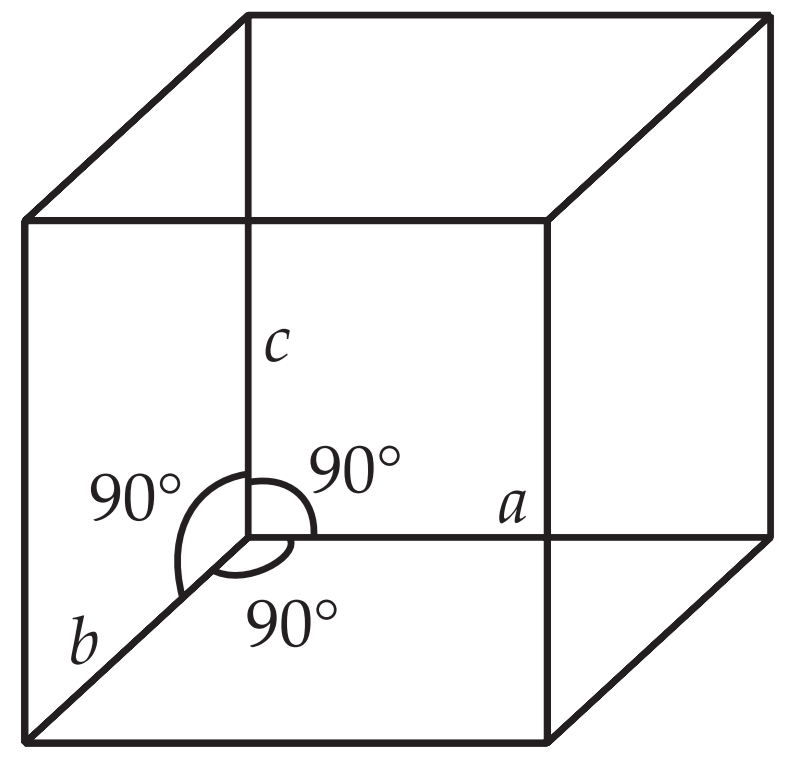
The adjective 'crystalline' when applied to solids, implies an ideal crystal in which the structural units, termed as unit cells, are repeated regularly and indefinitely in three dimensions in space. The unit cell, containing at least one molecule, has a definite orientation and shape defined by the translational vectors, a, b and c. The unit cell therefore has a definite volume, V that contains the atoms and molecules necessary for generating the crystal. Every crystal can be classified as a member of one of the seven possible crystal systems or crystal classes that are defined by the relationships between the individual dimensions, a, b and c of the unit cell and between the individual angles, ⁣$\alpha,\beta$ and $\gamma$ of the unit cell. The structure of the given crystal may be assigned to one of the $7$ crystal systems, to one of the $14$ Bravais lattices, and to one of the 230 space groups. These uniquely define the possible ways of arranging atoms in a three-dimensional solid. Based on these observations, seven crystal systems were identified: triclinic, monoclinic, trigonal or rhombohedral, tetragonal, hexagonal, rhombic or orthorhombic and cubic.
The following questions are multiple choice questions. Choose the most appropriate answer:
  1. The crystal system of a compound with unit cell dimensions, $a = 0.38$7nm, $b = 0.387$nm and $c = 0.504$nm $\alpha=\beta=90^\circ$ and $\gamma=120^\circ$ is.
  1. Cubic
  2. Hexagonal
  3. Orthorhombic
  4. Rhombohedral.
  1. The unit cell with the structure given below represents________________crystal system.
  1. Cubic
  2. Orthorhombic
  3. tetragonal
  4. trigonal
  1. In a triclinic crystal.
  1. $\text{a}=\text{b}=\text{c},\ \alpha=\beta=\gamma\neq90^\circ$
  2. $\text{a}\neq\text{b}=\text{c},\ \alpha=\beta=\gamma=90^\circ$
  3. $\text{a}\neq\text{b}\neq\text{c},\ \alpha\neq\beta\neq\gamma\neq90^\circ$
  4. $\text{a}\neq\text{b}\neq\text{c},\ \alpha=\gamma=90^\circ\beta\neq90^\circ$
  1. The unit cell with dimensions $\alpha=\beta=\gamma=90^\circ,\ \text{a}=\text{b}\neq\text{c}$ is.
  1. Cubic
  2. Triclinic
  3. Hexagonal
  4. Tetragonal.
  1. An example of orthorhombic crystal system is.
  1. $SnO_2$
  2. $KN0_3$
  3. $ZnO$
  4. $K_2Cr_2O_7$
Read the passage given below and answer the following questions:In contrast to the disorders of gases and liquids, there is translational order in crystals. However, disordered or amorphous solids also exist which lack such order, they are really highly viscous liquids. In translational order entire structure or lattice, can be generated by repeated replication of a small regular figure, termed as unit cell. The planes of any crystalline structure can be specified using Miller indices, which is also serve to identify single crystal faces.The ordered structure, or lattice, of a solid can be determined by X-ray or neutron diffraction studies, in which a beam of X-rays of neutrons is scattered from the sample to produce a diffraction pattern which can be analyzed to reveal the crystal structure of the sample. All crystal lattices can be classified into 14 Bravais lattices belonging to 7 systems. For example, the simple cubic, face-centred cubic and body-centred cubic lattices are the 3 lattices of the cubic system. Cubic and hexagonal close-packed structures have the structure of tightly packed spheres, where each sphere touches 12 neighbours, 6 in the same plane and 3 above and 3 below. These two dose-packed structures differ in the placement of successive planes or layers. For the hexagonal close packing, a third layer is laid down to reproduce the first layer, so that the structure could be represented by ABABAB …. For cubic close packing, third layer is again displaced, corresponding to ABCABC.
The following questions are multiple choice questions. Choose the most appropriate answer:
  1. In hexagonal close packing, a sphere has coordination number of.
  1. 4
  2. 6
  3. 8
  4. 12
  1. Which of the following arrangements correctly represents hexagonal and cubic close packed structure respectively?
  1. ABCABC...and ABAB...
  2. ABAB...and ABCABC...
  3. Both have ABAB ... arrangement.
  4. Both have ABCABC... Arrangement.
  1. The arrangement of the first two layers, one above the other, in hep and ccp arrangements is.
  1. Exactly same in both cases
  2. Partly same and partly different
  3. Different from each other
  4. Nothing definite.
  1. Which of the following statements is not correct?
  1. The amorphous solids have a random, disordered arrangement of constituents.
  2. The simple cubic, face-centred and body-centred are the three lattices of the cubic system.
  3. The number of Bravais lattice in which a crystal can be categorized is 7.
  4. A metal that crystallizes in hep structure has coordination number 12.
  1. Which of the following statements about amorphous solids is incorrect?
  1. They melt over a range of temperature.
  2. There is no orderly arrangement of particles.
  3. They are anisotropic.
  4. They are rigid and incompressible.
In these questions, a statement of assertion followed by a statement of reason is given. Choose the correct answer out of the following choices.
Assertion: Aqueous gold colloidal solution is red in colour.
Reason: The colour arises due to scattering of tight by colloidal gold particles.
Read the passage given below and answer the following questions: Amines are alkyl or aryl derivatives of ammonia formed by replacement of one or more hydrogen atoms. Alkyl derivatives are called aliphatic amines and aryl derivatives are known as aromatic amines. The presence of aromatic amines can be identified by performing dye test. Aniline is the simplest example of aromatic amine. It undergoeselectrophilic substitution reactions in which $-NH_2$ group strongly activates the aromatic ring through delocalisation of lone pair of electrons of N-atom. Aniline undergoes electrophilic substitution reactions. Ortho and para positions to the $-NH_2$ group become centres of high electrons density. Thus, $-NH_2$ group is ortho and para-directing and powerful activating group. The following questions are multiple choice questions. Choose the most appropriate answer:
  1. Cyclohexylamine and aniline can be distinguished by:
  1. Hinsberg test.
  2. carbylamine test.
  3. Lassaigne test.
  4. azo dye test.
  1. Which of the following compounds gives dye test?
  1. Aniline.
  2. Methyl amine.
  3. Diphenyl amine.
  4. Ethyl amine.
  1. Aniline when acetylated, the major product on nitration followed by alkaline hydrolysis gives:
  1. Acetanilide.
  2. o-nitroacetanitide.
  3. p-nitroaniline.
  4. m-nitroanitine.
  1. Oxidation of aniline with manganese dioxide and sulphuric acid produces:
  1. Phenylhydroxylamine.
  2. Nitrobenzene.
  3. p-benzoquinone.
  4. Phenol.
  1. Aniline when treated with cone. $HNO_3$ and $H_2S0_4$ gives:
  1. p-phenylenediamine.
  2. m-nitroaniline.
  3. p-benzoquinone.
  4. Nitrobenzene.
Read the passage given below and answer the following questions:
Transition elements are elements that have partially filled d-orbitals. The configuration of these elements corresponds to $(n - 1)d^{1-10}ns^{1-2}.$ It is important to note that the elements mercury, cadmium and zinc are not considered transition elements because of their electronic configurations, which corresponds to $(n - 1)d^{10}ns^2.$ Some general properties of transition elements are:
These elements can fonn coloured compounds and ions due to $d-d$ transition;
These elements exhibit many oxidation states;
A large variety of ligands can bind themselves to these elements, due to this, a wide variety of stable complexes formed by these ions. The boiling and melting point of these elements are high. These elements have a large ratio of charge to the radius.
In these questions $(Q. No. i-iv),$ a statement of assertion followed by a statement ofreason is given. Choose the correct answer out of the following choices.
  1. Assertion and reason both are correct statements and reason is correct explanation for assertion.
  2. Assertion and reason both are correct statements but reason is not correct explanation for assertion.
  3. Assertion is correct statement but reason is wrong statement.
  4. Assertion is wrong statement but reason is correct statement.
  1. Assertion: Tungsten has very high melting point.
Reason: Tungsten is a covalent compound.
  1. Assertion: $Zn, Cd$ and $Hg$ are normally not considered transition metals.
Reason: d-Orbitals in $Zn, Cd$ and $Hg$ elements are completely filled, hence these metals do not show the general characteristics properties of the transition elements.
  1. Assertion: Copper metal gets readily corroded in acidic aqueous solution such as $HCl$ and dil. $H_2SO_4.$
Reason: Free energy change for this process is positive.
  1. Assertion: Tailing of mercury occurs on passing ozone through it.
Reason: Due to oxidation of mercury.
  1. Assertion: Transition metals are poor reducing agents.
Reason: Transition metals fonn numerous alloys with other metals.
Read the passage given below and answer the following questions:
Ligands are atoms or ions which can donate electrons to the central atoms. Ligands can be monodentate, bidentate or polydentate as well. Few ligands can coordinate with the central atom through more than one site, these are called ambidentate ligands. When a di- or polydentate ligand uses its two or more donor atoms to bind a single metal ion, it is said to be a chelating ligand.
In these questions (Q. No. i-iv), a statement of assertion followed by a statement ofreason is given. Choose the correct answer out of the following choices.
  1. Assertion and reason both are correct statements and reason is correct explanation for assertion.
  2. Assertion and reason both are correct statements but reason is not correct explanation for assertion.
  3. Assertion is correct statement but reason is wrong statement.
  4. Assertion is wrong statement but reason is correct statement.
The following questions are multiple choice questions. Choose the most appropriate answer:
  1. Assertion: Glycinate ion is an example of monodentate ligand.
Reason: Glycinate contains $N$ and $O$ as donor atoms.
  1. Assertion: EDTA forms complex with divalent metals of 3d-series in the ratio of $1 : 1.$
Reason: EDTA has $4 - COOH$ groups.
  1. Assertion: Oxalate ion is a bidentate ligan.
Reason: Oxalate ion has two donor atoms.
  1. Assertion: A chelating ligand must possess two or more lone pairs at such a distance that it may form suitable strain free $5$ and $6$ membered rings with the metal ion.
Reason: $H_2N - NH_2$ is a chelating ligand.
  1. Assertion: In Zeise's salt coordination number of Pt is five.
Reason: Ethene is a monodentate ligand.

Read the passage given below and answer the following questions:
When a solution of an et-amino acid is placed in an electric field depending on the pH of the medium, following three cases may happen.
  1. In alkaline solution, CL-amino acids exist as anion II, and there is a net migration of amino acid towards the anode.
  2. In acidic solution, a-amino acids exist as cation III, and there is a net migration of amino acid towards the cathode.
  3. If II and III are exactly balanced there is no net migration; under such conditions any one molecule exists as a positive ion and as a negative ion for exactly the same amount of time, and any small movement in the direction of one electrode is subsequently cancelled by an equal movement back toward the other electrode. The pH of the solution in which a particular amino acid does not migrate under the influence of an electric field is called the is oelectric point of that amino acid.
The following questions are multiple choice questions. Choose the most appropriate answer:
  1.  

Arrange in order of increasing acid strengths.
  1. X > Z > Y
  2. Z < X < Y
  3. X > Y > Z
  4. Z > X > Y
  1. In aqueous solutions, amino acids mostly exist as:
  1. $NH_2 - CHR - COOH$
  2. $NH_2 - CHR - COO^-$
  3. $\stackrel{+}{\hbox{ N}}\text{H}_3\text{CHRCOOH}$
  4. $\text{H}_3\stackrel{{+}}{\hbox{N}}\text{CHRCOO}^-$
  1. Amino acids are least soluble:
  1. at pH 1
  2. at pH 7
  3. At their isoelectric points.
  4. None of these.
  1. The $\text{pK}_{\text{a}_1}$ and $\text{pK}_{\text{a}_2}$ of an amino acid are 2.3 and 9.7 respectively. The is oelectric point of the amino acid is:
  1. 12.0
  2. 7.4
  3. 6.0
  4. 3.7
  1. A tripeptide (X) on partial hydrolysis gave two dipeptides Cys-Gly and Glu-Cys. Identify the tripeptide.
  1. Glu-Cys-Gly
  2. Gly-Glu-Cys
  3. Cys-Gly-Glu
  4. Cys-Glu-Gly

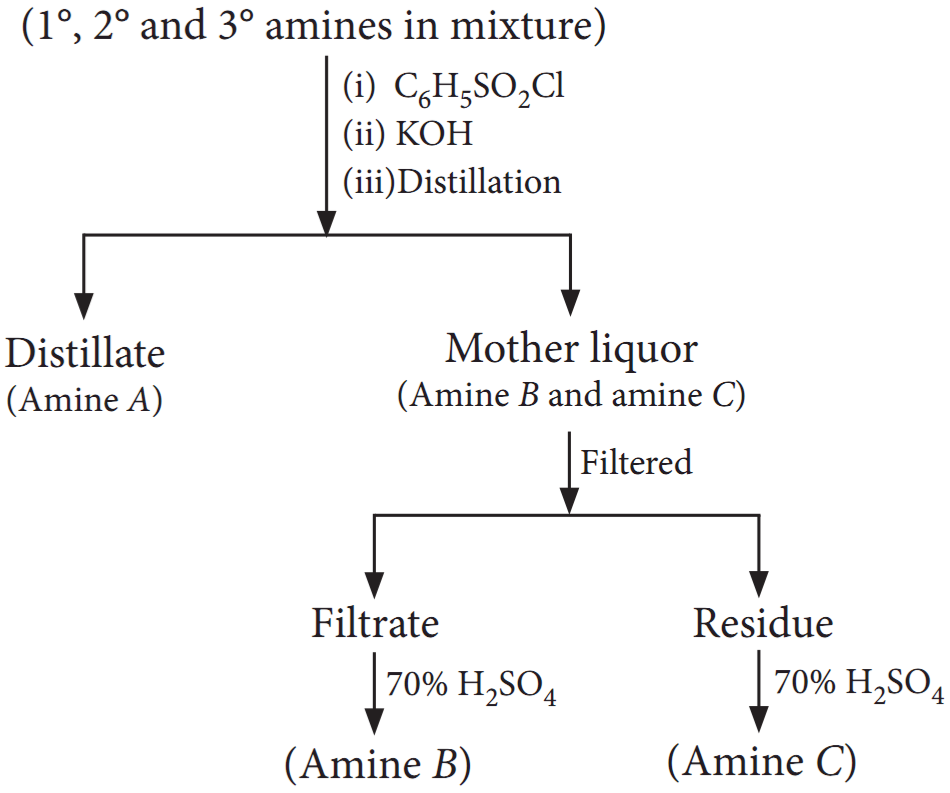
When the mixture contains the three amine salts (1º, 2º and 3º) along with quaternary salt, it is distilled with KOH solution. The three amines distill, leaving the quaternary salt unchanged in the solution. Then the mixture of amines is separated by fractional distillation, Hinsberg's method and Hoffmann's method.

The following questions are multiple choice questions. Choose the most appropriate answer:
  1. Hinsberg reagent is:
  1. Aliphatic sulphonyl chloride.
  2. Phthalamide.
  3. Aromatic sulphonyl chloride.
  4. Anhydrous ZnCl2 + cone. HCI.
  1. Primary amine with Hinsberg's reagent forms:
  1. N-alkyl benzene sulphonamide soluble in KOH solution.
  2. N-alkyl benzene sulphonamide insoluble in KOH solution.
  3. N, N-alkyl benzene sulphonamide soluble in KOH solution.
  4. N, N-alkyl benzene sulphonamide insoluble in KOH solution.
  1. Secondary amine with Hinsberg's reagent forms:
  1. N-alkyl benzene sulphonamide soluble in KOH solution.
  2. N-alkyl benzene sulphonamide insoluble in KOH solution.
  3. N,N-dialkyl benzene sulphonamide soluble in KOH solution.
  4. N,N-dialkyl benzene sulphonamide insoluble in KOH solution.
  1. To separate amines in a mixture Hoffmann's method is used. The Hoffman n's reagent is:
  1. Benzenesulphonyl chloride.
  2. Diethyl oxalate.
  3. Benzeneisocyanide.
  4. P-toulenesulphonic acid.
  1. 3º amines with Hinsberg's reagent give:
  1. No reaction.
  2. Product which is same as that of 1° amine.
  3. Product which is same as that of 2° amine.
  4. Products which is a quaternary salt.
Read the passage given below and answer the following questions:
Proteins are high molecular mass complex biomolecules of amino acids. The important proteins required for our body are enzymes, hormones, antibodies, transport proteins, structural proteins, contractile proteins etc. Except for glycine, all $\alpha$-amino acids have chiral carbon atom and most of them have L-configuration. The amino acids exists as dipolar ion called zwitter ion, in which a proton goes from the carboxyl group to the amino group. A large number of $\alpha$-amino acids are joined by peptide bonds forming polypeptides. The peptides having very large molecular mass (more than 10,000) are called proteins. The structure of proteins is described as primary structure giving sequence of linking of amino acids; secondary structure giving manner in which polypeptide chains are arranged and folded; tertiary structure giving folding, coiling or bonding polypeptide chains producing three dimensional structures and quaternary structure giving arrangement of sub-units in an aggregate protein molecule.
A statement of assertion followed by a statement of reason is given. Choose the correct answer out of the following choices.
  1. Assertion and reason both are correct statements and reason is correct explanation for assertion.
  2. Assertion and reason both are correct statements but reason is not correct explanation for assertion.
  3. Assertion is correct statement but reason is wrong statement.
  4. Assertion is wrong statement but reason is correct statement.
  1. Assertion: Except glycine, all naturally occurring CL-amino acids are optically active.
Reason: All naturally occurring CL-amino acids, except glycine, has at least one asymmetric carbon.
  1. Assertion: All amino acids are optically active.
Reason: Amino acids contain asymmetric carbon atoms.
  1. Assertion: In $\alpha$-helix structure, intramolecular H-bonding takes place whereas in $\beta$-pleated structure, intermolecular H-bonding takes place.
Reason: An egg contains a soluble globular protein called albumin which is present in the white part.
  1. Assertion: Secondary structure of protein refers to regular folding patterns of continuos portions of the polypeptide chain.
Reason: Out of 20 amino acids, only 12 amino acids can be synthesised by human body.
  1. Assertion: The helical structure of protein is stabilised by intramolecular hydrogen bond between -NH and carbonyl oxygen.
Reason: Sanger's reagent is used for the identification of N-tenninal amino acid of peptide chain.