Question
Describe experiment of two stationary coil which explains clectromagnetic induction.

Answer

Image

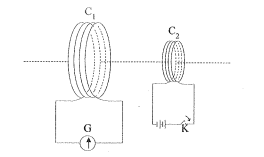
Even if there is no relative motion between two coils, phenomenon of electromagnetic induction can be obtained.
Two stationary coils $C _1$ and $C _2$ are shown in figure.
Galvanometer is connected to $C _1$ and battery and key K are connected to $C _2$.
On pressing K (closing), galvanometer shows momentary deflection & then comes to zero.
After pressing (closing) key and keeping it in same situation, galvanometer does not show deflection.
On releasing key (opening), galvanometer shows deflection in opposite direction.
On repeating experiment keeping iron rod on axis of coil, very large deflection is seen in galvanometer.
Thus, it is proved that a changing magnetic field produces electric current.

Need a full question paper?

Generate a complete, print-ready paper with questions like this in minutes — across 16+ boards, with answer keys.
Start Generating Free

Similar questions

A current carrying loop consists of 3 identical quarter circles of radius R, lying in the positive quadrants of the x-y, y-z and z-x planes with their centres at the origin, joined together. Find the direction and magnitude of B at the origin.
Obtain the equation of electric potential energy of a system of two electric charges in external electric field.
Distinguish between polarised and unpolarized light. Does the intensity of polarised light emitted by a Polaroid depend on its orientation? Explain briefly.
The vibrations in a beam of polarised light make an angle of 60° with the axis of the polaroid sheet. What percentage of light is transmitted through the sheet?
Write down the Coulomb's law and explain its scalar form.
An uncharged capacitor is connected to a battery. Show that half of the energy used by the battery to charge the capacitor is dissipated as heat.
An electric dipole of length 2 cm, when placed with its axis making an angle of $60^\circ$with a uniform electric field, experiences a torque of $8\sqrt{3}$ Nm. Calculate the potential energy of the dipole, if it has a charge of $\pm4\text{nC}.$
The electric field intensity and electric potential at a point due to a point charge are 30 Newton/ Coulomb and 15 Joule/Coulomb respectively. Find (i) the distance of the charge from the observation point and (ii) the magnitude of the charge.
Is it necessary for the plane of the orbit of a satellite to pass through the centre of the earth?
Explain controlled thermonuclear fusion.
Explain the observation of Hallwachs and Lenard for the photoelectric effect.